
This image of M87 shows quite a few interesting treats:
* The jet streaming out from the nucleus of M87. Note that the jet is somewhat bluish, indicative of the high-energy radiation emanating from it.
* The generally reddish eliptical galaxy NGC 4478, and the blue foreground star superimposed on it (above/left of M87). This has generated more than a few skipped heartbeats over the years, looking as it does like a dramatic supernova. Nope - just a foreground star that's been around (and teasing astronomers) for a long time.
* Note the specs of brightness surrounding M87 - those are M87's globulars. First time I've ever managed to record another galaxy's globs, at least that I know of.
There are also a number of interesting colored stars, and many background galaxies (including two that can be seen right through M87).
This three 5-minute luminance images plus three sets of 1.5:2.5:3 minute RGB sets. I was really surprised at the details revealed in such short exposures, but the C14/ST-1001E combo really does a great job.
In order to show the M87 jet and globulars, I had to resort to a fairly unconventional histogram processing. The low end is stretched quite a bit, while the bright end of things is fairly restrained. If I had allowed the brighter areas to get too bright, the jet would not be visible and the globulars would be immersed in the glow. This makes M87 look smaller than it actually is, and creates a somewhat soft cotton-like appearance to the smaller ellipticals, but I thought these were reasonable trade-offs to show the details I wanted to show.
Taken with the remote telescope at New Mexico Skies.
Ron Wodaski
The New CCD Astronomy
http://www.newastro.com/remote
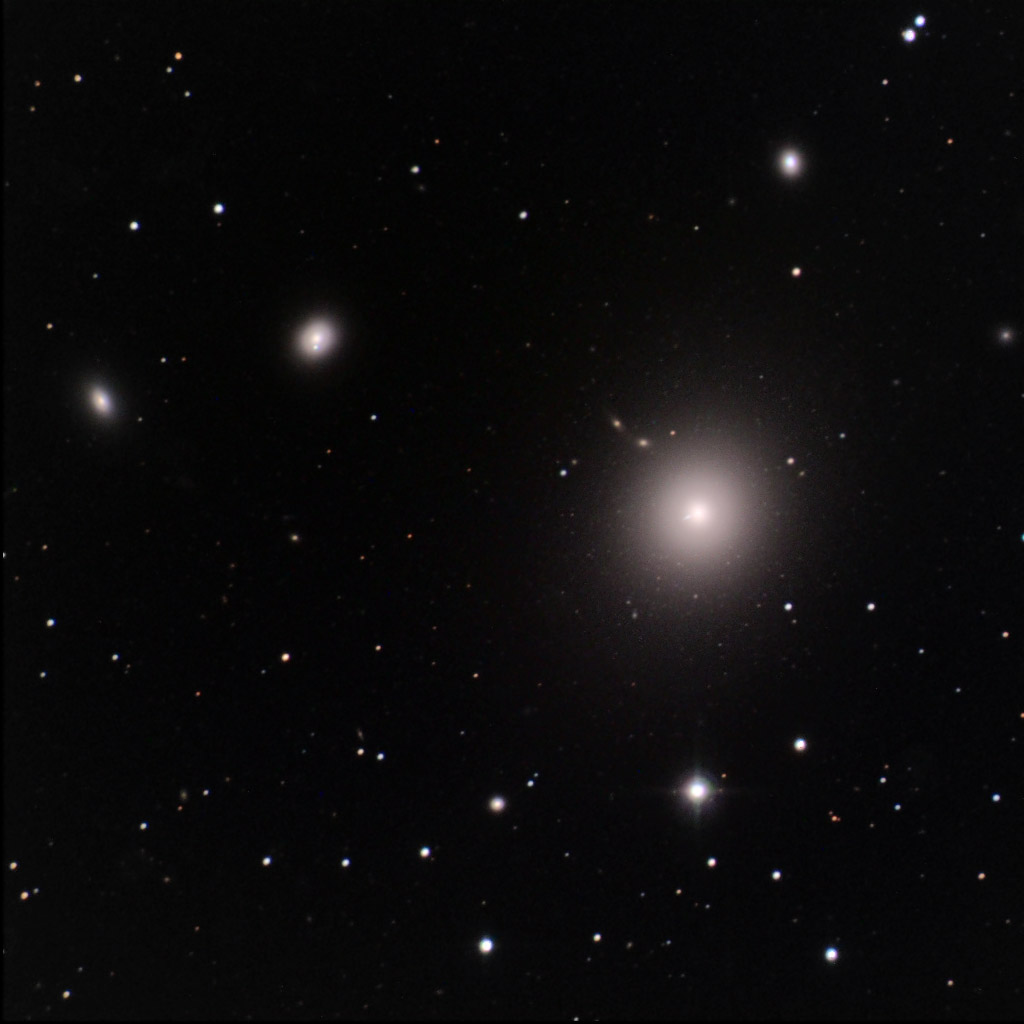
* The jet streaming out from the nucleus of M87. Note that the jet is somewhat bluish, indicative of the high-energy radiation emanating from it.
* The generally reddish eliptical galaxy NGC 4478, and the blue foreground star superimposed on it (above/left of M87). This has generated more than a few skipped heartbeats over the years, looking as it does like a dramatic supernova. Nope - just a foreground star that's been around (and teasing astronomers) for a long time.
* Note the specs of brightness surrounding M87 - those are M87's globulars. First time I've ever managed to record another galaxy's globs, at least that I know of.
There are also a number of interesting colored stars, and many background galaxies (including two that can be seen right through M87).
This three 5-minute luminance images plus three sets of 1.5:2.5:3 minute RGB sets. I was really surprised at the details revealed in such short exposures, but the C14/ST-1001E combo really does a great job.
In order to show the M87 jet and globulars, I had to resort to a fairly unconventional histogram processing. The low end is stretched quite a bit, while the bright end of things is fairly restrained. If I had allowed the brighter areas to get too bright, the jet would not be visible and the globulars would be immersed in the glow. This makes M87 look smaller than it actually is, and creates a somewhat soft cotton-like appearance to the smaller ellipticals, but I thought these were reasonable trade-offs to show the details I wanted to show.
Taken with the remote telescope at New Mexico Skies.
Ron Wodaski
The New CCD Astronomy
http://www.newastro.com/remote
Attached Image:
Ron Wodaski
New Astronomy Press
http://www.newastro.com
