OK. This is not definitive by a long shot, but because a recent sale of my MX716 fell through, coupled by the fact that I went crazy and bought a ST7ME, I ended up with both CCD cams.
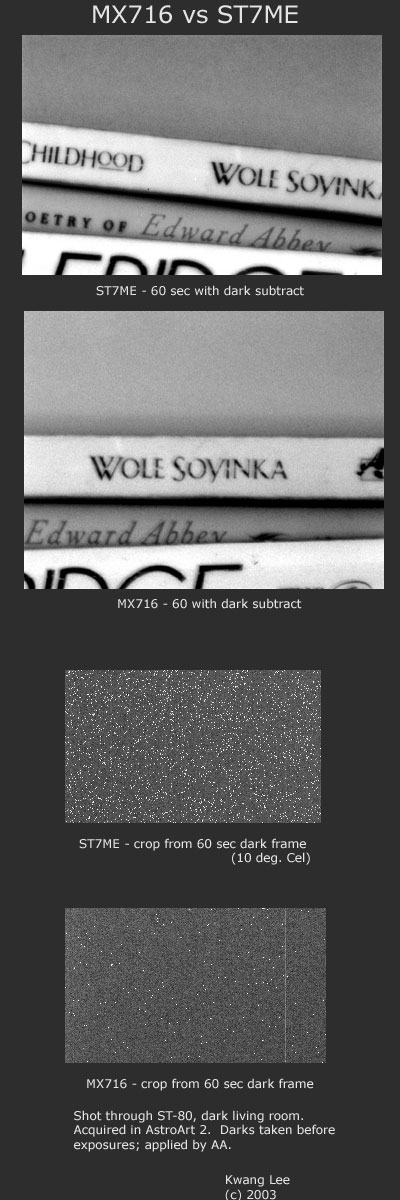
I realized I had a unique opportunity to test both rigs, so I setup a quick test with my Short Tube 80 aimed at my bookcase. I acquired images and darks through AstroArt 2.0. I let the camera sit idle for 10 minutes before taking any exposures. I chose 1x1 binning for ST7 and Hi-Res 'Fast' mode for the MX. So, after goofin around, I decided on 60 sec darks with 60 sec exposures. I let AA do the dark processing and I exported all images as jpg's. In PS, I didn't do any processing except video de-interlacing (odd fields) as the MX716 image had noticeable banding. (Oh yeah, I resized the final image size.)
General stuff: I knew that the ST7ME was noisier, but I didn't realize HOW much noisier. I think it affects the final image as it seemed to me that the smooth area above Soyinka's book is 'splotchier' in the ST7ME image. Also, the MX716 seems to capture the slight shadow above the book with more finesse. Though I could bring it out in PS by playing with Curves.
When looking at the raw images, I had the impression that the MX716 was picking up more detail and more light from
the scene.
But looking at the dark made by the MX716, it's clear there's some kind of 'amp glow' from the left side. And in a self-guide scenario, the MX716 will require much longer expsoures with Star2000, which will introduce more
gradient issues. Dark subtracting will take care of this.
There's something really nice about having the guide chip and imaging chip in the same camera. Though I didn't realize how large the ST7 head was.
Anyways, now I'm not sure which camera I should keep. What strikes me about this comparison is that there's a big difference between imaging a bookcase and imaging a faint galaxy. So, a big grain (or chunk?) of salt is required for my comparison.
Regards,
Kwang Lee
I realized I had a unique opportunity to test both rigs, so I setup a quick test with my Short Tube 80 aimed at my bookcase. I acquired images and darks through AstroArt 2.0. I let the camera sit idle for 10 minutes before taking any exposures. I chose 1x1 binning for ST7 and Hi-Res 'Fast' mode for the MX. So, after goofin around, I decided on 60 sec darks with 60 sec exposures. I let AA do the dark processing and I exported all images as jpg's. In PS, I didn't do any processing except video de-interlacing (odd fields) as the MX716 image had noticeable banding. (Oh yeah, I resized the final image size.)
General stuff: I knew that the ST7ME was noisier, but I didn't realize HOW much noisier. I think it affects the final image as it seemed to me that the smooth area above Soyinka's book is 'splotchier' in the ST7ME image. Also, the MX716 seems to capture the slight shadow above the book with more finesse. Though I could bring it out in PS by playing with Curves.
When looking at the raw images, I had the impression that the MX716 was picking up more detail and more light from
the scene.
But looking at the dark made by the MX716, it's clear there's some kind of 'amp glow' from the left side. And in a self-guide scenario, the MX716 will require much longer expsoures with Star2000, which will introduce more
gradient issues. Dark subtracting will take care of this.
There's something really nice about having the guide chip and imaging chip in the same camera. Though I didn't realize how large the ST7 head was.
Anyways, now I'm not sure which camera I should keep. What strikes me about this comparison is that there's a big difference between imaging a bookcase and imaging a faint galaxy. So, a big grain (or chunk?) of salt is required for my comparison.
Regards,
Kwang Lee
Attached Image:
