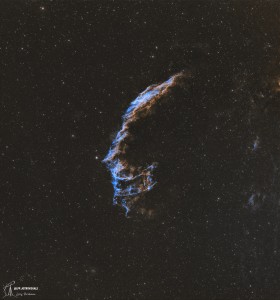
Image of the day

Captured by
Lawrence Parchman

Eastern Veil Nebula (NGC 6992) - Wide View

My Account

New to Astromart?

Register an account...

Need Help?

Re: firewire cams: advantages/ disadvantages?

Started by Wes Higgins, 02/22/2005 08:14PM
Posted 02/22/2005 08:14PM | Edited 02/22/2005 08:28PM Opening Post
Hi Eric,

Why would the DMK's have less sensitivity than a B&W Toucam with the same CCD ??
One of the first things I noticed about my DMK was that it had a lot less noise than
my Toucam.
I agree that 30FPS at 1/33s exposure may not give enough light for scopes with less than 10" of aperture but 15 to 20 FPS uncompressed may work just fine and you can not do that(uncompressed) with a Toucam, some may argue the advantages of faster frames rates but I am a firm believer in them.
In about five weeks I will have a Point Grey Dragonfly camera (funny name smile ) that images at 30FPS in raw color, it will be interesting to see what this camera can do on Saturn and Jupiter with the 18" grin

Thanks,

Wes Higgins


Eric Todd said:

I just answered this question over on my forum, based on some research I've been conducting, but would appreciate comments here, particularly from those using firewire cams for dimmer work, like Jupiter and Saturn, with 10" scopes or less. My response was as follows:

"....Although I haven't tried the firewire cams, I have done some research into them lately. What I find is that even with the more expensive ones, they use a CCD that has the same or less sensitivity than a b&w modified Toucam (ICX098BL). This would mean that, even though you no longer have compression, you would still have to increase the gain even more than a Toucam at the higher frame rates. So the big disadvantage would be lack of gain which means more frames still need to be stacked to overcome noise. So, even though you might be capturing double or triple the amount of frames, you still have to stack that double or triple amount to make up for higher gain levels. No advantage for dimmer targets like Saturn or maybe Jupiter.

I do see one advantage with firewire though. On bright targets like the moon/ sun and *perhaps* Jupiter, gain is not as much of an issue and can be kept minimal. The camera should, in that case, be a better performer than a Toucam because more frames can be stacked at low noise levels. I question this for Jupiter though because of its dimness.

Of course, firewire should work quite well with large aperture scopes, which are independent of the aforementioned....."

The big scoped guys, like Wes and Mike, I'm excluding since I think firewire should help you in all cases since you have the aperture to make up for the gain. I'm more interested in seeing how they perform with the smaller scopes since gain amount becomes an issue (although I'm not saying not to comment: please do if you want to smile ). I'm also going to exclude the ATK series.

Thanks,
Eric
Posted 02/22/2005 09:23PM #1
I agree with Wes here... I just have one of the new DMK firewires with long exposure (brand new on the market). It gives the same sensitivity as my modified monochrome Vesta, so not more gain than that one is needed given the same exposure time. However, you don't get the compression artefacts, so cleaner images which needs less frames. And at equal frames one can process more before noise becomes visible in the result.

This is my first experience after two nights of testing (I used the ToUcam and as I said monochrome vesta before).

Another advantage is that exposure times are nearly stepless from 1/30s to 30 seconds, meaning you can do easily 1/8 or 1/4 second with gain=0. Impossible to do with a modified webcam as far as I know from my own cams. A modified one jumps from 1/25second to 1 second, nothing in between (don't know about the ATK tho).

Finally, since we are often having very mediocre seeing here, it is more interesting to get a lot of images in the brief moments. In perfect seeing, one can make an avi of Jupiter at 5fps and have enough frames in 3 minutes. In very mediocre seeing, at that rate you never have enough frames to process something useful. That's where uncompressed high frame rates come to rescue as well.

I don't say it makes a universe of difference, but so far my experiences are very favorable compared to the USB cams.

And yes, I am curious about your Dragonfly camera Wes wink

Dodi

Posted 02/22/2005 09:28PM #2
Eric,

I work with a smaller scope. No problems as I explained. You have to imagine that with higher gain at 15 to 30fps, the compression takes serious proportions, blurring the image significantly and introducing more artefacts.

If you would ask a rating to me comparing the three cams (toucam color, monochrome usb and monochrome firewire), I would say in terms of image quality at high frame rates, I would give the toucam a 3/10, a monochrome usb a 6/10 and the firewire a 9/10 wink

I think the biggest step up is to a monochrome usb, with the firewire adding some interesting advantages.

Dodi
Posted 02/22/2005 09:30PM #3
Hi Wes -

I was just looking at these cameras this morning. The developers at AstroIIDC are working on writing control software for these - they look very interesting. Firewire used to be all the rage a couple of years ago - but with USB2, firewire peripherals are in very short supply.

Alan

Alan Friedman

http://www.avertedimagination.com
Posted 02/23/2005 02:16AM #4
Hi Eric,

It's the one with the Sony ICX424 CCD, I understand now what you were getting at as far as the
gain increase on smaller scopes and it could still be a problem with the current Firewire cameras.

Thanks,

Wes Higgins


Eric Todd said:

Hi Wes,

It wouldn't be less sensitive, but I'm wondering about gain levels at the 15-30 fps range, particularly when using a smaller scope. This is where my uncertainty lies.... if the same ICX098BL is used at 15 and 30 fps, say, will the gain have to be increased so much on dimmer targets that it outweighs the benefits of no compression? With the standard Toucam which has the color version of the 098, I've seen a significant dimming when going to even 10 fps on a target like Saturn which requires a gain increase of about 70% or so. I know the monochrome version wouldn't have this much increase, but there would still be a jump.

Oh, I think with a scope like yours, you'll benefit greatly from these faster cameras because you have more than enough aperture to compensate, but unless a CCD significantly more sensitive and/or less noisy is used, the smaller scopes are going to have a harder time benefiting from the additional frames... unless a bright target like the moon, sun or maybe Jupiter is imaged.

I predict you'll have good results with the camera you have coming and look forward to seeing the images! (Is that the one with the 424/204 CCD?) You certainly have the aperture and conditions to benefit from these faster cameras.

Eric
