Image of the day

Captured by
Michael Scherman

M17 Swan-Omega Celestron C6 Hyperstar2

My Account

New to Astromart?

Register an account...

Need Help?

Whats missing

Started by brian11333, 04/22/2006 10:43PM
Posted 04/22/2006 10:43PM Opening Post
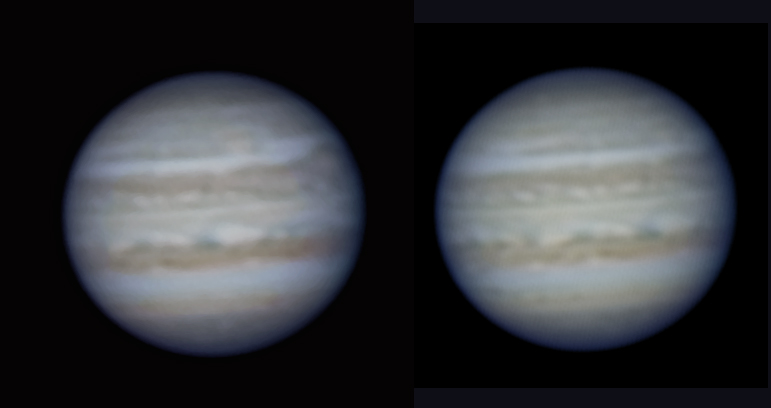
I see excellent post of images where the author says the seeing was so so or 3/10 etc. Yet they're able to produce nice sharp images. Then, there's my images. I've been trying to get that great image for years. I know about collimation and focus and the basics. But something is missing. I know the Toucam is a dinasaur these days but I still see great images. Take my Jupiter image. It's low in the sky where I'm at. I know thats not ideal but the seeing was very steady on this night and I thought I had some good data. But as you can see, its soft with little detail. Is it my processing. I use Registax 3. I've slide every wavelet under the sun. I'm just at a loss. My scope is a C11 and visual star test show great optics. I've had a Mewlon 250 and got the same results. I'm lookin for some real help and would appreciate it alot. Thanks and steady skies.
Attached Image:

brian11333's attachment for post 31098
Posted 04/22/2006 11:05PM #1
Looks like your focus could use a little work. wink

[SIZE="Large"][/SIZE][COLOR="Blue"][/COLOR] Floyd Blue grin
Amateur Imager
Posted 04/23/2006 01:21AM #2
How many frames went into this image? How large
is the AVI file? What frame size are you shooting?
320x240? 640x480?

This is a ToUcam? Any IR/UV filter?

What sort or Barlow, etc. are you using? Need to be
around F/30 to F/40.

What size registration box are you using in
Registax? Does it cover the entire planet?

Could be focus, but not much that can go wrong if
you are focussing using the computer screen.

Sorry for all the questions. If you've got
good seeing, you should do better. Send me a
private message if you want. Be glad to help.
Posted 04/23/2006 01:08PM | Edited 04/23/2006 01:25PM #3
Brian, I have the same C11 scope, with a 2.5x powermate and ir blocking filter, and also struggle to achieve a sharp image with my toucam. As a focusing aid, last time out I tried to focus on a nearby moon and increase the gain so the moon is visible on the screen. Then using QC Focus, and the star focus option, I achieved the smallest FHM value. Then canceled out of the QC Focus, back to the Toucam software to try to image Jupiter. 10fps, 90sec seems "best"

In my case, my scope is 20years old and the coatings are blotchy and full of dust motes, so I am seriously considering spending the $600 to factory clean/recoat everything. A new DMK will cost approx the same and I can't afford both this year.

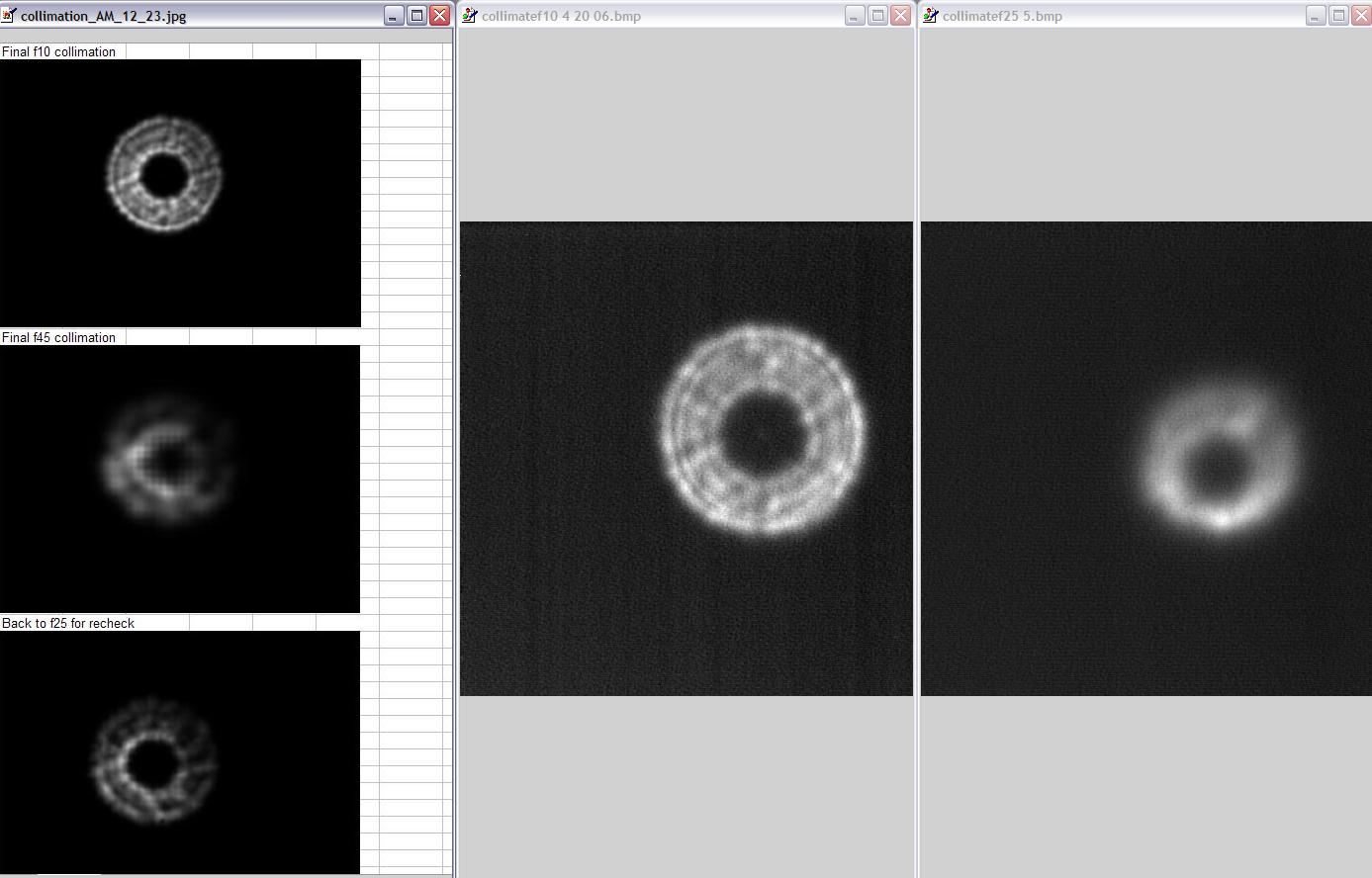
Before each session, I try to optimize my collimation on a nearby star. My last time out, thurs night, had below average seeing. Attached are my collimation images, on the left were my 50um artifical star images from Dec, and on the right a real 2.5mag star f10, f25 from thurs. The f25 was horrible and in hind site, I should have just imaged at f10. I am yet to see any seeing/transparency condition above average this Jupiter season here in CT.

Regards,
Steve

Attached Image:

fugardi's attachment for post 103024
Posted 04/23/2006 02:21PM #4
Thanks guys. It's most appreciated. I don't have the avi's any more. I don't usualy save them. if I can get some good data again I'll try to send some youe way John. Thank
Posted 04/23/2006 02:28PM #5
Brian,

You mentioned the 256 box did not quite cover the whole planet. This tells me you are working above f/20 possibly f/30. It sounds like the camera is not plugged into the barlow directly, but there is something else between them, possibly a flip mirror? I don't use a flip mirror anymore,
rather I prefer a guide scope, which at these f ratios has to be aligned every night. Flip mirrors add way to much to the path, which is OK at F10
or under, but for planets it is possible spherical aberration will be added. The SCT is well corrected for a fairly short back focus over a limited range.

Do you collimate straight through? I recommend that highly. The C11 is notoriously difficult to get collimation right on. A very slight movement will
throw it off, only visible at very high mags (I collimate way above 500x when possible). Of all Celestrons scopes, the C11 is the hardest and the C9.25 the easiest to collimate and hold. I collimate every night I use my C11, and when
the seeing is average this can take over 30 minutes after the 2 hrs this scope
needs to equillibrate.

You also mentioned that your image was 1900/2400. I could only achieve a yield that high in very good seeing, which happens maybe 7 nights a year where I live outside of Phoenix Az. At 5fps and 90 seconds, you should only have 450 images. I
recommend the Gradient estimator, and then scroll through and reject the frames that are fuzzy. If you have only 200 frames that passed your quality limit its not so hard.

Are you using the Toucam unmodified? I've used a similar camera before, the Celestron NexImage, and it operates far better in optimized color mode. Its
kind of a pain, but worth it.

I hope this helps, but of all the factors seeing is the overriding limitation. Without good seeing, collimation is difficult and focus is difficult. And no image processing is going to to help much. If possible check with your local club and find
out their experiences on seeing, when its best, which is a seasonal thing as well as
temporal.

Clear and steady skies!

Glenn Jolly