Rod,
Several others have made some suggestions to help you with your pistol problem. I'd like to reinforce some of those suggestions and add a few others.
1. Unless your pistol has been damaged somehow, it's unlikely that a gunsmith could sight-in your pistol any better than you could on your own and you could probably do it for only the cost of a few targets, some ammo and an hour at a range.
2. Start with a thoroughly clean and properly lubricated gun. This should only require simple disassembly (field stripping) by hand, requiring no tools. I only mention this because I've helped a number of people with malfunctioning guns and the only problem I could find was gunk build-up in the wrong places and lack of lubrication in the right places.
3. The type of .22LR ammo you're using can cause two types of problems:
a. Some .22 semi auto pistols will jam with hollow point bullets. (Mine is one of them.) Stick with regular 40 grain solid round nose bullet ammo.
b. A short barreled pistol will tend to shoot
low with high velocity (and/or lighter hollow point bullet) ammo. Try some standard velocity .22LR ammo and see if this makes a difference. (There's about a 150 fps difference between standard and high velocity .22LR.)
4. As others have mentioned, you need to find out if the bullets are hitting all over the place or in a tight group away from the point of aim. (I believe that this is the first thing a gunsmith would ask you if you took the pistol to him to repair.) The
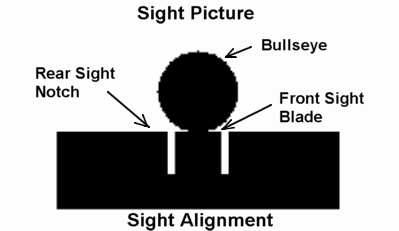
only way to determine this is by carefully firing 5~10 rounds at a paper target, starting at about 10 yards and again at 20~25 yards. This would need to done from a sandbag rest on a table or shooting bench, with careful concentration on sight alignment and sight picture, slowly squeezing the trigger to obtain useful information. (See attached graphic.) If the bullets are all hitting in one particular area, then you only need to adjust the sights. If they're all over the place, then you have a problem with the pistol, which may or may not be reparable.
5. Depending on how old your Llama .22 pistol is, it may or may not have adjustable sights. On the later models, the rear sight was adjustable for "windage" (left-right) via the screws on the sides of the rear sight notch. I don't know if there's an elevation (up-down) adjustment. You adjust the rear sight notch (left or right) in the same direction you want to move the point of impact on the target.
6. Your Llama .22 pistol has a relatively short "sight radius" (distance between the rear sight notch and the front sight blade), probably much shorter than your .357 revolver, which will make it more difficult (but not impossible) to hit what you're aiming at. That's just the nature of a small pistol.
7. Your Llama .22 pistol has the sights attached to the slide, which is separate from the barrel. The necessary looseness between these parts to allow it to function is a detriment to the pistol's inherent accuracy. (True target .22 pistols have the sights rigidly attached to the barrel.) If there is enough looseness to affect accuracy, it
could be "accurized" by a good gunsmith but that type of work would be pretty expensive. Again, it's just the nature of that pistol.
Good luck.
Attached Image:


 I have to look tremendously silly at the range each time. I have to make a V with my fingers, hold up my opposite thumb, sight at my target, move my hands around, until I ponder it out. Every danged time.
 So, I'm copying the wikipedia entry here for future reference.

