Search Stories
Matter Surfs on Ripples of Space Time Around Black Hole

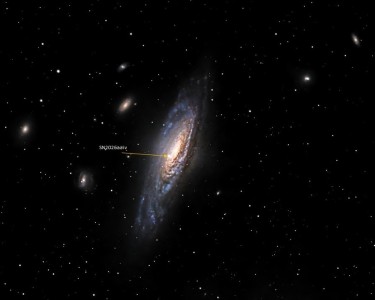
Scientists at Harvard and MIT say they have seen evidence of hot iron gas riding a ripple in spacetime around a black hole, much like a surfer catching a gnarly wave. <b> NOTE: French, German, and Italian translations follow...</b>
Saturn's Auroras Defy Scientists' Expectations
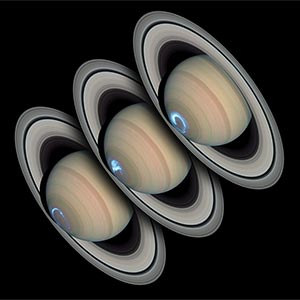
The dancing light of the auroras on Saturn behaves in ways different from how scientists have thought possible for the last 25 years.
From the Battle emerges a Victor!

This week's review winner concerns a Battle Royale of diminutive proportions....
The Ring, like you've never seen it before...

NASA's Spitzer Space Telescope finds a delicate flower in the Ring Nebula. The outer shell of this planetary nebula looks surprisingly similar to the delicate petals of a camellia blossom.
Hysteresis* in spectral state transitions of accreting black holes

Scientists at the Max-Planck-Institute for Astrophysics describe a further step in understanding the flow of matter towards objects of very high concentration of mass. These compact objects are known as "black holes", with gravitation so dominant that all matter and radiation fall into them if close enough.
Pulsar pair gives scientists magneto-pause for thought
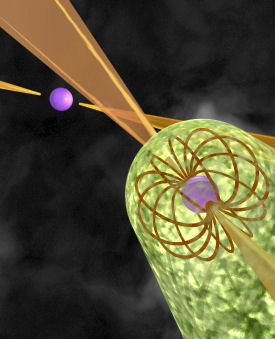
A study of the first double-pulsar binary system to be discovered shows that magnetic interactions between the pulsars are strikingly similar to those between the Sun and the Earth.
Colliding galaxies light up dormant black holes

In the early universe, many galaxies exhibit extremely bright sources at their nuclei, so-called quasars. It is thought that the luminosity of the quasars is produced by super massive black holes in the centers of galaxies. The masses of these black holes are tightly correlated with the velocity dispersion of the stars in the central bulge of their host galaxies, which suggests a common formation mechanism...
Galaxy patterns reveal missing link to Big Bang
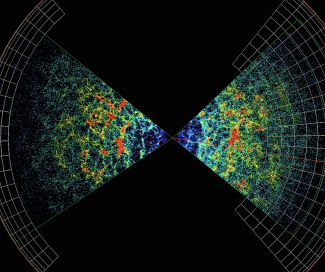
Australian astronomers from the Anglo-Australian Observatory, The Australian National University, CSIRO and the University of New South Wales, together with their UK colleagues, today announced that they have found the 'missing link' that directly relates modern galaxies like our own Milky Way to the Hot Big Bang that created our Universe 14 thousand million years ago.
Spitzer Finds Stellar "Incubators" With Massive Star Embryos
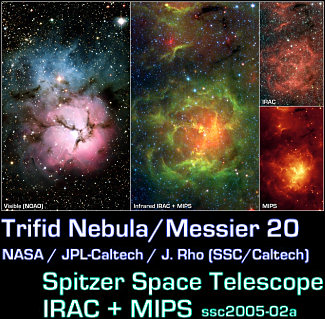
NASA's Spitzer Space Telescope has uncovered a hatchery for massive stars in a Messier favorite.
Hubble's Infrared Eyes Home in on Suspected Extrasolar Planet
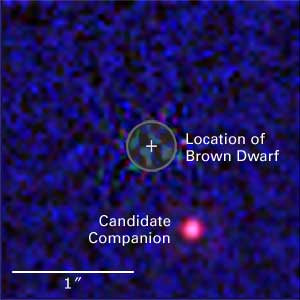
The Hubble Space Telescope's near-infrared vision is hot on the trail of a possible planetary companion to a relatively bright young brown dwarf located 225 light-years away in the southern constellation Hydra...
What does protein folding have to do with astronomy?

Not much perhaps but dipping a paw into another food group for a moment promotes good mental health and, in this case, good health in general. This is all about a novel distributed computing project by Stanford University that could help lead to cures for Alzheimer's, Mad Cow (BSE), CJD, ALS, Huntington's, and Parkinson's disease. We are posting it in the hope that people familiar with SETI@HOME might consider it as an alternative way to be of service...
Worldwide Astronomy 101 Anyone?
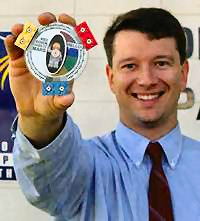
Free Astronomy Course Offered via Internet and Cable. Planetary Society and California State University Dominguez Hills Team Up on Distance Learning - Article by Susan Lendroth
An Extraspecial Camera for Extrasolar Planets

It hasn't found planets yet - but in its first year of operation, the instrument has already proved its worth...
Type 4's Revealed in This Week's Winning Review

Ed Moran covers the 22mm and 17mm Nagler T4 eyepieces and has captured the prize this week.
Portrait of a Star on the Edge

A new telescope array yields an unprecedented close-up of the bright star Regulus