
Astronomers Find the Most Stable Optical Clock in the Heavens
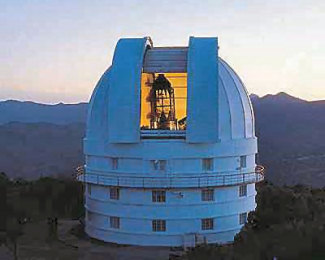
After 31 years of tracking the light-output of burnt-out white dwarf stars from telescopes at the University of Texas McDonald Observatory, a team of astronomers, led by S. O. Kepler of Brazil’s Universidade Federal do Rio Grande do Sul, have discovered the most stable optical clock in the heavens. The finding has important implications for theories of how stars live and die.
The star in question is a 400 million-year-old white dwarf called G117-B15A, located in Leo Minor. Its pulses of light are so regular that it loses one second in 8.9 million years. This makes the pulses of G117 more accurate and much more stable than the ticks of an atomic clock, Kepler said.
Some may suggest that the so-called “millisecond pulsars” are better timekeepers than G117, but Kepler doesn’t think so. Millisecond pulsars are the spinning remnant cores of massive stars that have exploded as supernovae. Their lighthouse-like beacons of radio waves and X-rays sweep by Earth regularly, acting as extremely accurate clocks, but their clocks are not as stable — that is, their accuracy breaks down sooner, Kepler said.
A white dwarf is what a star like our Sun becomes when it has exhausted its nuclear fuel. Near the end of its nuclear burning stage, the star expels most of its outer material, leaving only a very hot, dense core. A typical white dwarf is half as massive as the Sun, yet only slightly bigger than the Earth. This makes white dwarfs one of the densest forms of matter, surpassed only by neutron stars.
As a white dwarf, G117 is the corpse of a Sun-like star that has exhausted its supply of nuclear fuel and shed its outer layers of gas so that only the core remains. This dead core slowly cools over billions of years. If astronomers could measure the rate of cooling, it would be a boon to understanding how stars evolve and die.
“The use of white dwarfs as chronometers is a sport we invented here at McDonald Observatory in 1987,” said white dwarf expert Don Winget of The University of Texas at Austin, one of the co-authors on the paper. “White dwarfs are now a standard chronometer for stellar evolution.”
The key is that some white dwarfs pulsate — that is, give off bursts of light in a regular rhythm. As the white dwarf cools over time, the pulse arrival time slows down. By measuring how the pulses slow over time, astronomers can measure how fast the white dwarf is cooling.
“What we’re measuring is the pulse arrival time of the main pulsation of the star, which is a 215-second pulsation,” Winget said. “Over the years we’ve accumulated timings of the pulsations of this star, which have turned out to be remarkably stable. And in fact we’ve finally measured a change in the pulsation period.
“This is a direct measure of the evolution of a star,” he said. That feat has only been reached once before. In 1987, Winget and a team of Texas astronomers measured the cooling rate of a pre-white dwarf star called PG1159-035. “Its evolutionary timescale was four orders of magnitude shorter — faster than G117,” Winget said. “So this new result is an extension by a factor of 10,000 over the only previous measure of stellar evolution.”
And because white dwarfs are some of the oldest stars in the galaxy, measuring how long they’ve been cooling is one way to measure the age of the Milky Way itself.
University of Texas astronomer Rob Robinson and his graduate student John McGraw began timing the pulses from G 117 in 1974, using the 2.1-meter and 0.9-meter telescopes at McDonald Observatory. Kepler joined the work as a graduate student at Texas in 1979. Kepler continued the project after he completed his PhD at Texas and returned home to Brazil.
“No one thought the project could be done,” Winget said. “Even 20 years ago, we knew it was going to take another 20 years. This result is a testimony to perseverance,” Winget said. “Kepler has seen this through.”
FOR MORE INFORMATION:
Click here for more about this subject. -Ed.
Funding Member
