Astronomers Find Water on Extra-Solar Planet
An international team of scientists, including researchers from University College London (UCL) using NASA's Spitzer Space Telescope, have discovered water on an extra-solar planet for the first time.
Commenting on this result Professor Keith Mason, CEO of the Science and Technology Facilities Council (STFC) said, "This first conclusive evidence of the presence of water vapour in the atmosphere of a planet beyond our Solar System provides an exciting breakthrough in our knowledge of extra-solar planets. It represents a real step forward into establishing whether we are alone in the Universe or whether there is life on other planets."
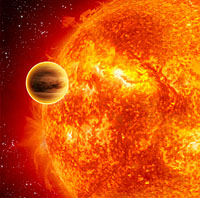
The planet which has water in its atmosphere is known as HD189733b, and orbits a star in the constellation of Vulpecula the Fox, which is 63 light years from the Sun. Planet HD 189733b, a gas giant about 15% bigger than Jupiter, is known as a "transiting planet" as it passes directly in front of its star, as viewed from the Earth. Unlike Jupiter, which is over five times as far away from the Sun as our Earth is, HD 189733b is over 30 times closer to its star than the Earth is to the Sun – that's why it is so hot.
The researchers, led by Dr Giovanna Tinetti, an ESA fellow from the Institute d'Astrophysique de Paris and UCL, found that HD 189733b absorbs the starlight of its "sun", as it passes in front, in a way that can only be explained if it has water vapour in its atmosphere. This is the first time that astronomers have demonstrated for certain that water is present in an extra-solar planet with the infrared analysis of the planet's transit across its parent star providing the breakthrough.
Dr Tinetti said; "Although HD 189733b is far from being habitable, and is actually quite a hostile environment, our discovery shows how water might be common out there and how our method can be used in the future to study more life-friendly environments."
Dr Tinetti adds, "The 'holy grail' for today's planet hunters is to find an Earth-like planet that also has water in its atmosphere. That discovery, when it happens, will provide real evidence that planets outside of our Solar System might harbour life. So the discovery that water exists on an extra—solar gas giant is a vital milestone along that road of discovery."
This exciting discovery was made using NASA's Spitzer Earth-orbiting telescope, taking measurements at a number of key wavelengths in the infrared region of the spectrum that pick out the crucial signature of water. The water detection relied not only on Dr Tinetti's painstaking analysis, but also on the calculation of highly accurate water absorption parameters by Dr Bob Barber and Professor Jonathan Tennyson, also from UCL.
Dr Barber said, "Initial data included over 500 million individual absorption features and from this we calculated the absorption parameters. Each feature is unique, like a fingerprint, and provides vital clues about the amount of water present and the temperature of the atmosphere."
Professor Tennyson, who heads UCL's Physics and Astronomy Department, explained: "Parts of the atmosphere of HD 189733b are very hot – around 2000 degrees. You need the millions of lines we calculated to simulate this, putting in absorption accurately where it should be and – just as accurately – giving gaps for the light to get through the atmosphere, where it can."
For more information:
http://www.esa.int/esaCP/SEMBDZI2O3F_index_0.html
http://www.scitech.ac.uk/PMC/PRel/STFC/ExSolWater.aspx
Astromart News Archive:
http://www.astromart.com/news/search.asp?search=.+&search_btn=Go
