
Astronomers Find Water on Extra-Solar Planet
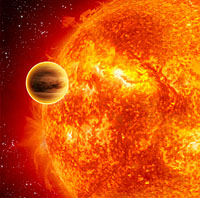
Over 200 extra-solar planets are known to exist, orbiting stars close to our own Sun. Now astronomers report the first conclusive evidence of the presence of water vapour in the atmosphere of a planet beyond our Solar System. An international team of scientists, using NASA's Spitzer Space Telescope, discovered water on an extra-solar planet named HD 189733b, which lies 63 light-years away in the constellation Vulpecula.
Comments:
Good thing they've found all these extra solar planets, given that since Pluto was demoted, we've been short one. Good to have extras. Same with water- shortages all over the world. <img class='' src='http://new.astromart.com/astromart/javascripts/sceditor/emoticons/grin.png' alt='grin' title='grin'/> <br><br>Jess Tauber
Given the new definition for planet, how, without applying those criteria to these 'planets' can these be called planets? Does not sound very scientific to me. If the definition only applies to our own solar system, then a new word needs to be coined instead of the use of the word planet. Until these objects are verified as meeting the criteria for planet, these objects can not correctly be called planets.
Bill:<br><br>Excellent point.<br><br>We can play around with definitions all day, but in the end what difference does it make?<br><br>Give it a few more years and maybe a new definition for planet will emerge.<br><br>I'm thinking that maybe a planet must have a moon to be a real planet. Otherwise it should be placed in a new category that we can call "Deficient Planet."<br><br>And speaking of moons, how does one define a moon?<br><br>We have recently discovered that Saturn has 60 moons. But when does a moon stop being a moon, and start being just another rock orbiting a planet?<br><br>See what I mean?<br><br>Where does this urge to categorize end? And how will we ever know that we have it right? It is all just too subjective, ambiguous, inprecise, and conflictuous (is that a word?).<br><br>I think William Shakespeare had it right:<br><br>"A rose by any other name would smell as sweet."<br><br>Meaning: What matters is what something is, not what it is called.<br><br>Guy Pirro<br><br><br><blockquote class="blockquote"><div class="italic"><i>Bill Prueter said:</i><br><br>Given the new definition for planet, how, without applying those criteria to these 'planets' can these be called planets? Does not sound very scientific to me. If the definition only applies to our own solar system, then a new word needs to be coined instead of the use of the word planet. Until these objects are verified as meeting the criteria for planet, these objects can not correctly be called planets.</div></blockquote>
Funding Member
