Black Holes and Neutron Stars -- The Difference is in the Event Horizon
Researchers using NASA's Rossi X-ray Timing Explorer (RXTE) have compared suspected neutron stars and black holes and found that X-ray light emitted from these two types of objects behave very differently. Black holes always behave as if they have an event horizon -- the theoretical border from beyond which nothing, not even light, can escape. The black holes appear to have no surface. Matter falling toward the black hole seems to disappear into the void. As expected, the neutron stars appear to have a hard surface, which erupts in an X-ray explosion every several hours.
"Event horizons are invisible by definition, so it seems impossible to prove their existence," said Ron Remillard of MIT in Cambridge, Mass. "Yet by looking at objects that pull in gas, we can infer whether that gas crashes and accumulates onto a hard surface or just quietly vanishes. For the group of suspected black holes we studied, there is a complete absence of surface explosions called X-ray bursts. The gas that would fuel such bursts appears to vanish."
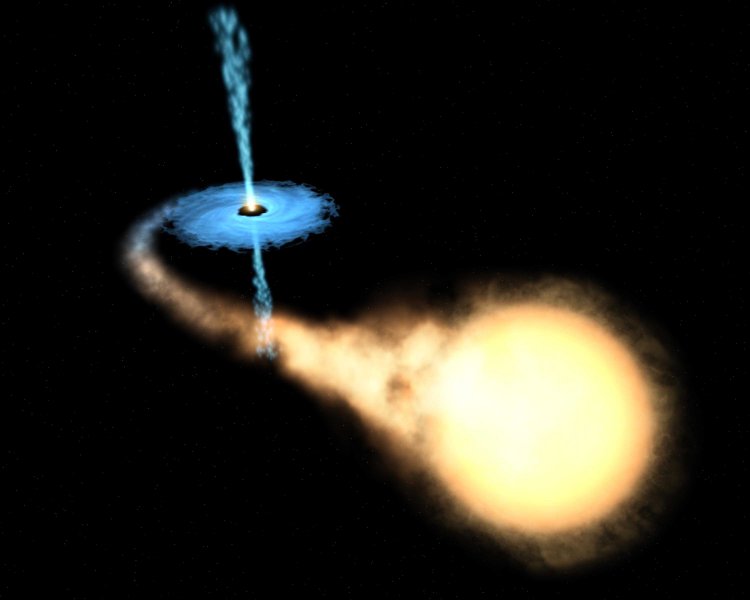
Using the NASA Rossi Explorer, the team observed all of the transient sources that have appeared in the X-ray sky over the last nine years. In all of these sources, a suspected neutron star or black hole accretes gas from a companion star in a tight binary system.
Gas can accumulate on a neutron star surface. When conditions are ripe, the gas will ignite in a thermonuclear explosion that is visible as a one-minute event called an X-ray burst. The suspected black holes - that is, the more massive types of compact objects in this study - behave as if they had no surface and were located behind event horizons.
The idea of using the absence of X-ray bursts to confirm the presence of event horizons in black holes was proposed in by Ramesh Narayan of Harvard and Jeremy Heyl of the University of British Columbia.
"It was a very simple but powerful idea," said Narayan. X-ray bursts “are easy to identify, and we can compare burst statistics with the quantitative predictions of our burst model for a variety of compact objects with a hard surface. With this new analysis, the argument for black hole event horizons has become much stronger."
Black holes form when very massive stars run out of fuel. Without energy to support its mass, the star implodes. If the star is over 25 times more massive than our sun, the core will collapse to a point of infinite density with no surface.
Within a boundary of about 50 miles from the black hole center in all directions, gravity is so strong that not even light can escape its pull. This boundary is the theoretical event horizon. Slightly less massive stars - about 10 to 25 solar masses - will collapse into compact spheres about 10 miles across, called neutron stars. These objects have a hard surface and no event horizon.
Black holes and their neutron star cousins are sometimes located in binary systems, orbiting a relatively normal star companion. Gas from these stars, lured by gravity, can flow toward the compact object. This process, called accretion, releases large amounts of energy, predominantly in the form of X-rays, as gas moves quickly and heats to high temperatures.
Two important aspects of this new study are the ability to model the conditions that produce X-ray bursts and to count the neutron star bursts as a function of the amount of gas raining down on the surface. The extensive computer modeling separates this analysis from similar comparisons in recent years. The model predictions computed for neutron stars roughly matched the measured burst rate function for the neutron star group. This increased the scientists' confidence that they have a reasonably good model for X-ray bursts, while decreasing the chance that the heavy compact objects can somehow hide their bursts if they did have a hard surface.
For More Information:
http://www.cfa.harvard.edu/press/pr0604.html
http://web.mit.edu/newsoffice/2006/blackhole1.html
http://www.nasa.gov/centers/goddard/news/topstory/2005/blackhole_noreturn.html
