
Black Holes and Neutron Stars -- The Difference is in the Event Horizon
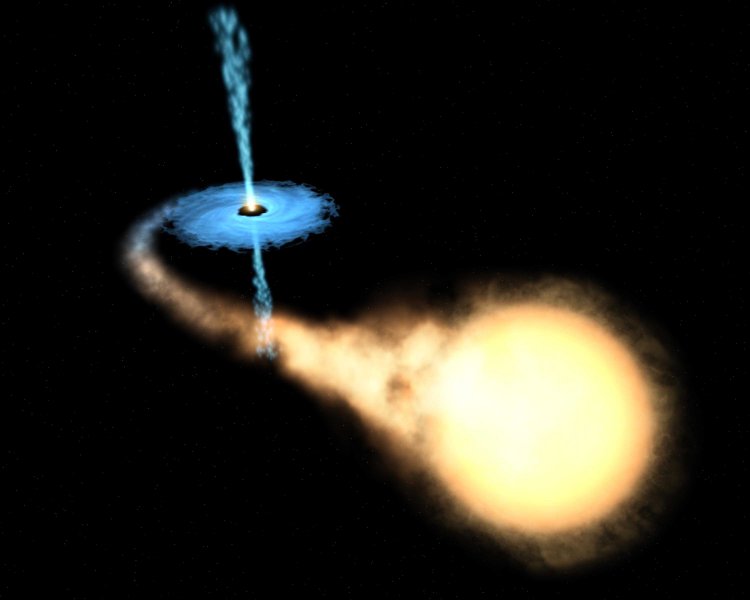
Researchers using NASA's Rossi X-ray Timing Explorer (RXTE) have compared suspected neutron stars and black holes and found that X-ray light emitted from these two types of objects behaves very differently. Black holes always behave as if they have an event horizon and no surface. Matter falling toward the black hole seems to disappear into the void. As expected, the neutron stars appear to have a hard surface, with X-ray explosions ocurring every several hours.
Comments:
Ok, so I takes my neutron star and incrementally feeds it matter till it ripens to the point of collapse into a black hole. What will happen when I add the straw that breaks the camel's back? This is no ordinary event, since it would lack the supernova that normally accompanies black hole formation. Will any energy be released, or will it all simply fall back into the nascent event horizon? Will the transition be instantaneous, or will there be an observable grey area between states A and B? In that hypothetical moment between such states will I be able to make a wish and expect it to come true? Or will proximity to the event make it moot for me anyway (i.e. all I'll need will be marinara sauce)?<br><br>Jess Tauber
One would think the transition would have to be instantaneous. In other words, you either have an event horizon or you don't. Once you have the event horizon I imagine you'll wish you didn't.<br><br>Stupid question time: how can black holes emit anything? Aren't X-rays just photons in a different part of the electromagnetic spectrum? Thanks.<br><br>Mark Scrivener
Funding Member
