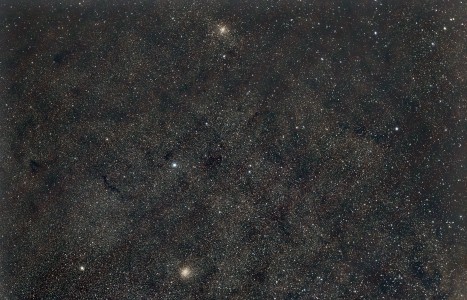
Canon Introduces the EOS 60Da DSLR Camera For Astrophotography
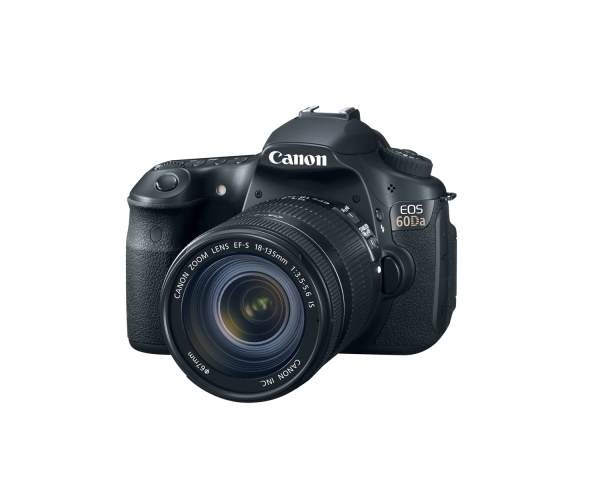
Canon today introduced the EOS 60Da Digital SLR Camera, the long-awaited successor to the EOS 20Da, which is optimized for astrophotography. This DSLR caters to amateur astronomers who enjoy capturing the beauty of the night sky by offering a modified infrared filter and a low-noise sensor with heightened hydrogen-alpha sensitivity. These modifications allow the camera to capture magnificent images of "red hydrogen emission" nebulae and other cosmic phenomena.
"The EOS 60Da is a testament to the constant desire to meet the needs of every customer, including those in specialized fields," said Yuichi Ishizuka, executive vice president and general manager, Imaging Technologies and Communications Group, Canon U.S.A., "This new camera enables an accurate depiction of a part of our solar system which is hard to achieve with conventional cameras but should be enjoyed and celebrated."
The Canon EOS 60Da camera packs a powerful 18-megapixel CMOS sensor (APS-C size) that produces sharp and high-contrast images of astronomical objects, a major enhancement over the EOS 20Da model's 8.2-megapixel sensor. The improved infrared-blocking filter is a modification suited specifically toward astronomy enthusiasts to achieve a hydrogen-alpha light sensitivity that is approximately three times higher than that of a normal Canon DSLR camera. This produces a 20-percent higher transmittance of Hydrogen Alpha line, or H-alpha wavelength, allowing astronomers to capture crisp, clear images of reddish, diffuse nebulae.
Crisp images of the stars and planets can be viewed on the EOS 60Da's improved 3.0-inch Clear View LCD screen with 1,040,000 dots for detailed focusing. The flip-out Vari-angle screen allows photographers to adjust the screen for easy viewing without straining even while the camera is mounted to a telescope via a T-ring adapter. Astronomy enthusiasts can connect the camera to a TV and display the night sky on a TV monitor using the camera's Live View mode. Moreover, the EOS 60Da's Live View mode is equipped with a Silent Shooting feature that eliminates shutter-induced vibration for maximum camera stability when the camera is mounted to a telescope.
Enhanced noise reduction on the EOS 60Da sensor offers photographers the ability to experiment with the wide array of ISO settings and increased ISO speeds up to 6400, expandable to 12800. Other features include an intelligent nine-point autofocus system, full manual controls, and RAW, JPEG, and RAW+JPEG image recording capabilities.
The EOS 60Da is packaged with a Remote Control Adapter, which is ideal for controlling time exposures longer than 30 seconds as well as capturing a series of consecutive time exposures that can be stacked during post-processing for improved image quality. This is especially useful when the camera body is connected to a telescope or an EF super telephoto lens.
For more information:
http://www.usa.canon.com/cusa/about_canon/newsroom?pageKeyCode=pressreldetail&docId=0901e0248051ddd1
http://www.usa.canon.com/cusa/professional/products/professional_cameras/digital_slr_cameras/eos_60da
AstroMart News Archive:
http://www.astromart.com/news/search.asp?search=.+
Funding Member
