
Einstein's Theory of General Relativity Proven to be 99.95% Right
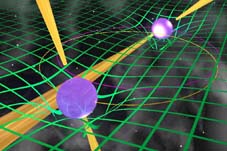
A research team at the University of Manchester's Jodrell Bank Observatory in the UK has used three years of observations of a "double pulsar", a unique pair of natural stellar clocks that they discovered in 2003, to prove that Einstein's theory of general relativity is correct to within a staggering 0.05%.
Comments:
A little while ago I read a little blurb that someone is suggesting that Einstiens general theory of realativity breaks down at very large distances. I believe this was an attempt to do away with dark matter or at least greatly reduce it's neccesary presence. This article seems to be a direct rebuttal to that suggestion eventhough it doesn't directly say so.<br><br>Two things jump out at me with this. One is the distances involved, very small when compared to galaxies or galaxy groups. Also there is that little bit of error... does this indicate an error in our measurements, a need to slightly tweak the theory or is it the evidence that Einstein's theory is already starting to breakdown within our detectable limits even in this short distance? <br><br>Newton's theory was proven absolutely true until the technology and knowledge was great enough to challenge it, it was that ever so slight deviation in Mercury's orbit that started it, wasn't it? I'm just wondering if these observations are starting to parallel those of the past.<br><br>I have no formal education of such things, I've only read a handfull books on this subject matter and those were only conceptual i.e. no mathematics, so take my opinion with a grain of salt. I'm just trying to stir up some conversation on this subject because from what I've read and understand (which is a drop in the ocean) I think there may be some merit to that argument and I'd like to hear what others have to say.<br><br>Take care,<br>Ryan
<br>Ryan:<br><br>What some researchers are questioning is not Einstein's General Theory of Relativity in total, but rather that our understanding of Gravity may be incorrect. If that is the case, then current calculations for the amount of Dark Matter in the Universe are grossly exaggerated. Some recent research has revealed that a simple "fine-tuning"<br>of the formula for Gravity that varies continuously with distance could eliminate the need for so much Dark Matter.<br><br>Here is one of my postings that provides more background on this topic:<br><br>http://www.astromart.com/news/news.asp?news_id=489<br><br>At the time, it stirred up a lot of debate.<br><br>Hope this helps.<br><br>Thanks,<br><br>Guy<br><br>-----------------------------<br><br>Ryan McIvor said:<br><br>A little while ago I read a little blurb that someone is suggesting that Einstiens general theory of realativity breaks down at very large distances. I believe this was an attempt to do away with dark matter or at least greatly reduce it's neccesary presence. This article seems to be a direct rebuttal to that suggestion eventhough it doesn't directly say so.<br><br>Two things jump out at me with this. One is the distances involved, very small when compared to galaxies or galaxy groups. Also there is that little bit of error... does this indicate an error in our measurements, a need to slightly tweak the theory or is it the evidence that Einstein's theory is already starting to breakdown within our detectable limits even in this short distance? <br><br>Newton's theory was proven absolutely true until the technology and knowledge was great enough to challenge it, it was that ever so slight deviation in Mercury's orbit that started it, wasn't it? I'm just wondering if these observations are starting to parallel those of the past.<br><br>I have no formal education of such things, I've only read a handfull books on this subject matter and those were only conceptual i.e. no mathematics, so take my opinion with a grain of salt. I'm just trying to stir up some conversation on this subject because from what I've read and understand (which is a drop in the ocean) I think there may be some merit to that argument and I'd like to hear what others have to say.<br><br>Take care,<br>Ryan
<br>It is a good point, Ryan. When I was taking a course in modern physics in college ("A-bomb" as we called it), the professor made a point which stuck with me. When talking about the possibility of objects going faster than the speed of light, he said "Sure, there may be. But we don't really care because we can neither measure nor could we interact with such objects." <br><br>In my opinion, they only claim to 99.95% because they can only measure to that accuracy with whatever metrics they are using. Their measurement of the theory of relativity does, in fact, boil down to being a measurement. As with any measurement, you can only measure an object to the accuracy of your measuring tool. For example, a dial caliper with an accuracy of 0.001" can ever only give you an accurate measurement to the nearest 0.001". For example, you could not use it to say some steel rod is 1.15275" long. <br><br>So the question is...does their measuring tool have an accuracy of 99.95%, thus preventing them from claiming greater accuracy? I would speculate that is the case. 99.95% accuracy is very good. If you were measuring the length of a mile, you would have to be accurate to less than 3 feet. This is well beyond the means of the typical mile-measuring device (a vehicle's odometer).<br><br>Scientists and engineers are usually very careful with their wording, in particular to avoid claiming too much. They have to be to survive the close scrutiny provided by their peers (and, for high profile claims, the media, which lately seems to have been enjoying proving scientists and other experts wrong).<br><br>Cheers,<br>Jason