Irregular Heartbeat of the Sun is Driven by a Double Dynamo
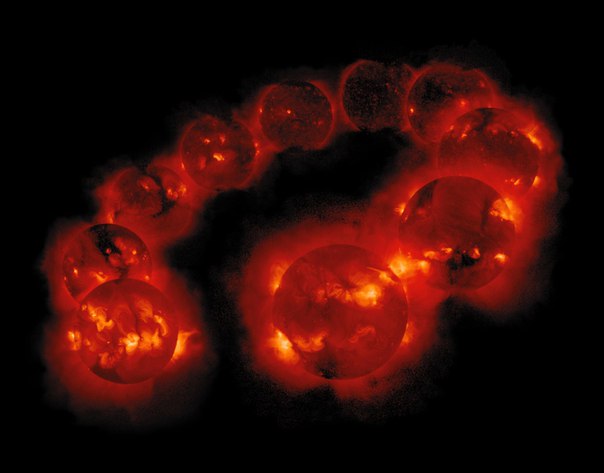
A new model of the Sun's solar cycle, developed by Dr. Valentina Zharkova of Northumbria University in the UK, is producing unprecedentedly accurate predictions of irregularities within the Sun's 11 year heartbeat. The model draws on dynamo effects in two layers of the Sun -- one close to the surface and one deep within its convection zone. Predictions from the model suggest that solar activity will fall by 60 per cent during the 2030s to conditions last seen during the "mini ice age" that began in 1645.
It has been 172 years since a scientist first spotted that the Sun's activity varies over a cycle lasting around 10 to 12 years. But every cycle is a little different and none of the models of causes to date have fully explained fluctuations. Many solar physicists have put the cause of the solar cycle down to a dynamo caused by convecting fluid deep within the Sun. Now, Valentina Zharkova and her colleagues have found that adding a second dynamo, close to the surface, completes the picture with surprising accuracy.
"We found magnetic wave components appearing in pairs, originating in two different layers in the Sun's interior. They both have a frequency of approximately 11 years, although this frequency is slightly different, and they are offset in time. Over the cycle, the waves fluctuate between the northern and southern hemispheres of the Sun. Combining both waves together and comparing to real data for the current solar cycle, we found that our predictions showed an accuracy of 97 percent," said Zharkova.
Zharkova and her colleagues derived their model using a technique called principal component analysis of the magnetic field observations from the Wilcox Solar Observatory in California. They examined three solar cycles' worth of magnetic field activity, covering the period from 1976 to 2008. In addition, they compared their predictions to average sunspot numbers, another strong marker of solar activity. All the predictions and observations were closely matched.
Looking ahead to the next solar cycles, the model predicts that the pair of waves become increasingly offset during Cycle 25, which peaks in 2022. During Cycle 26, which covers the decade from 2030 to 2040, the two waves will become exactly out of synch and this will cause a significant reduction in solar activity.
"In cycle 26, the two waves exactly mirror each other -- peaking at the same time but in opposite hemispheres of the Sun. Their interaction will be disruptive, or they will nearly cancel each other. We predict that this will lead to the properties of a "Maunder minimum" said Zharkova.
"Effectively, when the waves are approximately in phase, they can show strong interaction, or resonance, and we have strong solar activity. When they are out of phase, we have solar minimums. When there is full phase separation, we have the conditions last seen during the Maunder minimum, 370 years ago."
For more information:
http://www.ras.org.uk/news-and-press/2680-irregular-heartbeat-of-the-sun-driven-by-double-dynamo
http://www.astromart.com/news/news.asp?news_id=1383
http://www.astromart.com/news/news.asp?news_id=1196
http://www.astromart.com/news/news.asp?news_id=1149
http://www.astromart.com/news/news.asp?news_id=984
http://www.astromart.com/news/news.asp?news_id=924
http://www.astromart.com/news/news.asp?news_id=1105
http://www.astromart.com/news/news.asp?news_id=945
http://www.astromart.com/news/news.asp?news_id=824
http://www.astromart.com/news/news.asp?news_id=1289
http://www.astromart.com/news/news.asp?news_id=652
AstroMart News Archive:
http://www.astromart.com/news/search.asp?search=.+
Funding Member
