NASA's Dawn Mission Produces First High Resolution Map of Ceres
2015 has certainly turned out to be the year of the Dwarf Planet. On March 6, 2015, Dawn made history as the first mission to reach Ceres. Then in mid-July 2015, New Horizons visited Pluto, truly the "Capo di tutti capi" of the Dwarf Planets.
Although Ceres is about 40 percent the size of Pluto, it is beginning to show a diverse topography, with height differences from crater bottoms to mountain peaks as great as 9 miles (15 kilometers). Scientists continue to analyze the latest data from Dawn as the spacecraft makes its third mapping orbit. And now some of these craters and other surface features are being assigned official names by the International Astronomical Union (IAU), the inventors of the "Dwarf Planet."
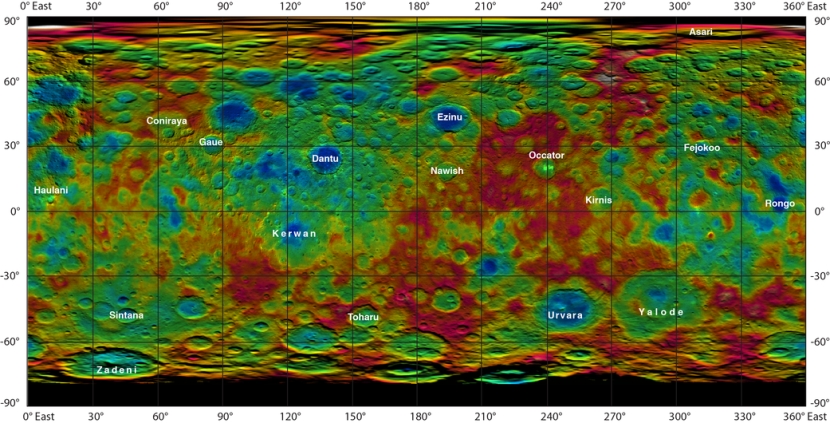
Colorful new maps of Ceres, based on data from NASA's Dawn spacecraft, showcase a diverse topography. "The craters we find on Ceres, in terms of their depth and diameter, are very similar to what we see on Dione and Tethys, two icy satellites of Saturn that are about the same size and density as Ceres. The features are pretty consistent with an ice-rich crust," said Dawn science team member Paul Schenk, a geologist at the Lunar and Planetary Institute in Houston.
Some of these craters and other features now have official names, inspired by spirits and deities relating to agriculture from a variety of cultures. The International Astronomical Union recently approved a batch of names for features on Ceres.
The newly labeled features include Occator, the mysterious crater containing Ceres' brightest spots, which has a diameter of about 60 miles (90 kilometers) and a depth of about 2 miles (4 kilometers). Occator is the name of the Roman agriculture deity of harrowing, a method of leveling soil.
A smaller crater with bright material, previously labeled "Spot 1," is now identified as Haulani, after the Hawaiian plant goddess Hau-lani. Haulani has a diameter of about 20 miles (30 kilometers). Temperature data from Dawn's visible and infrared mapping spectrometer show that this crater seems to be colder than most of the territory around it.
Dantu crater, named after the Ghanaian god associated with the planting of corn, is about 75 miles (120 kilometers) across and 3 miles (5 kilometers) deep. A crater called Ezinu, after the Sumerian goddess of grain, is about the same size. Both are less than half the size of Kerwan, named after the Hopi spirit of sprouting maize, and Yalode, a crater named after the African Dahomey goddess worshipped by women at harvest rites.
"The impact craters Dantu and Ezinu are extremely deep, while the much larger impact basins Kerwan and Yalode exhibit much shallower depth, indicating increasing ice mobility with crater size and age," said Ralf Jaumann, a Dawn science team member at the German Aerospace Center (DLR) in Berlin.
Almost directly south of Occator is Urvara, a crater named for the Indian and Iranian deity of plants and fields. Urvara, about 100 miles (160 kilometers) wide and 3 miles (6 kilometers) deep, has a prominent central pointy peak that is 2 miles (3 kilometers) high.
In all, the following Ceres craters and other surface features have been officially named to date:
Asari - Syrian god of agriculture
Coniraya - Inca god responsible for the system of agricultural terracing and irrigation
Dantu - Ghanan god associated with the planting of the corn
Ezinu - Sumerian goddess of the grain
Fejokoo - Nigerian god who supplied the yams
Gaue - Germanic goddess to whom offerings are made in harvesting the rye
Haulani - (Hau-lani) Hawaiian plant goddess
Kait - Protoattic Hittite goddess of grain (Asia Minor)
Kerwan - Hopi spirit of the sprouting maize (Arizona, SW USA)
Kirnis - Lithuanian spirit, guardian of cherry trees
Nawish - Acoma (New Mexico, SW USA) guardian of the field
Occator - Roman agricultural deity of the harrowing
Rongo - Maori (New Zealand) god of agriculture and of cultivated foods
Sintana - Columbian deity who produced the fertile black earth for sowing
Toharu - Pawnee (Nebraska, Central USA) god of food and vegetation
Urvara - Indian and Iranian deity of plants and fields
Yalode - Dahomey goddess worshiped by women at the harvest rites
Zadeni - Ancient Georgian god of bountiful harvest
Dawn is currently entering its third science orbit, 900 miles (less than 1,500 kilometers) above the surface, or three times closer to Ceres than its previous orbit. The spacecraft will reach this orbit in mid-August and begin taking images and other data again.
Ceres, with a diameter of 584 miles (940 kilometers), is the largest object in the main asteroid belt, located between Mars and Jupiter. Dawn made history as the first mission to reach a dwarf planet and was also the first to orbit two distinct extraterrestrial targets, as it conducted extensive observations of Vesta in 2011-2012.
For more information:
http://www.jpl.nasa.gov/news/news.php?feature=4669
http://www.astromart.com/news/news.asp?news_id=1456
http://www.astromart.com/news/news.asp?news_id=1204
http://www.astromart.com/news/news.asp?news_id=1209
http://www.astromart.com/news/news.asp?news_id=1078
AstroMart News Archive:
http://www.astromart.com/news/search.asp?search=.+
Funding Member
