
NASA's Kepler Telescope Jettisons Dust Cover, Sees First Light
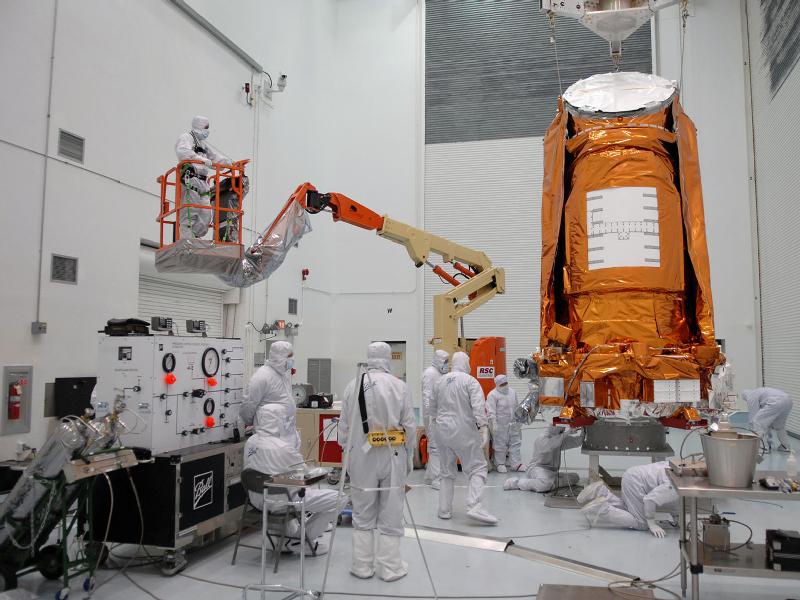
Engineers have successfully ejected the dust cover from NASA's Kepler telescope, a spaceborne mission soon to begin searching for worlds like Earth.
"The cover released and flew away exactly as we designed it to do," said Kepler Project Manager James Fanson of NASA's Jet Propulsion Laboratory, Pasadena, CA. "This is a critical step toward answering a question that has come down to us across 100 generations of human history -- are there other planets like Earth, or are we alone in the galaxy?"
Kepler, which launched on March 6, 2009 from Cape Canaveral, FL, will spend three-and-a-half years staring at more than 100,000 stars in our Milky Way galaxy for signs of Earth-size planets. Some of the planets are expected to orbit in a star's "habitable zone," a warm region where water could pool on the surface. The mission's science instrument, called a photometer, contains the largest camera ever flown in space -- its 42 charge-coupled devices (CCDs) will detect slight dips in starlight, which occur when planets passing in front of their stars partially block the light from Kepler's view.
The telescope's oval-shaped dust cover, measuring 1.7 meters by 1.3 meters (67 inches by 52 inches), protected the photometer from contamination before and after launch. The dust cover also blocked stray light from entering the telescope during launch -- light that could have damaged its sensitive detectors. In addition, the cover was important for calibrating the photometer. Images taken in the dark helped characterize noise coming from the instrument's electronics, and this noise will later be removed from the actual science data.
The spring-loaded cover swung open on a fly-away hinge, before drifting away from the spacecraft. The cover is now in its own orbit around the sun, similar to Kepler's sun-centric orbit.
"Now the photometer can see the stars and will soon start the task of detecting the planets," said Kepler's Science Principal Investigator William Borucki at NASA's Ames Research Center, Moffett Field, CA. "We have thoroughly measured the background noise so that our photometer can detect minute changes in a star's brightness caused by planets."
With the cover off, starlight is entering the photometer and being imaged onto its focal plane. Engineers will continue calibrating the instrument using images of stars for another several weeks, after which science observations will begin.
Kepler will be the first space mission to search for Earth-size and smaller planets in the habitable zone of other stars in our neighborhood of the galaxy. Kepler is a special-purpose spacecraft that precisely measures the light variations from thousands of distant stars, looking for planetary transits. When a planet passes in front of its parent star, as seen from our solar system, it blocks a small fraction of the light from that star—this is known as a transit.
Searching for transits of distant “Earths” is like looking for the drop in brightness when a moth flies across a searchlight. Measuring repeated transits, all with a regular period, duration and change in brightness, provides a method for discovering and confirming planets and their orbits—planets the size of Earth and smaller in the habitable zone around other stars similar to our Sun.
The centuries-old quest for other worlds like our Earth has been rejuvenated by the intense excitement and popular interest surrounding the discovery in the past decade of more than 250 giant planets orbiting stars beyond our solar system. With the exception of the pulsar planets, most of the extrasolar planets detected to date are gas giants. The challenge is to find terrestrial planets, which are 30-600 times less massive than Jupiter.
Kepler is specifically designed to search for Earth-size and smaller planets in the habitable zone of solar-like stars out to distances of about three thousand light years.
Kepler will continuously monitor over 100,000 stars similar to our Sun for brightness changes produced by planetary transits. At the beginning of the mission, planets of all sizes orbiting very close to their stars will be found. After three years, we will be able to discover planets with orbits of one year, that is those in the habitable zone of stars like the Sun. If Earth size planets in the habitable zone are common, then life may be ubiquitous in our galaxy. On the other hand, if no terrestrial planets are found, then “Earths” may be rare.
For more information:
http://www.nasa.gov/mission_pages/kepler/news/kepler-20090407.html
http://planetquest.jpl.nasa.gov/missions/keplerMission.cfm
http://www.astromart.com/news/news.asp?news_id=852
AstroMart News Archive:
http://www.astromart.com/news/search.asp?search=.+
"The cover released and flew away exactly as we designed it to do," said Kepler Project Manager James Fanson of NASA's Jet Propulsion Laboratory, Pasadena, CA. "This is a critical step toward answering a question that has come down to us across 100 generations of human history -- are there other planets like Earth, or are we alone in the galaxy?"
Kepler, which launched on March 6, 2009 from Cape Canaveral, FL, will spend three-and-a-half years staring at more than 100,000 stars in our Milky Way galaxy for signs of Earth-size planets. Some of the planets are expected to orbit in a star's "habitable zone," a warm region where water could pool on the surface. The mission's science instrument, called a photometer, contains the largest camera ever flown in space -- its 42 charge-coupled devices (CCDs) will detect slight dips in starlight, which occur when planets passing in front of their stars partially block the light from Kepler's view.
The telescope's oval-shaped dust cover, measuring 1.7 meters by 1.3 meters (67 inches by 52 inches), protected the photometer from contamination before and after launch. The dust cover also blocked stray light from entering the telescope during launch -- light that could have damaged its sensitive detectors. In addition, the cover was important for calibrating the photometer. Images taken in the dark helped characterize noise coming from the instrument's electronics, and this noise will later be removed from the actual science data.
The spring-loaded cover swung open on a fly-away hinge, before drifting away from the spacecraft. The cover is now in its own orbit around the sun, similar to Kepler's sun-centric orbit.
"Now the photometer can see the stars and will soon start the task of detecting the planets," said Kepler's Science Principal Investigator William Borucki at NASA's Ames Research Center, Moffett Field, CA. "We have thoroughly measured the background noise so that our photometer can detect minute changes in a star's brightness caused by planets."
With the cover off, starlight is entering the photometer and being imaged onto its focal plane. Engineers will continue calibrating the instrument using images of stars for another several weeks, after which science observations will begin.
Kepler will be the first space mission to search for Earth-size and smaller planets in the habitable zone of other stars in our neighborhood of the galaxy. Kepler is a special-purpose spacecraft that precisely measures the light variations from thousands of distant stars, looking for planetary transits. When a planet passes in front of its parent star, as seen from our solar system, it blocks a small fraction of the light from that star—this is known as a transit.
Searching for transits of distant “Earths” is like looking for the drop in brightness when a moth flies across a searchlight. Measuring repeated transits, all with a regular period, duration and change in brightness, provides a method for discovering and confirming planets and their orbits—planets the size of Earth and smaller in the habitable zone around other stars similar to our Sun.
The centuries-old quest for other worlds like our Earth has been rejuvenated by the intense excitement and popular interest surrounding the discovery in the past decade of more than 250 giant planets orbiting stars beyond our solar system. With the exception of the pulsar planets, most of the extrasolar planets detected to date are gas giants. The challenge is to find terrestrial planets, which are 30-600 times less massive than Jupiter.
Kepler is specifically designed to search for Earth-size and smaller planets in the habitable zone of solar-like stars out to distances of about three thousand light years.
Kepler will continuously monitor over 100,000 stars similar to our Sun for brightness changes produced by planetary transits. At the beginning of the mission, planets of all sizes orbiting very close to their stars will be found. After three years, we will be able to discover planets with orbits of one year, that is those in the habitable zone of stars like the Sun. If Earth size planets in the habitable zone are common, then life may be ubiquitous in our galaxy. On the other hand, if no terrestrial planets are found, then “Earths” may be rare.
For more information:
http://www.nasa.gov/mission_pages/kepler/news/kepler-20090407.html
http://planetquest.jpl.nasa.gov/missions/keplerMission.cfm
http://www.astromart.com/news/news.asp?news_id=852
AstroMart News Archive:
http://www.astromart.com/news/search.asp?search=.+
Funding Member