Princeton University Astronomers Capture a Supernova Just as it Explodes
When she peered into the screen of her computer one day in January of this year, Alicia Soderberg, a Princeton University astronomer, was supposed to see a small, dull glowing smudge in one corner, the evidence of a month-old supernova that would help her better understand the mystery of these huge exploding stars.
What Soderberg saw instead was anything but dull. As Soderberg and Edo Berger, a postdoctoral research associate at Princeton, studied the X-ray emissions conveyed from space by NASA's Swift satellite, they saw an extremely bright light that seemed to jump out of the sky.
They didn't know it, but they had just become the first astronomers to have caught a star in the act of exploding. The once-in-a-lifetime event, has transfixed the worldwide astronomical community.
"In the old days -- last year -- people found supernovae by their optical light and then started to study them to understand which stars blow up, what the mechanism is and what they produce," said Robert Kirshner, a professor of astronomy at Harvard University. "But this is something new -- the X-rays come right at the beginning and provide a very early alert to the event."
Soderberg regards the discovery as a case of extreme serendipity. The satellite was pointing in the right place at the right time, she said, because she had asked Neil Gehrels, Swift's lead scientist at NASA's Goddard Space Flight Center in Greenbelt, Md., to turn it that way to look at another supernova. And while she was away lecturing, she had asked her colleague, Berger, to keep an eye on the data for her.
"It's a really lucky chain of events -- a surprise," said Soderberg, who is leading the group studying the explosion. "It was all over in a matter of minutes."
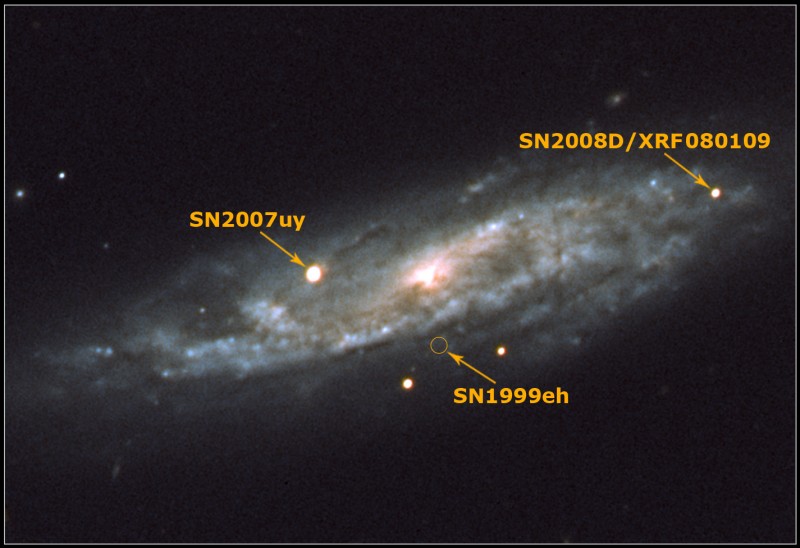
Soderberg and Berger wanted to observe a supernova known as SN 2007uy in the spiral galaxy NGC 2770, located 90 million light years from Earth in the constellation Lynx. They could plan to do that because they are able to view images captured by the telescope a few hours after the observation merely by downloading the data from the Swift website. The sudden appearance nearby of the X-ray burst of the newer supernova, easily captured by the NASA satellite with multiple instruments that can detect gamma rays, X-rays and ultraviolet light, has set scientists on a new path.
"This phenomenon had been predicted more than 30 years ago, but is now observed for the first time," said Roger Chevalier, Professor of Astronomy at the University of Virginia. "These are the earliest observations of light from a supernova after the central collapse that initiated the explosion."
Soderberg showed that the energy and pattern of the X-ray outburst is consistent with what scientists would have expected to see in the birth of a neutron star -- a shock wave blasting through the surface of the original massive star.
A typical supernova occurs when the core of a vast star runs out of nuclear fuel and collapses under its own gravity to form an ultra-dense object known as a neutron star. The next activity is what the scientists were able to see for themselves -- the newborn neutron star first compresses then rebounds, triggering a shock wave that plows through the star's gaseous outer layers and rips the star apart.
Until now, astronomers have only been able to observe supernovae brightening days or weeks after the event, when the expanding shell of debris is energized by the decay of radioactive elements forged in the explosion.
Supernovae are fascinating to researchers because, in the destruction of their progenitor and in their own creation, all the elements in the universe are produced and injected into galaxies. A small fraction of supernovae turn into black holes and emit gamma rays, according to Soderberg. Most act the way this one, called SN 2008D, does.
With the discovery of the X-ray outburst, Soderberg immediately mounted an international observing campaign to study the newest supernova. Scientists peered at SN 2008D using the Hubble Space Telescope, the Chandra X-ray Observatory, the Very Large Array in New Mexico, the 200-inch and 60-inch telescopes at the Palomar Observatory in California, the 3.5-meter telescope at the Apache Point Observatory in New Mexico, and the Gemini North Telescope and the Keck 1 Telescope, both in Hawaii.
For more information:
http://www.princeton.edu/main/news/archive/S21/13/76G41/index.xml?section=topstories
http://www.astromart.com/news/news.asp?news_id=644
http://www.astromart.com/news/news.asp?news_id=624
http://www.astromart.com/news/news.asp?news_id=609
http://www.astromart.com/news/news.asp?news_id=564
http://www.astromart.com/news/news.asp?news_id=553
http://www.astromart.com/news/news.asp?news_id=414
http://www.astromart.com/news/news.asp?news_id=409
Astromart News Archive:
http://www.astromart.com/news/search.asp?search=.+&search_btn=Go
