Princeton University Astronomers Capture a Supernova Just as it Explodes
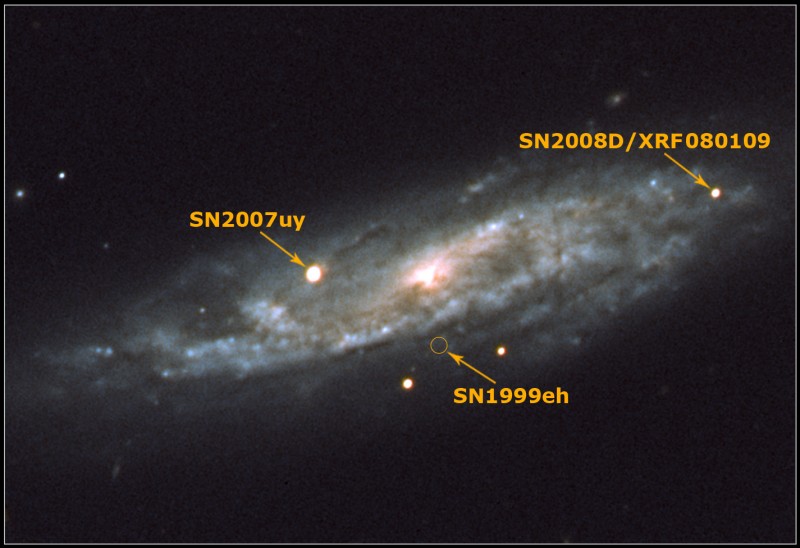
Supernovae are fascinating to researchers because in the destruction of their progenitor and in their own creation, all the elements in the universe are produced and injected into galaxies. Two Princeton University astronomers using NASA's Swift satellite became the first to catch a Supernova (SN 2008D) in the act of exploding. This once-in-a-lifetime event has transfixed the worldwide astronomical community because the Supernova was captured as the initial X-rays exploded and just before the optical light was visible.
Comments:
I enjoy astronomy, but I am a rank amateur. I see these pictures of SN's blooming out to what looks like 300 light years diameter when - in fact - the real time effect would be more like seeing a tiny bright pinpoint against a backdrop (host galaxy)that is so faint that is more like a visual appearance.<br><br>Our eyes and ccds just don't do justice to these kinds of images. I guess there is a certain point where the only way to convey image brightness is through size rather than intensity.<br><br>I would like to see it as it really is. Imagine a swirl of salt on a black background in a very dimly lit all black room with a .05mm high intensity LED representing the SN.<br><br>Perhaps concentrated image intensity - which is typically conveyed through image bloom can find a better (more accurate) medium for representation.
