
Sooner or Later it was Bound to Happen -- Two Satellites Collide in Space
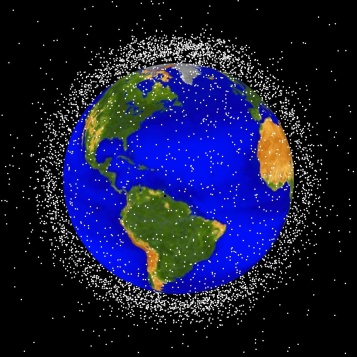
This week Iridium, a provider of mobile satellite service with coverage over the entire globe, lost an operational satellite when it collided with a defunct Russian military satellite. It is believed that this is the first time that two satellites have collided in orbit. With roughly 17,000 pieces of manmade debris orbiting Earth, orbital debris is now the biggest threat to a space shuttle in flight, surpassing the dangers of liftoff and return to Earth.
According to information shared with the company by various U.S. government organizations that monitor satellites and other space objects (such as debris), it appears that the satellite loss is the result of a collision with a non-operational 2,094 lb Russian Kosmos 2251 military satellite that had been launched in 1993 and ceased functioning two years later. The Iridium satelite weighed 1,234 lbs and was launched in 1997.
The Iridium constellation of low-earth orbiting (LEO), cross-linked satellites provides critical voice and data services for areas not served by terrestrial communication networks. Iridium operates the largest commercial satellite constellation in the world with a fully meshed in–orbit network comprised of 66 satellites plus in-orbit spares. While this is an extremely unusual, very low-probability event, the Iridium constellation is uniquely designed to withstand such an event.
The event had minimal impact on Iridium’s service and the company took immediate action to address the loss. In terms of the impact to Iridium’s customers, this satellite loss may result in very limited service disruption in the form of brief, occasional outages. Within the next 30 days, Iridium expects to move one of its in-orbit spare satellites into the network constellation to permanently replace the lost satellite.
"We believe it's the first time that two satellites have collided in orbit," said Air Force Colonel Les Kodlick of the U.S. Strategic Command.
"We knew this was going to happen eventually," said Mark Matney, an orbital debris scientist at Johnson Space Center in Houston. "The collisions are going to be becoming more and more important in the coming decades," Matney said.
For more information:
http://iridium.mediaroom.com/index.php?s=43&item=885
http://www.nytimes.com/reuters/2009/02/11/world/international-us-space-collision.html?_r=2
http://www.washingtonpost.com/wp-dyn/content/article/2009/02/11/AR2009021103387.html
http://online.wsj.com/article/SB123438921888374497.html?mod=dist_smartbrief
http://apnews.myway.com/article/20090211/D969MCSO0.html
Astromart News Archive:
http://www.astromart.com/news/search.asp?search=.+&search_btn=Go
Funding Member
