
Sooner or Later it was Bound to Happen -- Two Satellites Collide in Space
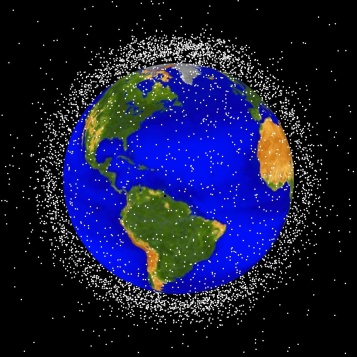
This week Iridium, a provider of mobile satellite service with coverage over the entire globe, lost an operational satellite when it collided with a defunct Russian military satellite. This is believed to be the first time that two satellites have collided in orbit. With roughly 17,000 pieces of manmade debris orbiting Earth, orbital debris is now the biggest threat to a space shuttle in flight, surpassing the dangers of liftoff and return to Earth.
Comments:
I can just see it now; Russian lawyers and US lawyers, in satellite traffic court, arguing over whose fault it was.
I am sure Thomas Holst is a nice person, but he is trying to make a mockery out of satellite court a $200,000,000,000 organization jointly developed between the US, Russia, China, and France to provide legal recourse if this ever happened. More on this later...
Comedy aspects aside, the old Sci-Fi TV shows "Quark" and "Salvage One" touched on this issue years ago but has anything been seriously proposed regarding clean-up of orbiting debris?<br><br>Scoops, nets, drag inducing gas clouds, high mass spacecraft to nudge objects out of orbit, etc... What is actually possible?<br><br>-Guy
That is one of my concerns also but who or what, short of Superman, could collect bits of trash traveling in different directions, much faster than a speeding bullet?
While space is getting filled, it seems that it is being painted the same as rush hour on the Tappan Zee Bridge. The area of just the United States is 3.5 million square miles. If you distributed 1 car evenly around it, that's one car in every 205 sq miles, or a square 14 miles on a side. Of course the surface area of the earth is much more at 200 million square miles, or one car in every 12,000 sq miles or a square 108 miles on a side. The collision took place at an altitude of roughly 450 miles. Add that to the earth's radius of 4000 miles and you have a sphere of surface area 240 million sq miles. This does not account for differences in altitude.<br><br>OK, so the debris is in lanes. At 450 miles altitude, a single line is 28,000 miles long. 17,000 cars would be 1.6 miles apart. Now that's beginning to get close, but of course everything is not in the same lane nor the same altitude. <br><br>I wish our state parks or interstates had one piece of trash every 1.6 miles. Every 108 miles would be positively pristine.
Funding Member
