Spacecraft Flyby Anomalies Continue to Confound Scientists
When space probes, such as Rosetta and Cassini, fly over certain planets and moons in order to gain momentum and travel long distances, their speed changes slightly for an unknown reason. A Spanish researcher has now analyzed whether or not a hypothetical Gravito-Magnetic field could have an influence. However, other factors such as solar radiation, tides, or even relativistic effects or dark matter could be behind this mystery.
Since the beginnings of space exploration, many spacecrafts have gone into a hyperbolic orbit around planets or moons, with the aim of taking advantage of their gravitational energy and go towards their target. However, during this flyby maneuver, something makes the scientists' theoretical calculations not meet and the speed of the probes deviates from that expected.
This anomaly has only been detected with a high level of precision in flybys of Earth, due to the availability of monitoring stations such as that of NASA in Robledo de Chabela near Madrid or that of the European Space Agency in Cebreros near Avila, which allow for the variations in the spacecraft speeds to be recorded by means of radars.
Thus, when the Galileo space probe flew over Earth in 1990, an unexpected increase of 4 millimeters per second was detected, as was a similar decrease when it took the same flyby in 1992. Also in 1998, a speed of 13 millimeters per second above estimates was observed in the spacecraft NEAR, and similar anomalies were repeated in the flybys of Cassini in 1999 (minus 2 millimeters per second), and those of the Messenger and Rosetta probes in 2005, with plus 0.02 and plus 1.82 millimeters per second respectively.
"These deviations do not seriously affect the trajectories of the spacecrafts, yet although they are seemingly small amounts, it is very important to clarify what they are caused by, especially in the current era of precise space exploration," Luis Acedo Rodriguez, physicist at the Polytechnic University of Valencia.
Scientists have still not found any convincing explanation for the phenomenon, although they have put forward a range of hypotheses. One points towards solar radiation being the cause of the change in speed, while others suggest an influence from magnetic fields or the effect of tides, and there are also even unconventional theories, such as the existence of a halo of dark matter trapped by Earth's gravitational pull.
Acedo has proposed an explanation based on a supposed circulating Gravito-Magnetic field, which would follow the Earth's parallels, an approach that can be used to explain the effects on the majority of flybys. "Einstein's general theory of relativity predicts the existence of a similar field, but in the case of meridians, with this strongly confirmed by experiments such as Gravity Probe B," the researcher comments, although he recognises significant limitations of the model.
"If a force field existed," he explains, "its effects would also be seen in the elliptical orbits of spacecrafts, and should have been detected a long time ago by geodynamic satellites such as LAGEOS or LARES. However, this is not the case, and it is therefore doubtful that a field of this kind could cast a light on this mystery without seriously changing our understanding of Earth's gravity."
With this possibility ruled out, the expert considers that the anomalous behaviour of the probes during their flybys "must originate in something that, although common, we have been unaware of to date, or in an error in the data analysis programs."
The difference in speeds could also have much more serious implications on the understanding of gravity, according to Acedo. "We already have evidence that shows a seemingly small anomaly in astronomical observations leading to new theoretical conceptions, such as the advance of Mercury's perihelion (closest point to the Sun), which was essential in the development of the theory on general relativity. For the case in question, and without ruling out an explanation by means of conventional sources, something similar could occur."
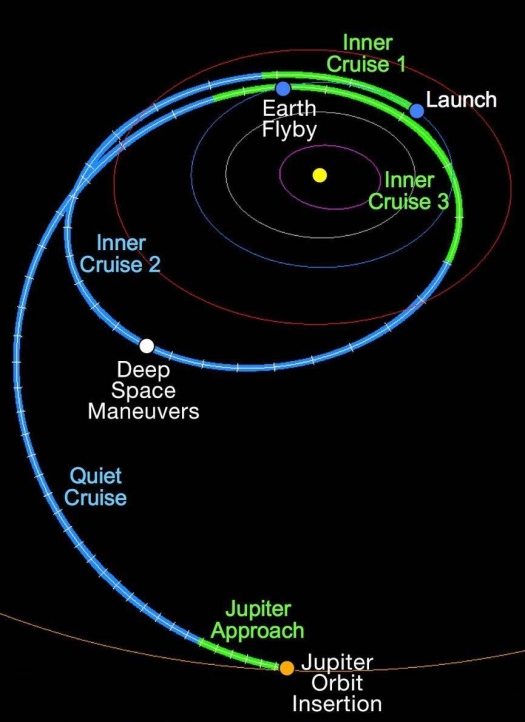
Meanwhile, space probes continue to challenge scientists every time they perform a flyby. One of the last was that of the spacecraft Juno in October 2013, from Earth en route to Jupiter. NASA has not yet published data on this journey, but everything indicates that its speed as it flew over our planet was once again different to estimates.
For more information:
http://www.agenciasinc.es/en/News/An-anomaly-in-satellites-flybys-confounds-scientists
http://www.astromart.com/news/news.asp?news_id=859
http://www.astromart.com/news/news.asp?news_id=990
http://www.astromart.com/news/news.asp?news_id=1043
http://www.astromart.com/news/news.asp?news_id=947
http://www.astromart.com/news/news.asp?news_id=667
AstroMart News Archive:
http://www.astromart.com/news/search.asp?search=.+
Funding Member
