Spacecraft Flyby Anomalies Continue to Confound Scientists
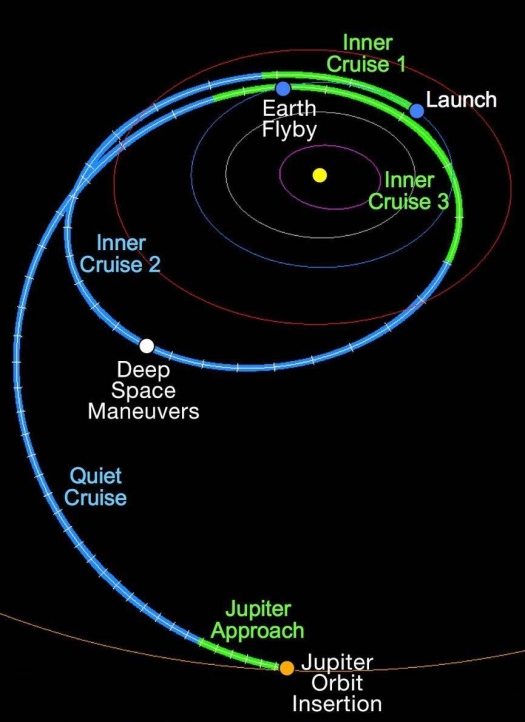
When space probes, such as Rosetta and Cassini, fly over certain planets and moons in order to gain momentum and travel long distances, their speed changes slightly for an unknown reason. A Spanish researcher has now analyzed whether or not a hypothetical Gravito-Magnetic field could have an influence. However, other factors such as solar radiation, tides, or even relativistic effects or dark matter could be behind this mystery. The observed difference in speeds could have serious implications on our understanding of gravity.
Comments:
I would be interested in knowing the positions of Jupiter during these events. <br><br>Quote "<i>when the Galileo space probe flew over Earth in 1990, an unexpected increase of 4 millimeters per second was detected, as was a similar decrease when it took the same flyby in 1992</i>" <br><br>This inconsistency suggest suggest a variable that is not constant such as the non-synchronous orbit of a large mass. I would postulate that if the maneuver were exiting into into Jupiter's gravitational field which does reach earth it might produce an acceleration just as attempting to pull away could produce the opposite effect. <br><br>Sadly my math skills are not up to this task <img class='' src='http://new.astromart.com/astromart/javascripts/sceditor/emoticons/wink.png' alt='wink' title='wink'/> <br><br>
John:<br><br>You make an excellent point -- the gravitational force due to Jupiter's position at any given time should have a variable effect on the velocity of a spacecraft performing a slingshot maneuver around Earth.<br><br>To take your thought one step further, the position of the Moon at any given time should also be taken into consideration for slingshots around the Earth.<br><br>Also, the position of the Sun should be factored-in. Although the Earth's orbit around the Sun is nearly circular, in reality it is an ellipse with a perihelion (shortest distance) of 91,500,000 miles and an aphelion (farthest distance) of 94,500,000 miles. The difference is only slightly more than 3 percent.<br><br>It may not sound like much, but that 3 percent difference leads to a 7 percent difference in solar radiation reaching Earth from one end of the orbit to the other. So, one would think that a 3 percent difference would also have some effect on the gravitational pull and on the exit velocity of a spacecraft -- especially when we are measuring velocity in fractions of a millimeter per second.<br><br>It would be interesting to find out if these factors were considered in the calculations. The folks doing this work are extremely smart, so my guess is that Yes, these factors were considered and the anomalies still show up -- But you never know.<br><br>Guy Pirro<br><br><br><br><blockquote class="blockquote"><div class="italic"><i>John A. Maher said:</i><br><br>I would be interested in knowing the positions of Jupiter during these events. <br><br>Quote "<i>when the Galileo space probe flew over Earth in 1990, an unexpected increase of 4 millimeters per second was detected, as was a similar decrease when it took the same flyby in 1992</i>" <br><br>This inconsistency suggest suggest a variable that is not constant such as the non-synchronous orbit of a large mass. I would postulate that if the maneuver were exiting into into Jupiter's gravitational field which does reach earth it might produce an acceleration just as attempting to pull away could produce the opposite effect. <br><br>Sadly my math skills are not up to this task <img class='' src='http://new.astromart.com/astromart/javascripts/sceditor/emoticons/wink.png' alt='wink' title='wink'/> <br><br> </div></blockquote>
Funding Member
