Two Exiled Stars Are Leaving Our Galaxy Forever
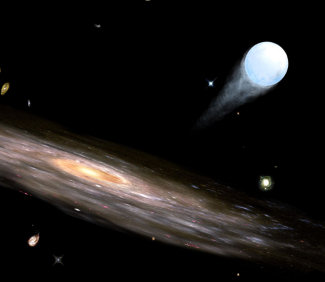
Cambridge, MA - TV reality show contestants aren't the only ones under threat of exile. Astronomers using the MMT Observatory in Arizona have discovered two stars exiled from the Milky Way galaxy. Those stars are racing out of the Galaxy at speeds of more than 1 million miles per hour - so fast that they will never return. <b>NOTE: French, German, Italian, and Spanish translations follow...</b>
Comments:
were heading toward M31 at about 1.4 million miles per hour,<br>how many years would it take to get there?<br><br>My very rough calculations suggest around 500 years, which<br>seems like a blink of an eye in terms of cosmic time.<br>But I could be off by one or two zeros. <img class='' src='http://new.astromart.com/astromart/javascripts/sceditor/emoticons/smile.png' alt='smile' title='smile'/><br>
Good question. This is off the top of my head, so if anybody knows the correct numbers, please correct me. I think we are only closing in on M31 at a speed of about 100km/sec. (this is the speed the Galaxies are closing in on each other, not the speed that Earth is closing in on M31—there is a difference because we are going round and round, and at the moment Earth is moving towards M31 at a faster rate than this).<br><br>I believe I just read that M31 is 2.52 (+/- .14) million light years away. Supposedly the best guestimate yet. <br><br>Light moves at 300,000kps and would take roughly 2.5 million years to reach there. So if we are closing this distance at 100kps we need take the equation<br><br>300,000kps = 2,500,000 years and change it to 100kps = ?<br><br>Since we need to divide 300,000 by 3000 to =100, we multiply 2,500,000 by 3000 to balance<br><br>This comes out to 100kps = 7,500,000,000 years<br><br>So we actually have 7.5 billion years before then. So, in reality we are talking about more than half the supposed current age of the universe. However, since we don't see anything ending in the next gazillion years, it is still relatively a blink of an eye on the timeline as a whole. Then again, so is our universe.<br>
Funding Member
