UK Scientists Believe That Life is Continuously Entering Earth's Atmosphere From Space
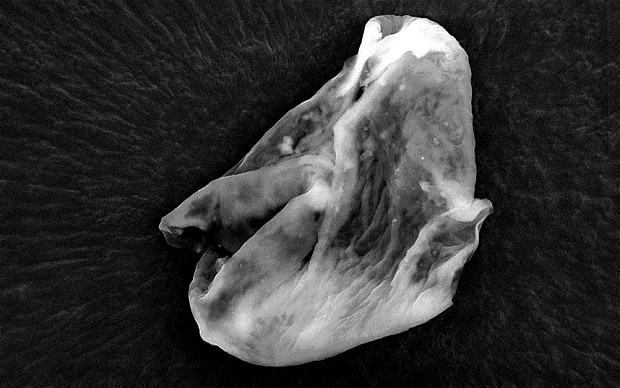
By using a balloon that was sent up into the stratosphere, scientists from the University of Sheffield in the UK believe they have found microscopic alien life forms that have arrived to Earth from space.
The team, led by Professor Milton Wainwright, from the University's Department of Molecular Biology and Biotechnology found small organisms that could have come from space after sending a specially designed balloon to 27km into the stratosphere during the recent Perseid meteor shower.
Professor Wainwright said "Most people will assume that these biological particles must have just drifted up to the stratosphere from Earth, but it is generally accepted that a particle of the size found cannot be lifted from Earth to heights of, for example, 27km. The only known exception is by a violent volcanic eruption, none of which occurred within three years of the sampling trip.
"In the absence of a mechanism by which large particles like these can be transported to the stratosphere we can only conclude that the biological entities originated from space. Our conclusion then is that life is continually arriving to Earth from space, life is not restricted to this planet and it almost certainly did not originate here."
Professor Wainwright said the results could be revolutionary. "If life does continue to arrive from space then we have to completely change our view of biology and evolution," he added. "New textbooks will have to be written."
The balloon, designed by Chris Rose and Alex Baker from the University of Sheffield's Leonardo Centre for Tribology, was launched near Chester and carried microscope studs which were only exposed to the atmosphere when the balloon reached heights of between 22 and 27km. The balloon landed safely and intact near Wakefield. The scientists then discovered that they had captured a diatom fragment and some unusual biological entities from the stratosphere, all of which are too large to have come from Earth.
Professor Wainwright said stringent precautions had been taken against the possibility of contamination during sampling and processing, and said the group was confident that the biological organisms could only have come from the stratosphere.
The group's findings have been published in the Journal of Cosmology. Professor Chandra Wickramasinghe of the Buckingham, University Centre for Astrobiology (of which Professor Wainwright is an Honorary Fellow) also gave a presentation of the group's findings at a meeting of astronomers and astrobiologists in San Diego last month.
Professor Wainwright's team is hoping to extend and confirm their results by carrying out the test again in October to coincide with the upcoming Haley's Comet-associated meteorite shower when there will be large amounts of cosmic dust. It is hoped that more new, or unusual, organisms will be found.
Professor Wainwright added "Of course it will be argued that there must be an, as yet, unknown mechanism for transferring large particles from Earth to the high stratosphere, but we stand by our conclusions. The absolutely crucial experiment will come when we do what is called "isotope fractionation." We will take some of the samples which we have isolated from the stratosphere and introduce them into a complex machine. A button will be pressed. If the ratio of certain isotopes gives one number then our organisms are from Earth, if it gives another, then they are from space. The tension will obviously be almost impossible to live with!"
For more information:
http://www.sheffield.ac.uk/news/nr/scientists-find-life-coming-to-earth-from-space-1.309972
AstroMart News Archive:
http://www.astromart.com/news/search.asp?search=.+
Funding Member
