
Worlds Darkest Man Made Material Approaches Ultimate limit
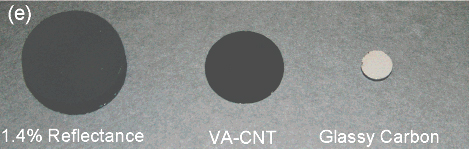
Materials Engineer Research Scientists report in the latest Journal of Nano Letters (Yang Z, Ci L, Bur JA, Lin S, and Ajayan PM "Extremely Dark Material Made By a Low-Density Nanotube Array", Nano Letters, 10.1021/Nl072369t (1/9/2008) that they have produced a surface of low density carbon nanotubes with varying lengths and tube diameters. This surface is both smooth on a macroscopic scale and irregular on a microscopic scale, with very deep pits that are vertical to the surface of the material.
The theoretical aspects of light absorbing material is directly related to its reflectance. The idea of a black body cavity was introduced over a century ago and both Kirchhoff’s law and Planck’s radiation law apply. The construction of a perfect black body absorbing surface has not been approached by black paint or by graphite surfaces which reflect about 5 to 10% of light at the air/surface interface. This is due to the inability to make a substance whose index of refraction is near 1.0 at the macroscopic length scale.
Advances in construction of nanotubes of varying length and density has now allowed these researchers to construct a low density forest of nanotubes with varying heights and diameters all aligned vertically, but with tips that are randomly bent near their tops. This provides a dramatic macroscopic optical property. The index of refraction is 1.026 and the total reflection is 0.045%, over a measured wavelength range from 450 to 650nm and for angles of incidence of -60 to +60 degrees.
Attempts to measure the total transmission intensity for this surface actually failed. “We have attempted to measure the transmission intensity for our nanotube array. However, the transmittance is so low that the detected signal is below the noise level or our detector…. A near perfect absorption of A=1-R-T is approximately 99.95%...” These measurements were done by pointing laser light beams at these films, and still they could not easily measure reflectance above noise! This is occurring in a film that is only about 300 microns thick. In fact the light absorbance is measured to be occurring in the outermost 8.3 microns of the film.
The previously claimed lowest reflectance material has a total reflectance of 0.16 to 0.18%, so that the authors claim that their results, at three time’s lower reflectance, make “our nanotube array the darkest man-made material ever.”
While the authors conclude that the material may have applications ranging from solar energy conversion to piezoelectric detectors, it is noteworthy that some of the authors are also members of the department of Applied Physics and Astronomy at RPI. Is it possible that they may yet consider this as an ultimate flocking paper for optical assemblies? The article neither mentions the sizes of these surfaces, nor the theoretical cost of manufacturing a quantity of this material. It does mention that these films are manufactured on a substrate and then can be “peeled off to get self standing films.” A new future for telescope tubes that don't require other kinds of light baffles may become possible if this material becomes available.
