
Worlds Darkest Man Made Material Approaches Ultimate limit
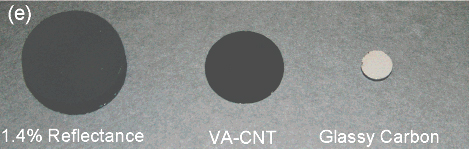
Materials Engineer Research Scientists at Rensselaer Polytechnic Report the manufactor of the World record for darkest man made material ever.
Comments:
If the low reflectivities are from -60 to +60 incidence angles would the same low reflectivities be in effect for the extremely low incidence angles on the inside of a telescope tube?<br><br>Keith
I am not the paper's author. It is copyrighted by the American Chemical Society, so I cannot transmit the whole article to you. Try getting a copy and see for yourself where the data ends. If you cannot get it through an academic library or a public library through interlibrary loan, let me know and I will see if I can help. <br><br>The authors did not publish information that addresses your specific question. Their reflectance graphs are actually flatter than the other best materials, as the angle of incidence varied. I can extrapolate and suggest that these properties may extend in a nice way to low angles of incidence. The very low macroscopic index of refraction and the roughness (on a wavelength of light length scale) of this material are nearly ideal to suppress low angle reflection. The authors just did not publish data. This material is more than virtual (the authors really made this stuff), but I have no clue how close to a practical material they are. It may be fragile, or shed nano particles from the surface over time or (you fill in the problem) that may actually prevent it from ever being a real flocking material. Manufacturing carbon nanofibers has turned out to be a rather inexpensive and practical process, so it is not out of the question. The authors allude to how well controlled they are able to tailor properties in nanotube forest materials. So maybe....<br><br>Anyway I thought it was a very interesting publication.
Please accept my apology for a second reply. It occurred to me that the manufacturing process would actually allow a straightforward solution (or at least a major mitigation) to your question. Manufacturing the nanotube forest to slant at an angle would put the 120 degree angle of greatest absorption toward the tube opening. While that would require the final material to be applied in a directional manner within the tube, it would still be a very flat film and would solve much of the problem with low angle of incidence reflection, at least for the stray light that comes in from the open aperture. This angle of tilt could even be varied for different sections as you go from the front to the back of the tube, to adjust for the angle that needs to be blocked most to reduce stray light. It is this flexibility in manufacturing the material to get the properties you want that struck me when I first read the paper.
Funding Member
