World’s Largest Telescope Sees First Light
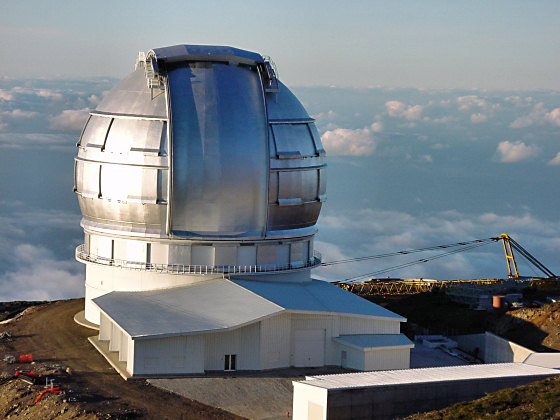
The world’s largest telescope took its first peek into the heavens this week. The Gran Telescopio Canarias, or GTC, under construction in Spain’s Canary Islands for the past seven years, held its “first light” opening ceremony on July 13, 2007.
The Observatorio del Teide (Tenerife) and Observatorio del Roque de los Muchachos (La Palma) are currently home to telescopes and other instruments belonging to 60 scientific institutions from 17 different countries. These observation facilities, together with the scientific and technological resources of the Instituto de Astrofísica at La Laguna (Tenerife) and Centro de Astrofísica en La Palma (CALP), make up the European Northern Observatory (ENO).
The roughly $175 million GTC is not yet complete. Only 12 of the 36 mirrors that together will compose its 34.1-foot primary mirror have been installed. The rest are expected to be mounted this year, with the telescope’s grand opening — to be presided over by King Juan Carlos I of Spain — set for next summer. Only after that date will scientific-quality observations begin.
Although not yet complete, enough of the mirror is assembled to allow telescope operators to make initial test runs. On July 13th, Prince Felipe, heir to the Spanish throne, trained the telescope on Polaris, the North Star, for a First Light ceremonial observation.
The University of Florida, the only US institution with a stake in the massive telescope, contributed $5 million to the project and owns a 5 percent share. “This is one of the largest international projects that the university is involved in,” said Stan Dermott, astronomy department chairman and one of four University of Florida astronomy faculty members who will attend Friday’s ceremony.
“This will be the first demonstration that the telescope can produce a focused image of a star,” Dermott said.
The Spanish government is the main owner of the GTC, with University of Florida and two institutes in Mexico as partners. As a result of its participation, UF astronomers will be allotted 20 nights of telescope time annually for observations. A UF-designed and built infrared imager and spectrometer, meanwhile, will be one of the first instruments mounted on the telescope when it opens for scientific observation next year.
“We are not just passive partners in this project,” Dermott said. “We are the world’s leader in developing astronomical instruments, and our instrument, CanariCam, will be one of the first instruments used on the GTC.”
Dermott said UF’s participation in the GTC effectively makes it one of a handful of institutions with guaranteed access to the world’s most powerful telescopes. That will open the door to a wide range of research.
”Already we are forming scientific teams that will involve other telescopes to take part in surveys of the distant universe,” he said. “For example, Rafael Guzman (a UF Astronomer) is leading a team that will investigate the origin of galaxies. In a sense, we have joined the club of big observers now.”
Funded in part by the Spanish government with a $6.5 million grant, Guzman’s team of 40 astronomers from the US, Spain, France and England is conducting a survey called GOYA, or Galaxy Origins and Young Assembly. Other UF astronomers are also participating or heading GTC-related projects.
For more information:
http://www.gtc.iac.es/home.html
http://www.iac.es/eno.php?lang=en
http://news.ufl.edu/2007/07/09/telescope/
Astromart News Archive:
http://www.astromart.com/news/search.asp?search=.+&search_btn=Go
Funding Member
