World’s Largest Telescope Sees First Light
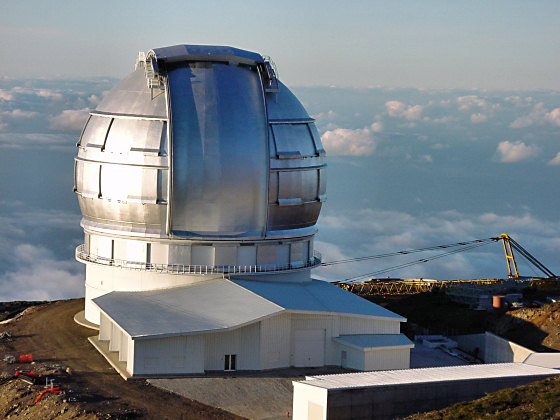
The world’s largest telescope, the Gran Telescopio Canarias (GTC), took its first peek into the heavens this week. GTC is a high performance, segmented, 10.4 meter optical-infrared telescope that has been built in one of the best astronomical sites in the Northern Hemisphere at La Palma in the Canary Islands. GTC is operated as part of the European Northern Observatory (ENO).
Comments:
Jim:<br><br>Good point.<br><br>It looks like each of the 36 independent mirrors that make up the Primary mirror of this telescope can be actively aligned in real-time.<br><br>The follwing link has some more info on this:<br><br>http://www.gtc.iac.es/home.html<br><br>Quote: "<u>Active alignment of segments:</u> <i>The axial position (piston and tip-tilt) of each segment can be corrected in real time by means of three positioners. In addition, the relative position between the segments will be measured by means of sensors in the adjacent edges between segments."</i><br><br>Also, <br><br>Quote: "<u>Active deformation of the segments:</u> <i>It will be possible to deform each segment automatically with 6 active degrees of freedom. This will allow partial correction of segment figure errors, which can arise in manufacture or due to thermal and dimensional instability of the optical and optomechanical components."</i><br><br>So it looks like at least the designers have built-in the ability to add an Adaptive Optics System to the telescope at a future date even if it is not available now.<br><br>Hope this helps,<br><br>Thanks,<br><br>Guy<br><br><br><br><blockquote class="blockquote"><div class="italic"><i>Jim Babcock said:</i><br><br>I read the article and all of the links. This sounds like, when finally completed, it is gong to be a great telescope. However, I did not see any mention of adaptive optics. As we all know, you can never have enough aperture. If you were going to build such a large telescope today, and spending this much money, why would you not implement adaptive optics? Am I missing something here?</div></blockquote>
Jim:<br><br>I have confirmed that an Adaptive Optics System will be deployed within a year of commissioning of the GTC telescope.<br><br>Following is an excerpt from a paper prepared for the International Society for Optical Engineering:<br><br>http://spiedl.aip.org/getabs/servlet/GetabsServlet?prog=normal&id=PSISDG005490000001000913000001&idtype=cvips&gifs=yes<br><br><br>"The 10m Gran Telescopio Canarias (GTC) is currently being installed in the Observatorio del Roque de los Muchachos (ORM) on the island of La Palma. <u>An adaptive optics (AO) system will be installed at one of the Nasmyth foci of the telescope within a year of the telescope being commissioned.</u> The system will initially be operated in single-conjugate mode using a natural guide star, but provisions are made for upgrade to dual-conjugate operation and the use of laser guide stars. The optical and mechanical design of the main system is planned to employ a piezo-stack deformable mirror having approximately 350 actuators and a Shack-Hartmann wavefront sensor. The tip-tilt correction will be provided by the secondary mirror of the GTC which is a lightweighted Beryllium mirror with a drive system capable of fast tip-tilt and chopping."<br><br><br>Thanks,<br><br>Guy<br><br><br><blockquote class="blockquote"><div class="italic"><i>Guy Pirro said:</i><br><br>Jim:<br><br>Good point.<br><br>It looks like each of the 36 independent mirrors that make up the Primary mirror of this telescope can be actively aligned in real-time.<br><br>The follwing link has some more info on this:<br><br>http://www.gtc.iac.es/home.html<br><br>Quote: "<u>Active alignment of segments:</u> <i>The axial position (piston and tip-tilt) of each segment can be corrected in real time by means of three positioners. In addition, the relative position between the segments will be measured by means of sensors in the adjacent edges between segments."</i><br><br>Also, <br><br>Quote: "<u>Active deformation of the segments:</u> <i>It will be possible to deform each segment automatically with 6 active degrees of freedom. This will allow partial correction of segment figure errors, which can arise in manufacture or due to thermal and dimensional instability of the optical and optomechanical components."</i><br><br>So it looks like at least the designers have built-in the ability to add an Adaptive Optics System to the telescope at a future date even if it is not available now.<br><br>Hope this helps,<br><br>Thanks,<br><br>Guy<br><br><br><br><blockquote class="blockquote"><div class="italic"><i>Jim Babcock said:</i><br><br>I read the article and all of the links. This sounds like, when finally completed, it is gong to be a great telescope. However, I did not see any mention of adaptive optics. As we all know, you can never have enough aperture. If you were going to build such a large telescope today, and spending this much money, why would you not implement adaptive optics? Am I missing something here?</div></blockquote></div></blockquote>
Hello:<br> Although AO is great (I was using it on Keck a few nights ago), its use is strongly limited to cases where you have a guide star and are interested in a small field. In my case, the field of view of the instrument was 10". Yup, that's it. With the camera I used, Uranus would fill a good portion of the field of view! Many people are interested in wide field surveys, both imaging and spectroscopic. These projects cannot use AO and demand instrumentation well suited to wide field studies. Other people are interested in radial veocity planet hunting, which has its own instrumentation requirements. Since there is only such money available, and since instruments for large telescopes are VERY expensive, only a few can be built. In the case of the GTC, other instrumentation priorities may have come before AO. Also, the user community may not be so interested in narrow field high resolution observations. For example, Subaru telescope has a great AO system, but it's rarely used since the Japanese astronomical community isn't interested in or used to narrow field infrared observations. <br><br>Cheers<br>Mike Connelley
Wow! The University of Florida's ownership stake in this new telescope is further proof that Gainesville, Florida, is the center of the Universe. <img class='' src='http://new.astromart.com/astromart/javascripts/sceditor/emoticons/grin.png' alt='grin' title='grin'/> Football, Basketball, and now Astronomy... <img class='' src='http://new.astromart.com/astromart/javascripts/sceditor/emoticons/wink.png' alt='wink' title='wink'/>
Funding Member
