Image of the day

Captured by
Ralph Ford

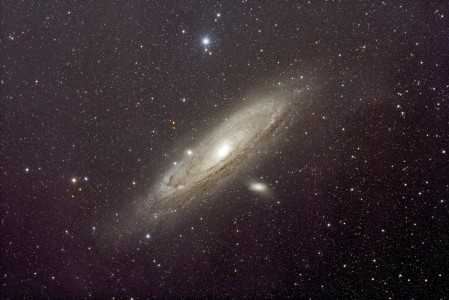
M31 with Redcat 51

My Account

New to Astromart?

Register an account...

Need Help?

Telescopes for School

Started by splathrop, 12/18/2002 02:47PM
Posted 12/18/2002 02:47PM Opening Post
I'm teaming up with a physics teacher at my local public high school to put together an observational astronomy supplement to the physics course. Questions: what scopes would best fit the needs of beginning students, offer a reasonable prospect of firing the imaginations of at least some of them, stand up to possible misuse, and not break the bank to buy? Portability and the scopes' ability to withstand repeated transport will also be an issue, because we will travel to find dark skies.

We will probably have to get donated funds to do this.

I am particularly keen to hear from people with the experience to compare the performance of any suggested scope to that of a 4-inch apo (Televue 102 in my case), which is the standard I'm used to.

My current thinking suggests a mix of Orion 8" dobs for deep sky, and Stellarview refractors for wide fields, and to ease initial difficulties with finding stuff, but I haven't used these. What can you see through them?

What other choices should I be thinking about?

What issues should I be considering that I haven't mentioned?

Any feedback?

Steve

Posted 12/18/2002 03:14PM #1
Steve:

What part of the country are you in? Perhaps a local organization can help you with this. In Dallas, TX, for example, there's a very active local group (Texas Astronomical Society) that helps with such activities.

I give local star parties (Garland, TX) the first Saturday of every month, and at times of special events (like eclipses and meteor showers). I usually set up an array of different telescopes at these. They include a Stellarvue AT1010 80mm refractor, a 6" Celestron CR150HD refractor, an 8" Celestron G8N f5 "cat" newtonian reflector and sometimes a range of "department store" scopes like an ST80 and a Meade Polaris 4.5" reflector.

This allows people to see for themselves what scopes of different types and sizes can do.

Binoculars should be among your cast, as well, because there are many objects that are far better in binoculars than in most scopes.

While I do not have a dob in my mix now, I will acquire one next year. People frequently bring them and they are wonderful scopes ... especially for DSOs.

As to comparisons with a TV 102, any of the 4" Stellarvues will be in the same range (a little color in the achromats, of course ... but not as much as you might think) but the Celestron 6" refractor will not be as sharp on bright objects or on planets unless well filtered. If you include a TV102 in your mix, then you'll have the best planet scope among those I've mentioned.

I'd heartily recommend either an AT1010 or an 85s or 78mm Blackhawk from Stellarvue for wide-field use. They will be ton sharper than a short-focus newt like the larger 8" G8N and a lot easier to transport and set up. The G8N is my favorite star party scope, however, because for its aperture it is very easy to transport and it maintains its collimation extremely well.

Email me at [email protected] if you have other questions or I can be of any other help. Also, check out my books list at the Yahoo! Group "astronomyforums" and let me know if there's a book on that list I could donate to your group.

There's also a downloadable PDF file I distribute at my star parties. You can download and copy that freely if it's of interest to you.

See the folder labeled StarGeezer (I post there as chipdatajeffb).

jb
Posted 12/18/2002 05:25PM #2
Hi Steve,

Congratulations on your efforts to set up the astronomy supplement to the physics course. As a satisfied Stellarvue owner (AT1010 and 102EDT), I'm happy to see your mention of Stellarvue as your initial choice for a wide-field refractor. I'm sure you won't be disappointed if you go that way. Rather than considering "best bang for the buck," I'd suggest letting the best value be the deciding factor, and the AT1010 certainly fills this bill. Does it gave APO images -- no, but very close, and certainly better than the typical Chinese imported achromat of the same aperture.

BTW, I agree with David on the alt-az mount. The students may easily tire of the hassles of an EQ mount. Either a UniStar light on a Bogen tripod or a Televue Telepod make a good match for the AT1010. While I prefer the UniStar Light, both are simple, lightweight, and easy to set up and dance around the skies. Whichever refractor you get, I'd recommend a red dot-type finder on the refractor and a Telrad or Rigel Quikfinder on the Dob rather than optical finders. As you probably know, these are much more intuitive, particularly for inexperienced viewers like the students.

Jim
Posted 12/18/2002 07:58PM #3
I think a couple pairs of Fujinon 16x70's, a complete set of Naglers and a couple C14's. Just kidding!!!!

I think the 6 to 8 inch dob is the best choice. The Orion XT6 or clone has received excellent planetary viewing reviews. And the XT8 or clone can give a little more umph for the DSO's.

Call Orion and ask if they can honor a volume or school discount. They'll probably do something. Free advertising for them when the students want to get a scope for home.

Good luck and glad to hear about your plans.

Clear skies,

Tim Hornbeck
Wellington, OH
Posted 12/19/2002 12:26AM #4
I have done stuff with schools and nothing beats an LX200 for 2 reasonst. With a line of kids with potentially low attentions spans the magic of star hopping is wasted - only one person gets the fun at the eyepiece and the rest have to wait. Once an object is located, having a drive and a sturdy tripod helps assure it remains their for all the eyes in line. With dobs you have to constantly recenter the scope plus it easily gets bumped requiring somebody the ability to find the object again.

The LX200 also allows you to do tours of different types of objects going from galaxies to globs to planets with a well thought ought educational curicullum to enhence the learning. You get a lot more viewing in a limited amount of time which is important if you want to "keep" people's attention.

Finally for groups I also recomment some kind of cheap astro video camera. For the moon and planets it allows group viewing and you can expain what is on screen to all. For elementary kids giving them the hand unit to drive the scope around makes them feal like they are exploring the moon.

You can probably get somebody on astromart to donate one if you ask - check into tax laws in Idaho you get a tax credit for donations to schools.
Posted 12/19/2002 02:04AM #5
Steve,

Get yourself at least one goto scope on a driven mount. A big ETX will do, although there are others. Optical quality is not critical. Put a one power viewer on it and use it as your "Finder Scope."

Get yourself as many six inch Dobs as you can find, maybe eight inchers if you have good skies. Make sure they have matching one power finders. Your students can use the goto scope to "find" the object, and then match their own one-power finders to wherever the goto is pointing. Much easier than using a star chart alone.

Alex
Posted 12/19/2002 03:11AM #6
I might suggest you think about what are the objectives of the class.
An old friend of mine teaches HS Astronomy and has done so for years. Like many others suggested, he has found that several decent 6 or 8 inch dobs are great work horses and supplements those with several Astroscans and binoculars. Budgets, portability,accessibility and durability are keys.
He learned his students love "hands on experience" and that simpler equipment in quantity makes that possible. He has one semester to do nothing but Astronomy and that is not much time.
He also realizes that he is not dealing with amateur astronomers ..so "good" equipment suffices ( quality decent enough to complete assignments) and yet it still creates excitement with rookie users who may think that Tasco is the only company that provides optical instruments.
Larry
Posted 12/19/2002 09:01AM #7
I would set some concrete goals before proceeding with the project. Since this is a class, maybe the equipment should be looked at like you'd look at football uniforms or something of that nature.

The goals I would set are at minimum the following.

1. One telescope per pair of students. This would include eyepiece sets, a mount and a chart.

2. The telescopes must have a fair chance of surviving ten years or more of use. This is an important goal, especially when it comes to acquiring funding.

3. The collection should be easily transportable.

Since you stated you are travelling to the dark sky site, I think refractors are your only option. I would shoot for a five inch refractor for each setup with a long and short FL eyepiece. A refractor also is very durable. The kids probably won't wreck it unless they knock the mount over. A dob has a delicate spider and a mirror that can break. Nose rings and things can fall down the tubes. They also need to be collimated which can cause stripped mirror cell holes, etc. A particle board mounted dob is close to the ground and would show wear sooner than a refractor. In ten years time with complete novices, everything will start going wrong with the dobs.

Mounts for the refractors could be obtained cheaply by the wood shop classes. Submit a blueprint for a simple alt-az mount, give the kids extra credit and they'd probably love to make them. They don't even have to look good. If one gets broken in the field just order another one from the shop teacher.

Tripods might be a problem. Maybe some piers could be made in metal shop with removable feet. There is a scrapyard around here that sells huge lengths of 3" stainless tubing by the pound. Again, they don't have to look that great. They just have to work.

The Orion Astroview 120 might be a good choice at F/5. It comes with two eyepieces. Or maybe something longer. You wouldn't need tube rings with this setup.

Also a couple of demonstrator scopes would be great like a larger dob and a SCT. Solar filters for daytime use might also be a good option. A couple of green laser pointers might help. Of couse a Ha solar filter would be awesome but you could blow your budget on that one alone!

Just a couple of ideas,
Mark Bernhardt
Posted 12/19/2002 05:37PM #8
Steve,

Don't know if anybody already mentioned this but a non-goto Dob requires some general knowledge of where to find things in the sky, not to mention the aspect of pointing them and keeping objects centered. Most beginners aren't going to know the sky that well and it may be frustrating for many to use this type of scope.

I suggest a good SCT with Goto. Maybe a Meade LX90 or Celestron Nexstar 8". They are fairly reasonably priced for what you are getting. This will allow very accurate pointing and keep objects centered for each student while they are viewing.

As far as refractors there a hundred you could choose for simple widefield views.

Paul Atkinson
AstroPro Products.com
Posted 12/19/2002 05:49PM #9
Steve,

This thread has been very interesting. I see lots of good notes on scope selection from an amateur astronomers' point of view that are very valid, but I notice we've had lots of solutions without a clear definition of the use case... which is putting the cart before the horse!

You mentioned this is a supplement to the Physics class. Realistically, how many kids will actually show up for each night? Realistically, how many will show up for more than half of the sessions in a series? Will it be 1 night a semester, 2 or 3, or 5-8? Few kids are going to free up more than 1 night a week, MAX... Since this is going on at night, it is going to have to be a purely optional attendence thing, right? The teacher/school cannot REQUIRE attendence after normal school hours. So out of 20 kids you may get 2-3 that are consistently showing for 6-7 out of 8 sessions? And most will drop out by the 3rd session? Is a count of 20 even realistic? Out of a 800 student high school I think our 1 night astronomy outing attracted 6 attendees?

The following is based on observation of College "supplements" in the technical arena ( astronomomy, electron microscope, etc ) and things like explorer scouts....

If it is really casual ( or a single night ), a couple slewing gotos regardless of quality/fov probably meets the Student's needs? If you have non-goto dobs/refractors/SCTs, you'll end up aligning them all yourself. And without tracking they'll lose objects continually. The kids want to SEE things, not hunt for things. If they are out in the field more than 2 hours, pat yourself on the back. And the aforementioned digital camera capability because it is VERY important that they have something to physically take away from the sessions.

If it is 2-3 nights casual, a couple slewing gotos for the "floaters" and a dob for the consistent students may be on order? They'll be tickled by a view of Saturn through anything.

If it is over 6-7 nights, structured, with regular attendence (frankly, little chance of that unless you are in an enviable and unique situation), a refractor for Dobs/brighter DSO where they can learn to navigate along with to aforementioned dob, and maybe a GOTO SCT to help them ( so they can slew it, use the red dot finder/telrad.. then go back to their own scopes to navigate? )

Most kids will not see the point of DSCs or star navigation when they know GOTOs exist. Seems like a total waste of time to 'em! Trying to force it down their throats is going to be more of a turn off to astronomy than a help.

Unless you have a large enough aperture and dark sky, Messiers that tickle you pink are downright boring to most kids who are used to Hubble photos.

Cheers and Best Wishes for your Endeavor!

Karl