Image of the day

Captured by
Michael Scherman

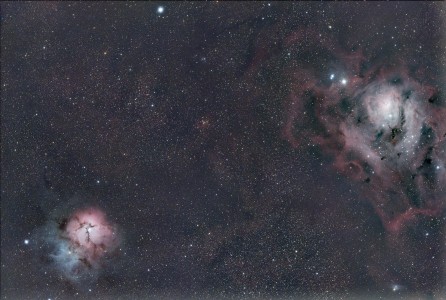
Lagoon and Triffid Celestron C6 Hyperstar4

My Account

New to Astromart?

Register an account...

Need Help?

visual observing "The Horsehead Neb."

Started by Midnight Sun, 06/08/2003 04:58AM
Posted 06/08/2003 04:58AM Opening Post
I would like to get into Deep Sky Observing. Someone told me the only way I could see the "Spiral Arms" on M-51 was to CCD image it. But that next Month I saw them (the arms) through a 25" Obsession Dob. at the Oregon Star Party ! So my question is; what is the best type ( SCT, Dob/Newt. Mac/Newt, Reflector, refractor... etc. etc.Scope and what size apeture?? without driving to Mt. WILSON or Palomar. I would love to view M-104 the "Sombrero Galaxy" and of course find the "Horsehead Neb." in Orion. When I place my Pan.22 into my TV 102 M-81 & 82 look like two dim frisbees, I have to use averted vision to make out the center of "The Ring" M-57. So using your experience Gentlemen as a "Skunkworks" maybe we can come up with a consensus of opinion..on what would be the right scope. This Aug. at the OSP I am going to attempt to look through every possible scope I can... thanks and good evening.
PS lately I have been observing our nearest Star with my Coronado SolarMax.. Great activity!! John M

Posted 06/08/2003 05:10AM #1
You'll need something bigger than a 10" reflector to see the Horsehead. I spent over an hour last winter with a really dark sky and a fair amount of imagination trying to see it, and I couldn't manage it.

How much are you willing to spend?
Posted 06/08/2003 05:21AM #2
And very well you should, John. DSO is very rewarding, fun, even thrilling when chasing down objects at the limit of your telescopes. Besides, the planets aren't always there :-(.

As you now know, you were told incorrectly about the only way to see M51 spiral arms is with CCD. I *instantaneous* saw it at a dark sky star party not two weeks ago through my host's sweatly Meade 10" LX200 - so obvious and stunning were the arms (haven't seen these yet through my TV-102 :-(). I also distastefully climbed the ladder :-( to the 16" Dobs and was rewarded with a better view! M104 through the 10" LX200 has the dark lane so clearly through it.

I don't know how dark your sky is. Here's a sketch of M51 from my TV-102 through my backyard.
http://members.cox.net/ronby/DSO-Sketches/M51-051803-inv2.jpg
I saw M51 later at 6000 ft dark sky and it was very noticeably better (I need to go back and do a sketch up there). I also need to work on my DSO sketching skills :-(.
Please note that the foreground star I saw is mag 13.5!

If you haven't gone out to the dark sky, please do - you'll be amazed at the difference. Even the so called most difficult Herschel 400 object NGC 6118 could not escape the 4-incher under dark skies! But aperture wins and wins so absolutely well under the dark skies!

Ron B[ee]
Posted 06/08/2003 05:45AM #3
Horsehead? This is one of my Light Cup's holy grail ;-), though we've failed every year from my backyard :-(. So I did a bit research. From my dossier, Walter Houston wrote he has glimpsed it with his 4" Clark refractor, and have detected with a 5" and 6" at low power. Jeff Medkeff has sighted it with his 4.5" reflector! Amazingly, Phil Harrington saw it through the 10x70 and 11x80 binos with H-Beta filter at WSP. I also saw a report of seeing it with a 4" TV Genesis without the H-Beta filter. Jay Freeman saw it at Fremont Peak with his 5" Meade ED refractor without filter. Other reports said it is quite easy with the 10" Newt. Dark sky is needed in all cases.

Ron B[ee]
Posted 06/08/2003 05:45AM #4
You don’t need a big scope to see spiral structure in m51. All you need is a really dark sky. I have seen spiral structure in that galaxy with both my 10" LX-200 and TV-85. Same thing goes for m104. The 10" of course throws up a much brighter image and one that is more detailed when it comes to DSO.
Posted 06/08/2003 07:11AM #5
Hi John -

I think you need at least an 8" and good, dark skies to be able to see the spiral arms well.

Also, try an orthoscopic instead of your Nagler - the fewer lens elements will help you to see M81/82 much easier in your TV102.

-Jake
Posted 06/08/2003 02:30PM #6
John,

As this thread goes along, you will see that dark skies are pretty important to seeing dim objects. One way they help is obvious--Whatever light there is has more contrast with the darker skies. However, it is important that your eyes are prepared to take advantage of those dark skies with good adaptation. This may or may not happen where where there are dark skies. Even in a dark sky site, I have often seen astronomers hurt their vision with ambient light (a nearby streetlight or houselight, or opening up their car door, or using a brighter than necessary red flashlight). In these cases, the skies themselves are dark--but they eyes cannot benefit fully. It takes 45 minutes for eyes to fully adapt, and even a red light can set this back some. SO--be very careful when you are going for the dimmest of objects.

Alex
Posted 06/08/2003 11:47PM #7
John,

I have the TV-102 as well.

Have you tried more power than you get from your Pan 22 on M81 & M82? When I use a 9mm Nagler T6, in good seeing but at sea level, I can see mottled structure in M82, and the dark lane that cuts across it, with averted vision. I get quick glimpses of one of the spiral arms in M81, also with averted vision only.

With the same EP, the dark lane in M104 is on the verge of being there in direct vision...sometimes after seeing it clearly in averted vision I can hold it for a second or so in direct vision.

I have been thinking with clear skies at altitude I would also be able to see spiral arms in M51. It looks like a round splotch with a donut around it from my sea level site. At 2200 feet in the Adirondacks last fall it looked like a round splotch, a donut, and some stuff in between, but not quite spiral arms.

Obviously, more aperture will make all this easier, but you can see a lot with your TV-102.

Steve
