Image of the day

Captured by
John Greenlee

Before and after

My Account

New to Astromart?

Register an account...

Need Help?

Seeking Enlightenment...

Started by dmathis, 10/25/2006 04:14PM
Posted 10/25/2006 04:14PM Opening Post
You know those questions that you'd really like to ask, but you're afraid that you'll look like an idiot if you do? Well, the time has come to possibly look like an idiot, or at least a little simple-minded.

Can someone explain to me (in layman's terms) what the differences are between Plossls, Kelners, Naglers, and the other common types of eyepieces? Also, what are the strengths and weaknesses of the types or when you'd use one over another?

And while I'm at it, could someone recommend a good eyepiece for DSO's that won't break the bank? I looked through what were evidently some great eyepieces at a star party last Saturday, but frankly the thought of spend hundreds of dollars on an eyepiece makes me a bit squeamish, especially when the price begins to approach the price that I paid for my whole setup.

FYI, I have a 25mm Sirius, a 12mm Vixen Lanthamum, and a 6mm Orion Expanse. I'm not sure what type of eyepieces these are, design-wise.

Thanks,

Dow

[COLOR="Green"]Nothing is foolproof to a sufficiently motivated fool.[/COLOR]
Posted 10/25/2006 04:18PM #1
Dow
There are some good EP options out there, but it would be important to know first what type of scope you observe with. Dob, Ref, Cas, ? And what size and focal length. Also indicate what type of DSOs you are interested in.

I Yam What I Yam!
Posted 10/25/2006 04:37PM #2
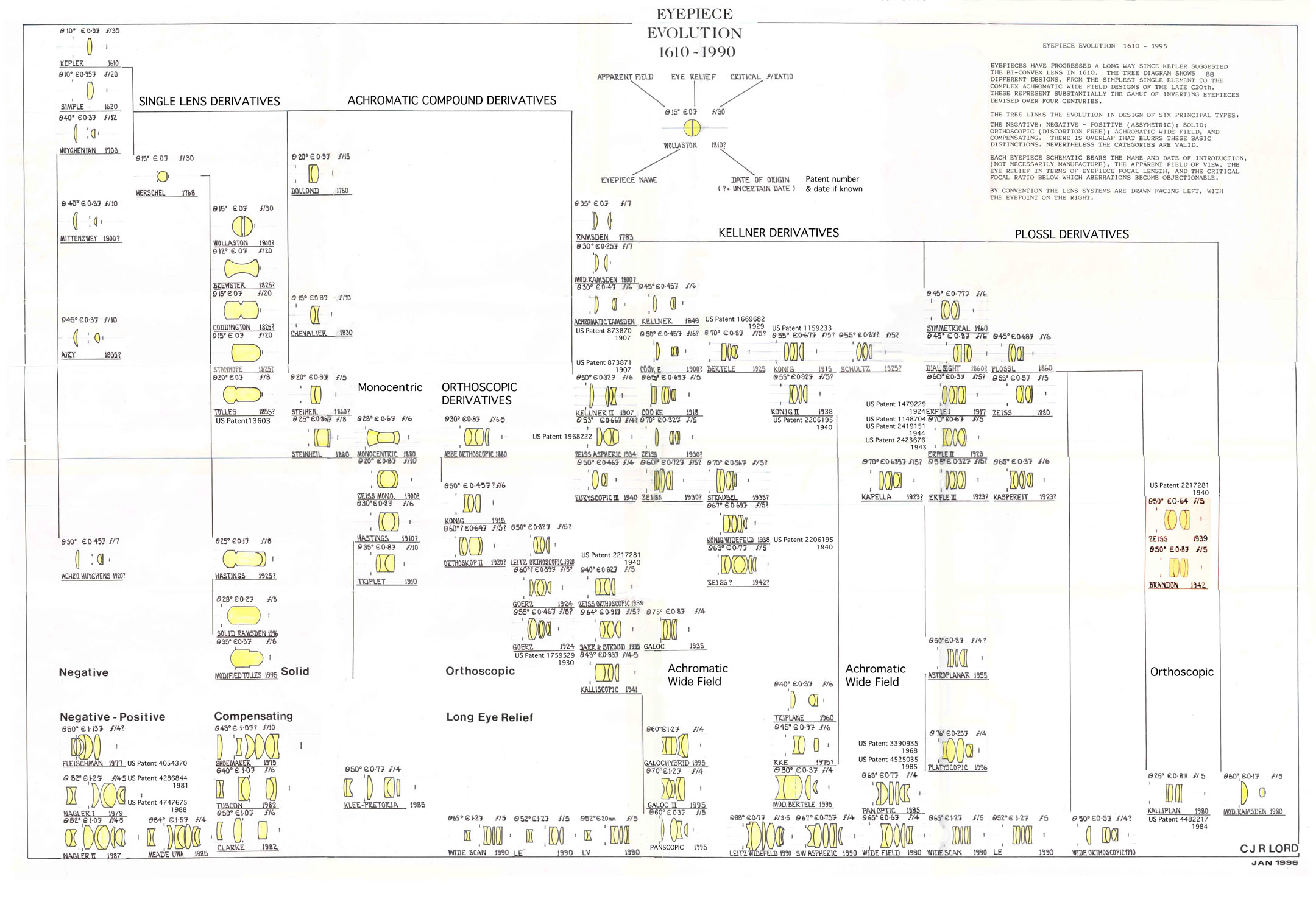
Take a look at this and see how they are were developed. I think it is pretty evident then as to what is what.

Attached Image:

fblue's attachment for post 108484

[SIZE="Large"][/SIZE][COLOR="Blue"][/COLOR] Floyd Blue grin
Amateur Imager
Posted 10/25/2006 05:40PM #3
I like Jim's assessment. Concise and to the point. Well done.
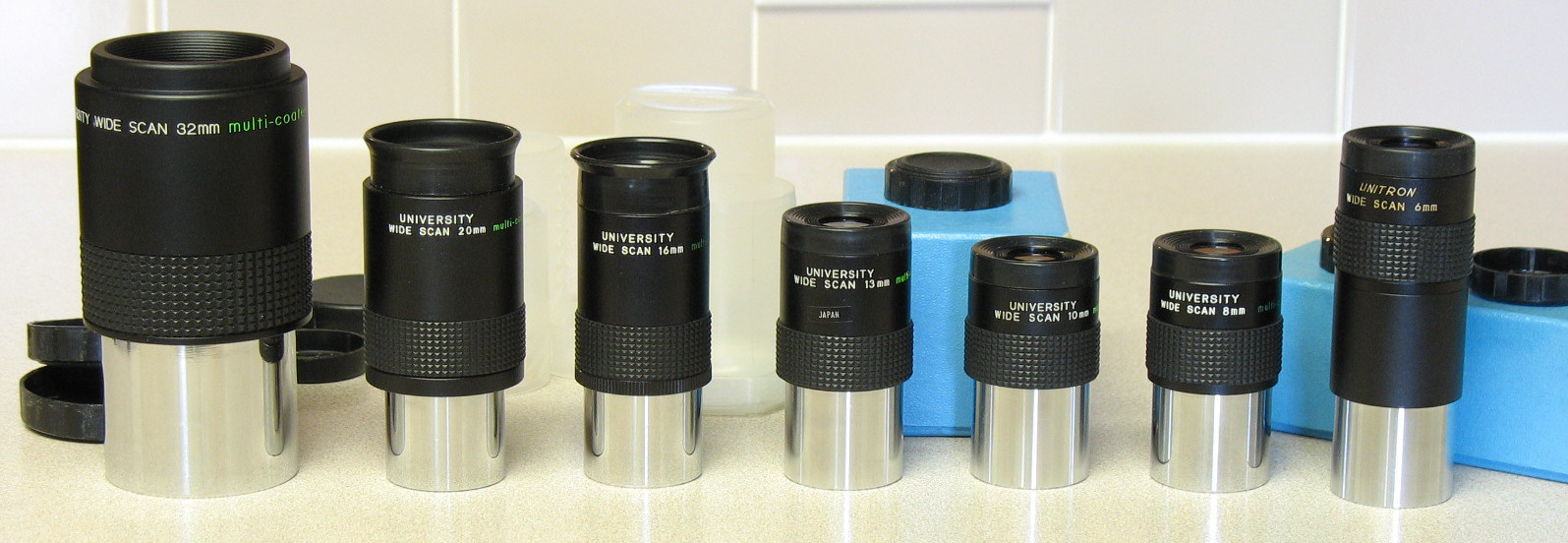
There are some older used eyepieces out there that may fit your budget and needs. Two come to mind which are the older TeleVue Wide Fields and the 'Wide Scan'.
The TV Wide Fields are the predecessor to the Nagler and work well. I see them on AstroMart at reasonable prices around $100.00+ in excellent condition. The Wide Scan is often referred to as the "Poor Man's Nagler". Personally I prefer the University Optics Wide Scans. I've haven't spent much time with the others like Unitron, but in a few brief comparisons they're close to the Univ. optics and more readily available. Seems like I see a lot of 13mm show up on AMart. (If you find a good Univ. Optics 8mm Wide Scan, I'll buy it or trade you for a 7mm TV Nagler. I need to complete my set.)
Good luck, hope you find something you're happy with.

Clear Skies, Bill

Attached Image:

wrose's attachment for post 108486
Posted 10/25/2006 05:59PM | Edited 10/25/2006 06:12PM #4

Can someone explain to me (in layman's terms) what the differences are between Plossls, Kelners, Naglers, and the other common types of eyepieces? Also, what are the strengths and weaknesses of the types or when you'd use one over another?

The different designs are a compromise between sharpness,
field of view, eye-relief, and cost. Other key factors are
the type and quality of the anti-reflection coatings on the lenses.

Eye-relief is how close you need to put your eye to
see the entire view. More is generaly better, but not always.

Plossl: 52 degree field, good sharpness in most scopes,
low cost.

Orthoscopic: 45 degree field, good sharpness in most scopes,
low cost.

Kelner: 40 degree field, good sharpness at F10 and higher
(not so good for your F5), very low cost.

Nagler: 80+ degree field, excellent sharpness, very high cost.


And while I'm at it, could someone recommend a good eyepiece for DSO's that won't break the bank? I looked through what were evidently some great eyepieces at a star party last Saturday, but frankly the thought of spend hundreds of dollars on an eyepiece makes me a bit squeamish, especially when the price begins to approach the price that I paid for my whole setup.

FYI, I have a 25mm Sirius, a 12mm Vixen Lanthamum, and a 6mm Orion Expanse. I'm not sure what type of eyepieces these are, design-wise.

The Sirius is a plossl.

The Lanthanum is specialize design with long eye-relief.
The field is about 50 or 55 degrees. The Expanse is similar
but the field is about 66 degrees.

For DSO in an F5 scope I might suggest something like the Orion
Stratus 13mm or Baader Hyperion 13mm. At $120 - $130 they wont
break the bank. 68 degrees and nice coatings. This design
uses a negative first element, which tend to work well in
scopes with lower F-numbers.
http://www.alpineastro.com/Eyepieces_Accessories/Eyepieces_Accessories.htm#hyperion

Up-scale from that would be something like the Nagler 13mm Type 6,
but at twice the price.

Posted 10/25/2006 05:59PM | Edited 10/25/2006 06:12PM #5
This is one of those times when I think it is necessary to start with a simplified answer. I'm going to emphasize just two concepts.

The first thing to consider is the Apparent Field of View (AFoV). The bigger the AFoV the more using it is like looking with the naked eye, the smaller the AFoV, the more it will be like looking through a narrow tube. I'm not talking about magnification here, or how much of the real sky you can see, just how the image comes across to the mind, how it feels to look.

The second thing to consider is how sharp the design is wherever you look in the field of view. Most eyepieces are about as sharp as possible in the center of the view, i.e. stars are pinpoint in the center, but stars near the edge are smeared.

So, some eyepieces have wider AFoVs than others, and some maintain sharpness better than others as you look farther from the center of the field. Not surprisingly, these two things tend to be connected in the sense that if the sharpness at the edge is good, the designer may increase the AFoV until it starts to deterioriate.

In terms of sharpness as you look away from the center, in increasing (improving) order we would have Kellners, then Plossls, then Naglers. The ranking happens to be the same for AFoV because the designers increased the AFoV to take advantage of the sharpness that their designs could provide farther away from the center of the field.

More advanced considerations would be to sort out the particular classification of unsharpness (aberration) at the edge of the field and issues like contrast. Generally speaking, eyepieces with more glass elements tend to achieve better sharpness at a given distance away from the center of the field, but it is thought that more air-to-glass interfaces scatter more light, which reduces contrast. It's a tradeoff, but I don't want to get into "contrast" because it's one of those things that we tend to treat very subjectively, and people will debate ad infinitum which of two eyepieces has greater contrast. Point is that there is a reason why we don't just pile a lot of glass into every eyepieces. Also, more glass elements tends to be more expensive.

A faster f-ratio in the telescope will reduce sharpness in a given eyepiece at the edge of field when compared to using the same eyepiece in a slower f-ratio. So, we tend to recommend more complex eyepieces for faster telescopes because they tend to have sharper edge performance. Simpler eyepiece designs (fewer elements), often perform poorly at fast f-ratios, such as your f/5 telescope. Many amateurs have observed that what might have been their favorite wide-angle DSO eyepiece in an f/10 telescope just isn't acceptable at f/5. However, because planetary observation normally requires only a very narrow AFoV with the planet in the center, people often choose simpler designs for that specific purpose even in faster scopes (because the edge of field sharpness is not important).

Like I said in the beginning, this is simplified, but understanding the AFoV and away-from-center (off-axis) sharpness issues is key. I debated whether to add eye relief to make it 3 things, but like magnification, it's a concept that people tend to grasp immediately when confronted with any pair of eyepieces with dramatically different eye relief. You don't seem to have any short eye relief in your collection, but when you get a chance, just look through a 12mm Plossl or a shorter focal length.
--
Mike
Posted 10/26/2006 12:15AM | Edited 10/26/2006 12:17AM #6
No one mentions Speers-Walers very often, but, for very good widefield views at an economical price, they are tops. 10 & 14 mm SW wide angles can be found on A-mart for less than $100 dollars. My recommendation: save the money and buy the 5-8 zoom - there are a lot more tiny DSOs than there are large ones. Most of the zooms I've seen have been priced less than $200. With your scope one would provide 80+ degree views from 127x to 204x with good contrast and better eye relief than plossls in that range. You'll be able to find and see a lot more planetary nebulas and galaxies with that than an EP in the mid teens,and it also works well as a planetary EP. Binoculars work better for the big DSOs.

One last note on SW and Antares - they are very easy to work with and will repair their EPs for very reasonable rates should that be needed.

Jim

Posted 10/26/2006 07:24PM #7
Dow Mathis said:

And while I'm at it, could someone recommend a good eyepiece for DSO's that won't break the bank?

Maybe a bit more pricy but I'll chime in with the Orion/Vixen Lanthanum super wides available used here on AMart from time to time for about $150. I have the 22mm and 8mm and they work well in my f4.7 dob, 65 degree apparant FOV, sharp to the edge and a nice flat field.

These were the EPs the Orion Stratus line was cloned from. I've never used a Stratus so I can't compare them. Has anyone else done a head to head test of them?
Posted 10/27/2006 05:35PM #8
<<...a good eyepiece for DSO's that won't break the bank?>>

===================

A mid priced 32mm plossl and a 9mm ortho.
Both often available here in the classifieds for very reasonable prices.