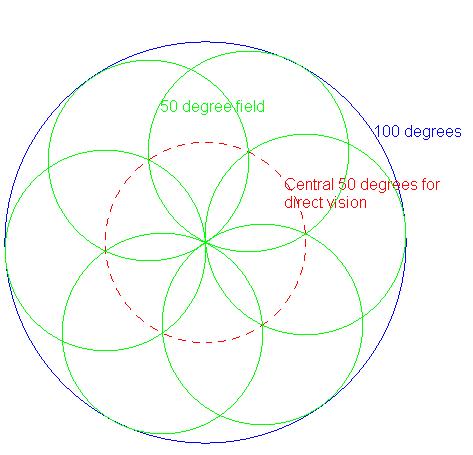

Given all the hype about 100 degree eyepieces eclipsing 82 degree models and dwarfing everything else, I've still have to ask: are they worth it?
Here's why: I've come to the conclusion, as at least one other amateur that I've read on a google search has, that there is no way you can take in and see a 100 degree field of view at once. There is no way you can take in and see a 82 degree field of view at once. You can look at a portion of these fields, such as the top, bottom, sides or center of the field of view but there is no way you can comprehend all of it at once. It is evident to me that about 70 degrees or so is near maximum of what you can reasonably see at once and comprehend what you're seeing. Even then, if you're looking for a small planetary or galaxy, you're still going to have to view portions of the field in order to realize what you've seen before you identify the object.
So I ask, are widefields really worth it?