I understand that a lower ratio = faster and is better for astrophotography, while a higher ratio = slower and is suppose to give better contrast. How much contrast would you give up going from a 150mm Skywatcher at f/8 versus f/6 for example? I really want to get a higher aperture but lighter weight refractor - yet I don't plan on any photography, mostly just planetary viewing - so it seems weight and contrast are going in opposite directions for me. I somewhere read that it's best to get a slower than f/6 for visual observing, yet I read about faster focal telescopes that the manufacturers say are great for observing... If I stay in the 110mm -127mm range for a refractor, any advice of focal ratios acceptable? Sorry to be so long-winded.
Focal ratio
Started by Dragonophile, 11/02/2007 01:56AM
Posted 11/02/2007 01:56AM
Opening Post
Posted 11/02/2007 11:50AM
#1

Jackie:
IF your primary interest is viewing the planets, then you do need to pay attention to focal ratio in these refractors. Affordable refractors are almost all achromats which means they have reasonable color correction but there will be definite color fringing ie chromatic aberrations.
This is because an achromatic objective does not focus all colors to the same point, the ends of the spectrum are defocused. To reduce this problem, filters can be used but it is only a partial solution. To fully correct the color one needs either an Apochromat which for a 6 inch would be on the other side of the $6000 or a reflective telescope, SCT, MAK or Newtonian.
The 6 inch F/8 will have significantly less false color than the 6 inch F/6,definitely and advantage for planetary viewing. But it is a big and rather heavy telescope, something you are aware of.
jon
Posted 11/04/2007 02:26AM
#4
I am speaking from my own personal experience only, but I do a lot of planetary viewing and I love my Celestron c4r/c102hd. Cheap "fast" scopes just don't do it for me! For under $1000, I would stick to an f/10. I'm convinced that owners of 5" and 6" f/8 achromats don't complain about all that color because they don't want to feel bad about all that money they just spent  you would have to spend a heck of a lot of money to get a fast scope that can handle that high of magnification and be steady enough to pick out details. For a telescope under $1000, the mount is almost more important than the optics, ESPECIALLY for planetary use! I had a 10" f/5 Dob before my little refractor and it almost drove me out of the hobby all together! I know you said you wanted a refractor, but again, for planetary use, I would keep an eye out for a used high quality 6"f10 newt on a decent GEM, No CA and a very comfortable viewing position. My 2 cents!
P.S. check out the C4R thread in the refractor group!
you would have to spend a heck of a lot of money to get a fast scope that can handle that high of magnification and be steady enough to pick out details. For a telescope under $1000, the mount is almost more important than the optics, ESPECIALLY for planetary use! I had a 10" f/5 Dob before my little refractor and it almost drove me out of the hobby all together! I know you said you wanted a refractor, but again, for planetary use, I would keep an eye out for a used high quality 6"f10 newt on a decent GEM, No CA and a very comfortable viewing position. My 2 cents!P.S. check out the C4R thread in the refractor group!
Sean Cunneen
ATM
8" f12 D&G Refractor among others
Posted 11/04/2007 06:22AM
#5

Jackie, if you mainly care to do planets then the focal length is everything; get the longest telescope that you can. At your given apertures you will need a scope with an f/ratio of 8 or more. This claim is true even at the upper ends of telescope making. Over several months last year I compared Astro-Physics 6 inch f/9 and f/12 telescopes on Jupiter, the Moon and Saturn, and the older f/12 was superior each time.
Mak-Cass, Mak-Newts and apochromatic (or at least achromatic) refractors are the cat's pajamas here. I don't recommend Dobs for this application, for while theoretically they are good for planets, they are hard to collimate to get images of the same resolution as are given by these other telescope types.
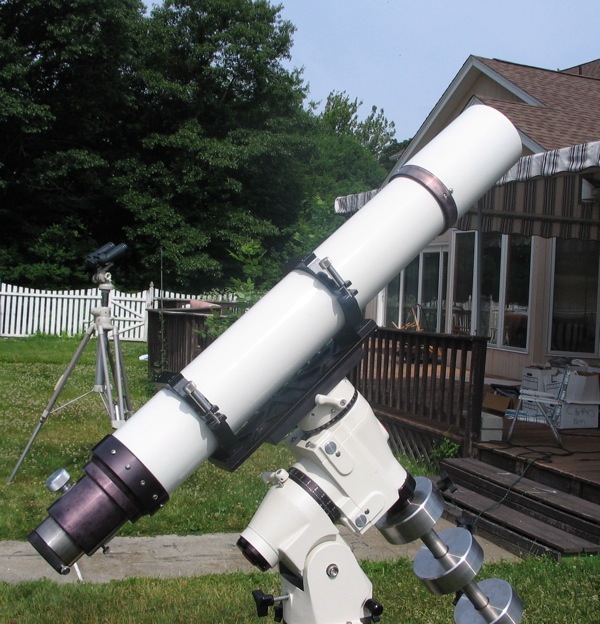
For less than $3k you can get yourself (used) a Questar 3.5, a TeleVue 102, a D&G 5 inch f/12 or an Astro-Physics Star 12 (see photo). You'll never fail on planetary observing with any of these.
Myself, I prefer the AP 6 inch f/12 for planets, but when it is too much trouble to get that puppy out, I am very happy with a 5 inch f/8.
Mak-Cass, Mak-Newts and apochromatic (or at least achromatic) refractors are the cat's pajamas here. I don't recommend Dobs for this application, for while theoretically they are good for planets, they are hard to collimate to get images of the same resolution as are given by these other telescope types.
For less than $3k you can get yourself (used) a Questar 3.5, a TeleVue 102, a D&G 5 inch f/12 or an Astro-Physics Star 12 (see photo). You'll never fail on planetary observing with any of these.
Myself, I prefer the AP 6 inch f/12 for planets, but when it is too much trouble to get that puppy out, I am very happy with a 5 inch f/8.
Attached Image:
Robert Howe
Wilbraham MA
TeleVue 85 f/7 // Astro-Physics Traveler 105 f/6 // Astro-Physics 130 f/8.35
Coronado 60 DS
"Scopes, Brains and Wisdom--but no Beauty"
Posted 11/04/2007 02:42PM
| Edited 11/04/2007 02:43PM
#6
I would like to see Al Nagler reprint some of his early discussions in the beautiful brochures he published for TeleVue equipment in the early days. Added to Rolando's, and the late Thomas Back's writings, we would have an excellent MODERN basic telescope education course second to none!
FWIW,
bill
FWIW,
bill
Funding Member
