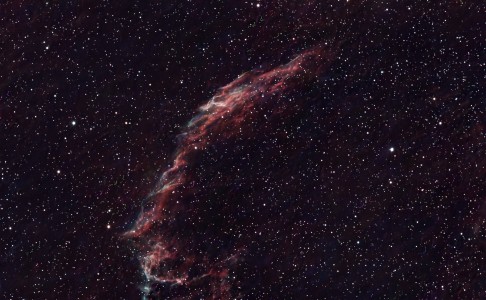
Image of the day

Captured by
GERALD KREITZBURG

Eastern Veil Nebula

My Account

New to Astromart?

Register an account...

Need Help?

Deep-sky observing under full moon

Started by JMG, 01/17/2003 07:35PM
Posted 01/17/2003 07:35PM Opening Post
Hi!

I think common sense would probably suggest to look for the brighter and (perhaps) the more compact objects, but did anyone knows if there exist on the web (or in print) some list(s) of deep sky objects observable at (or near) full moon? Any hints or particular observing techniques? I have a Orion Starmax127 (5'' f12) Maksutov-Cassegrain and a 10'' Dobsonian f4.7, OIII and Ultrablock (narrowband) filters. Which scope is better? which filter? in this ''anti deep-sky'' environment...

Thanks
Posted 01/17/2003 08:04PM #1
Hello Jean-Marc!

Well.... not sure about the resources on the Web, as far as DSO's under Full Moon goes... but...

The majority of DSO's are very faint already, so a Full Moon is normally a DSO killer...
You can always plan ahead of time, and look at the DSO's that will be located very far from the Moon, so that you'll have a better chance to see them.

Also, depending on the DSO if your LPR filters will be useful or not, remember those filters are not good for clusters and/or galaxies... only good for nebulas.

As far as which scope will be a better one, for DSO's, the bigger the better, no matter how much light pollution is around you, aperture rules! so the 10" is it!


Clear skies!


Ivan
smile

Ivan Gastaldo 8)
Coconut Creek, FL

Ivan's Observatory
Lat 26N 16' 48" Long 80W 10' 48"
[COLOR="Red"]Personal Website:[/COLOR] http://www.ivangastaldo.com

CCD Imaging and Processing/Deep Sky - Moderator
I like to complain about everything - Moderator
Posted 01/17/2003 08:08PM #2
Difficult question. I wouldn't be too optimistic about the effect of narrowband filters during full moon since ambient light will disturb too much. Rather try some double stars, and find out for yourself which scope is best for the purpose.
Posted 01/17/2003 11:28PM #3
Umm Jean-Marc, how about open clusters and double stars ;-)? However, most open clusters looked washed out under the full moon, so perhaps double stars then.

Ron B[ee]
Posted 01/17/2003 11:34PM #4
Thanks to all for the replies. I think I will concentrate on double stars and planets for now. It is minus 18 deg (Celsius, about 0 Far.) tonight here in Montreal region. Hope my eyes won't stick on these very short eye relief 5,5mm and 4mm Plossl...
Posted 01/18/2003 09:59PM #5
Jean-Marc,

Believe it or not, I have observed M51 and M66 during full moons using a 17" f/15 classical Cassegrain housed in a dome. Needless to say these galaxies did not look very pretty with the bright background sky but they were visible at high power. With the moonlight I probably would not have been able to locate them without the help of a DSC.

In addition to multiple stars, bright open clusters, and bright compact planetary nebulae, bright globular clusters can also be observed.

Dave Mitsky

Chance favors the prepared mind.

De gustibus non est disputandum.
