Hi Inge--
I posted something on this one (along with some remarks on ngc 1365 and ngc 1300) in reply to your "burn out?" post a while ago, but nobody bit on it. I was particularly interested in hearing from southern observers whether my hunch that 2477 was comparable to m37 was apt or not. Now I notice in the current sky and tel a column by Les Dalyrimple (sp?) featuring this object among others in puppis. (He also likens it to a globular.) Here again is what I wrote in that earlier thread about seeing 2477, first in binoculars in Hawaii, then at home (San Francisco area) with my scope:
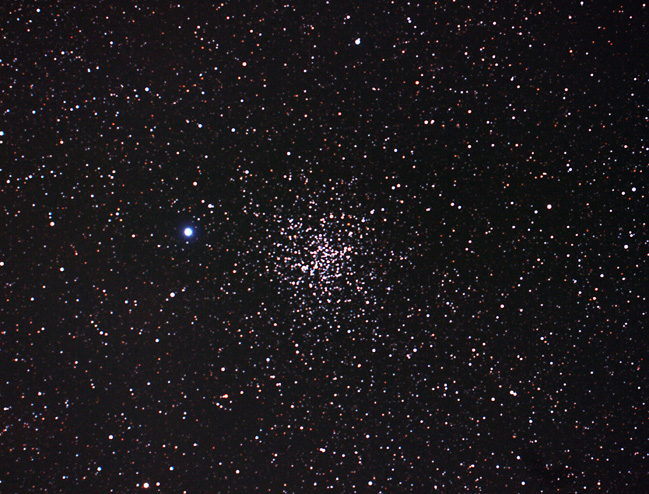
"I turned to Puppis, first to look at M46--the PN 2438 was very bright in the 11mm and showed its ring structure--and then to find 2477, a rich OC far to the south. A week ago I was in Kauai on a family vacation, with my trusty 8x40’s, and I spotted this cluster, about 2 degrees NW of zeta-puppis, not knowing its identity—clearly an open cluster, but very bright and compact, almost like a big globular in the little binoculars, and I figured it had to be a nice target in any telescope. At Lake Sonoma, it was just 10 degrees off the horizon in the heart of the Santa Rosa light dome—the only visible reference star was pi-puppis, 7 degrees to the WNW. In my binoculars I was able to identify ngc 2451 (very coarse, large, close OC), about a degree from 2477 and so point the scope. Well, it was very washed out in the glare, but evidently very rich, compact OC of about 15’ diameter, a little oblong. It must be a beauty in southern skies, perhaps comparable to M 37."
BTW I have to disagree a bit with Warren and Joe, in that 2477 is much brighter overall than 7789--mag 5.8 vs. mag 6.7--I was really struck by the binocular view in Kauai--it's as bright as M13.
--George
George Golitzin