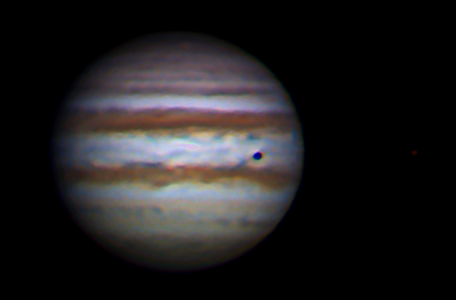
Image of the day

Captured by
John Roach

Jupiter IO Transit 12-10-26

My Account

New to Astromart?

Register an account...

Need Help?

Way Too Slow

Started by Lee_S, 07/31/2007 03:10PM
Posted 07/31/2007 03:10PM Opening Post
As cool as these Voyager spacecraft are and as much as they've given humanity, I've got to say: they are awfully darned slow.

According to NASA, "In about 40,000 years, Voyager 1 will drift within 1.6 light years (9.3 trillion miles) of AC+79 3888, a star in the constellation of Ophiucius. In some 296,000 years, Voyager 2 will pass 4.3 light years (25 trillion miles) from Sirius, the brightest star in the sky ."

http://voyager.jpl.nasa.gov/mission/interstellar.html
http://voyager.jpl.nasa.gov/mission/weekly-reports/index.htm

[SIZE="Small"]------------
I have several telescopes, but none are semi-APO, APO, or in anyway valuable.
[/SIZE]
Posted 07/31/2007 03:30PM #1
And we'll be where? 8O :S

Ivan Gastaldo 8)
Coconut Creek, FL

Ivan's Observatory
Lat 26N 16' 48" Long 80W 10' 48"
[COLOR="Red"]Personal Website:[/COLOR] http://www.ivangastaldo.com

CCD Imaging and Processing/Deep Sky - Moderator
I like to complain about everything - Moderator
Posted 07/31/2007 03:40PM #2
I wonder how long it will take for them to deteriorate into dust? :S

Darian R.
Posted 07/31/2007 10:39PM #3
I think by then they may be sitting on display in a museum because we will have flown out there and got them.

Andreas

DSOs observed:
NGCs 2005, ICs 103, Other 70, Palomar GCs 6, Abell PNs 12, Herschel 400: 316.
Equipment
Celestron CPC 1100, Lunt 60mm Ha Solar Scope
Posted 08/08/2007 02:51PM #4

Slow compared to what? Your car or the starship Enterprise?

wink

Lee Spain said:

As cool as these Voyager spacecraft are and as much as they've given humanity, I've got to say: they are awfully darned slow.

According to NASA, "In about 40,000 years, Voyager 1 will drift within 1.6 light years (9.3 trillion miles) of AC+79 3888, a star in the constellation of Ophiucius. In some 296,000 years, Voyager 2 will pass 4.3 light years (25 trillion miles) from Sirius, the brightest star in the sky ."

http://voyager.jpl.nasa.gov/mission/interstellar.html
http://voyager.jpl.nasa.gov/mission/weekly-reports/index.htm
