Image of the day

Captured by
Douglas Rollain

The Witch’s Broom - NGC6960 (SeeStar S30 Pro)

My Account

New to Astromart?

Register an account...

Need Help?

Be on the Lookout for the Planetary Trio

Started by Dave Mitsky, 12/02/2006 05:17PM
Posted 12/02/2006 05:17PM Opening Post
There's an unusual massing of three naked-eye planets in store for us this month. Unfortunately, the planetary trio will be very low in the east-southeast during morning twilight so clear skies and good horizons will be necessary to see them.

Mercury (which is still undergoing its best morning apparition of 2006), Mars, and Jupiter all fit within a circle with a 5 degree diameter from December 7 to December 14 and a 2 degree circle from December 9 to December 11.

Mercury lies 1.0 degree north of Mars and 1.5 degrees west of Jupiter on December 9. On December 10, Mercury and Jupiter are separated by 17'. (The two planets are within 8' of each other at noon.) Mars and Jupiter are 48' apart on December 11.

Prior to dawn on December 10, the three planets come within a degree of each other, the closest approach of three naked-eye planets from 1980 through 2050. The 2.5 magnitude binary star Beta Scorpii (Graffias) fits into a 1.1 degree diameter circle with the three planets that morning.

Dave Mitsky


Chance favors the prepared mind.

De gustibus non est disputandum.
Posted 12/04/2006 04:25AM #1
Great thanks to Dave Mitsky for reminding everyone of the upcoming planetary trio. He has provided fine data for the unusual event. Now I’ll expand upon the details of the grouping that I presented earlier in my Mercury thread, and notify folks of the availability of an animated graphic. The commentary that follows was prepared several weeks ago for publication after the Pleiades occultation, therefore my apologies are extended for any of it that may have duplicated some of Dave’s announcement.


My calculations reveal that the tightest trio of naked-eye planets between 1926 and 2052 will occur on 2006 DEC 10 at 11:20 UT. The longest side of the triangle formed by Mercury, Mars and Jupiter will measure only 58.7 arcminutes from a geocentric perspective.

The trio will be just 15° west of the Sun, but northern hemisphere observers should be able to spot them above the southeastern horizon in the constellation of Scorpius before dawn. On that morning of the 10th the Mag +2.6 binary star Beta Scorpii will appear about 12 arcminutes above Mercury.

Note: The apparent angular diameter of the Sun or Full Moon is about half a degree or 30 arcminutes.

2006 DEC 10 at 11:20 UT
Mercury-Mars: 58.7 arcminutes
Mercury-Jupiter: 20.2 arcminutes
Mars-Jupiter: 58.7 arcminutes

When considered as pairs, the minimum separations will be even less at slightly different times.

2006 DEC 10 at 06:43 UT
Mercury-Mars: 58.0 arcminutes

2006 DEC 10 at 17:12 UT
Mercury-Jupiter: 7.4 arcminutes

2006 DEC 11 at 15:24 UT
Mars-Jupiter: 47.6 arcminutes

Magnitudes
Mercury: -0.6
Mars: +1.5
Jupiter: -1.7

I’ve created an animated graphic demonstrating the dance of the trio as seen from Chicago 30 minutes before sunrise from December 3 through 17. It can be seen at http://www.curtrenz.com/astronomical.html .

In the upper left of the graphic is an inset that includes an enlarged depiction of the Moon. The Moon does not actually appear in the field of view for the planets. Although it will be seen elsewhere above the horizon during most of the period covered by the animation. The graphic may be removed soon after December 10.

For astronomical graphics, including
monthly wallpaper calendar, visit:
CurtRenz.com/astronomical

Curt Renz
Posted 12/10/2006 11:06PM | Edited 12/10/2006 11:12PM #2
<>

=======================

It was purdy.
Jove was an oval. Mercury was twinkly. Mars was tiny, red and not seeable to my unaided eye. But all three looked just dandy together in my 6" at 23x.

Saturn and Selene looked cool together too. Still very high near dawn. Saturn sported Titan, Cassini, belting in the southern hemisphere, the ring's shadow and Rhea faintly sparkling in and out with the Moon in the same of the field of view. A near and far, together again.

Darn cold with the temps in the twenties and wind in an open field. My eyes kept tearing up. The seeing was good! Selene was calling. But scope mount and operator where not up to the crosswinds. : )
Posted 12/11/2006 02:36AM | Edited 12/11/2006 03:46AM #3
Dave Mitsky said:

Prior to dawn on December 10, the three planets come within a degree of each other, the closest approach of three naked-eye planets from 1980 through 2050. The 2.5 magnitude binary star Beta Scorpii (Graffias) fits into a 1.1 degree diameter circle with the three planets that morning.

I witnessed this spectacle from my home here in Chester County, PA. Very beautiful. Jupiter and Mercury were obvious to the naked eye (this at 6:20 am EST). I needed binocs to see Mars. Binoculars also revealed Beta Scorpii. All four were hovering above the fiery orange-red of the impending sunrise.

One other thing that I noted, Dave. Your post and the S&T website mention that the three planets AND Beta Sco fit within a 1.1-degree circle. I missed that little detail about Beta Sco. Using one of the "Meeus Magic Formulae" I calculated that the three PLANETS were contained within a circle slightly less than one degree in diameter. I thought Jan and/or my planetarium software let me down until I read the "fine print."

Hope you got to see the grouping.

Regards,
Louis Marchesi
[COLOR="Gray"]New London Township, PA[/COLOR]
Posted 12/12/2006 12:07PM #4
I witnessed the planetary trio on Saturday and Sunday mornings. It was fairly cloudy on Saturday morning despite forecasts of clear skies. I decided to take a chance anyway and drove to the top of a hill with an excellent view of the eastern horizon. The clouds began to dissipate and after finally spotting Mercury naked-eye in the east-southeast I observed all three planets through a 8x42 Celestron binocular. I then set up my 80mm f/5 Orion ST80 refractor. The trio easily fit into the field of view produced by an old 26mm Tele Vue Ploessl. I tried to get a prime focus shot with my Canon EOS Digital Rebel and the ST80 but after a series of miscues the sky was growing too bright and my fingers too numb from the cold to continue so I called it quits.

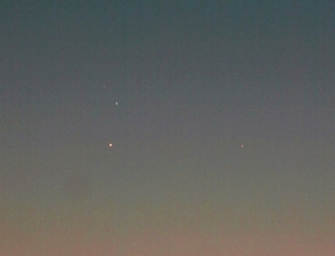
On Sunday, I observed the event from a closer vantage point. It was very clear and the trio and Beta Scorpii (Graffias) were easily visible through the 8x42s. Since I had overslept a bit, I didn't have the time to bring the ST80 and set it up so I settled for some shots with a Canon zoom lens set at 200mm.

This is the only one that clearly showed the three planets and Graffias.

Dave Mitsky

Attached Image:

Dave Mitsky's attachment for post 109904

Chance favors the prepared mind.

De gustibus non est disputandum.
Posted 12/12/2006 12:17PM #5
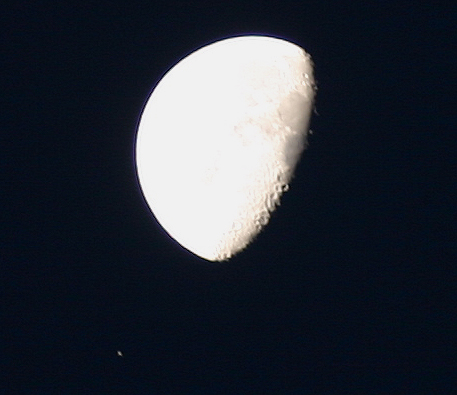
Here's a photo of Saturn (lower left) and the Moon on Sunday morning.

Dave Mitsky

Attached Image:

Dave Mitsky's attachment for post 109905

Chance favors the prepared mind.

De gustibus non est disputandum.