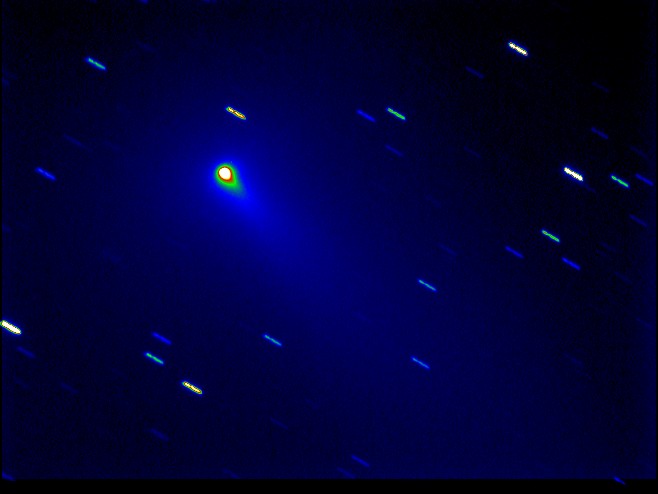
I traveled to the Naylor Observatory again last night to help out with observing portion of the ASH astronomy class. The B fragment was far easier to see through the 17" f/15 classical Cassegrain (162, 202, and 259x) and 5" f/5 finder scope than it had been last Wednesday. Try as I might I couldn't resolve the two pseudonuclei that are present in images since the split that occurred on April 21.
http://www.spaceweather.com/swpod2006/24apr06/james1.jpg
I had a look at the C fragment through the two aforementioned instruments as well as the ASH 110mm f/7.3 TAL Newtonian, a fellow ASH member's 10" f/10 Meade LX200, and the ASH 12.5" f/6.5 Cave Newtonian.
The combined light of the pseudonuclei of fragment B seemed similar in brightness to C's pseudonucleus.
I also viewed the Hyades, M45, the ISS, Mars and M35, Saturn and M44, Jupiter, M104, and Melotte 111 through a fellow ASH member's Oberwork 11x70 binocular and Jupiter and its four Galilean satellites and M104 through the 10" SCT.
Dave Mitsky
Chance favors the prepared mind.
De gustibus non est disputandum.