Image of the day

Captured by
Michael Scherman

M17 Swan-Omega Celestron C6 Hyperstar2

My Account

New to Astromart?

Register an account...

Need Help?

Hipparchus

Started by Martian, 12/18/2004 07:14AM
Posted 12/18/2004 07:14AM Opening Post
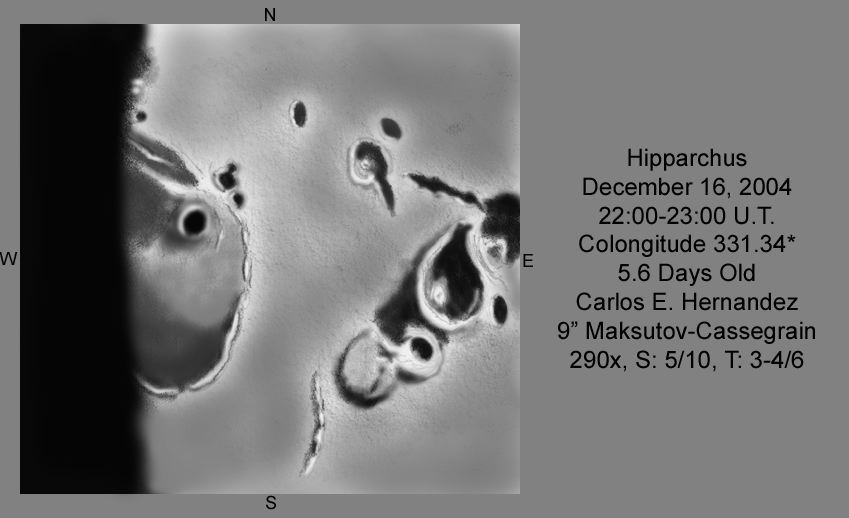
I made an observation of the Hipparchus region of the Moon on December 16, 2004 between 22:00 and 23:00 U.T. I was clouded out before I was able to complete the observation (e.g. lack of features between craters). I believed that this represented an interesting region that was located on the lunar terminator at the time. Hipparchus (5.5*S, 4.8*E) represents a large disintegrated walled plain that measures 93 miles (150 km) in diameter. The crater towards the eastern (right) limb is Lindsay (20 miles (32 km) diameter). I welcome any comments on my observation.

Happy Holidays and a Happy New Year!

Regards,
Carlos E. Hernandez

Attached Image:

Martian's attachment for post 20869
Posted 12/18/2004 07:54AM #1
Hi Carlos,

I spent a fair bit studying the Moon tonight as well. With very good seeing conditions the Moon looked like 3D coral.

I am curious as to how you got the granulated texture between the craters. I find the Moon to be intensely detailed and I am always amazed at this aspect, amongst others, that appears in your Lunar renderings.

A peaceful holdiday to you and best wishes, Sol Robbins
Posted 12/18/2004 10:36PM #2
Excellant sketch of this crator,it looks like it has the texture of clay,very realistic looking congrads.
Posted 12/19/2004 06:54AM #3
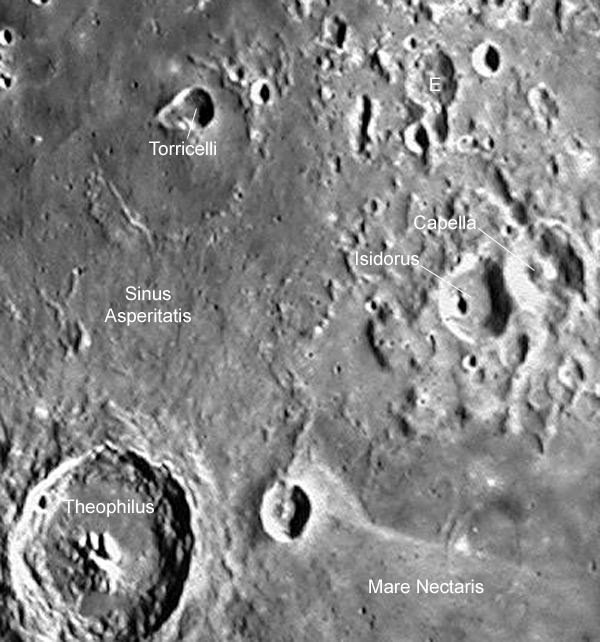
I must apologize in that I mistakenly identified the large crater towards the west (left side of observation) as the crater Hipparchus. It is in fact a ghost crater that contains the crater Torricelli (4.6*S, 28.5*E; 14.3 miles (23 km) diameter) over it's northern portion. The prominent crater over the eastern (right) side of my observation is Capella (7.6*S, 34.9*E: 30.5 miles (49 km) diameter). I am sorry if my mistake had veteran lunar observers scratching their heads and saying "That does not look like the Hipparchus region." This proves that even veteran observers such as myself make silly mistakes. I have included a detailed section of an image from the Consolidated Lunar Atlas ( http://www.lpi.usra.edu/research/cla/info/e9/ ) for reference. I have included the crater Theophilus as a reference point.

Thank you for your understanding.

Carlos E. Hernandez


Attached Image:

Martian's attachment for post 86093