
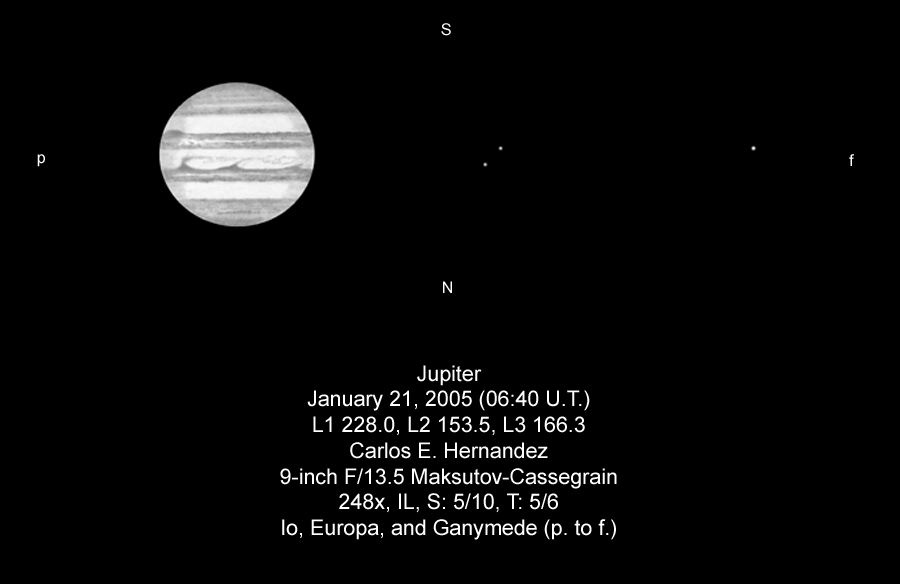
I made an observation of Jupiter on January 21, 2005 at 06:40 U.T. under average seeing conditions (5/10). The Great Red Spot (GRS) was visible on the preceding limb. The South Equatorial Belt (SEB) was very active following the GRS. Prominent blue festoons were visible along the southern border of the North Equatorial Belt (NEB-S). Io, Europa, and Ganymede were visible following the planet, from preceding to following. I welcome any comments on my observation.
Date (U.T.): January 21, 2005
Time (U.T.): 06:40
L1 228.0, L2 153.5, L3 166.3
Instrument: 9-inch (23-cm) F/13.5 Maksutov-Cassegrain
Magnification: 248x
Filters: IL
Seeing (0-10): 5, Antoniadi (I-V): III
Transparency (1-6): 5
Notes:
South Polar Region (SPR): Appears dark to dusky (3-4/10) and mottled.
South South Temperate Zone (SSTZ): Appears thin and shaded (6/10).
South South Temperate Belt (SSTB): Appears thin and dusky (4/10).
South Temperate Zone (STZ): Appears thin and bright (7/10).
South Temperate Belt (STB): Appears dark to dusky (3-4/10) and broad. No ovals visible within it at this time.
South Tropical Zone (STrZ): Appears bright (7/10) and no detail visible within it at this time.
Great Red Spot (GRS): Appears dark to dusky (3-4/10) over the preceding limb.
South Equatorial Belt (SEB): Appears dark to dusky (3-4/10) with dark (3/10) condensations visible along the southern border and irregular bright material over it's midsection.
Equatorial Zone (EZ): Appears bright (7/10) with diffuse, dusky to dull (4-5/10) streaks and condensations within it.
North Equatorial Belt (NEB): Appears dark to dusky (3-4/10) with dark (3/10) blue festoons noted along the southern border. Thin and bright (7/10) streaks are noted over it's midsection.
North Tropical Zone (NTrZ): Appears bright (7/10) and broad.
North Polar Region (NPR): Appears dark to dull (3-5/10) and mottled. A dark (3/10) streak is noted over the center of the NPR.
The best of luck in your own observation and imaging of Jupiter.
Regards,
Carlos E. Hernandez
Date (U.T.): January 21, 2005
Time (U.T.): 06:40
L1 228.0, L2 153.5, L3 166.3
Instrument: 9-inch (23-cm) F/13.5 Maksutov-Cassegrain
Magnification: 248x
Filters: IL
Seeing (0-10): 5, Antoniadi (I-V): III
Transparency (1-6): 5
Notes:
South Polar Region (SPR): Appears dark to dusky (3-4/10) and mottled.
South South Temperate Zone (SSTZ): Appears thin and shaded (6/10).
South South Temperate Belt (SSTB): Appears thin and dusky (4/10).
South Temperate Zone (STZ): Appears thin and bright (7/10).
South Temperate Belt (STB): Appears dark to dusky (3-4/10) and broad. No ovals visible within it at this time.
South Tropical Zone (STrZ): Appears bright (7/10) and no detail visible within it at this time.
Great Red Spot (GRS): Appears dark to dusky (3-4/10) over the preceding limb.
South Equatorial Belt (SEB): Appears dark to dusky (3-4/10) with dark (3/10) condensations visible along the southern border and irregular bright material over it's midsection.
Equatorial Zone (EZ): Appears bright (7/10) with diffuse, dusky to dull (4-5/10) streaks and condensations within it.
North Equatorial Belt (NEB): Appears dark to dusky (3-4/10) with dark (3/10) blue festoons noted along the southern border. Thin and bright (7/10) streaks are noted over it's midsection.
North Tropical Zone (NTrZ): Appears bright (7/10) and broad.
North Polar Region (NPR): Appears dark to dull (3-5/10) and mottled. A dark (3/10) streak is noted over the center of the NPR.
The best of luck in your own observation and imaging of Jupiter.
Regards,
Carlos E. Hernandez
Attached Image:

