
I made an observation of Mars this morning using a new filter designed by Sirius Optics that I am testing. It is appropriately called the Mars Filter. Much detail was noted across the martian disk that is difficult to describe. I welcome any comments on my observation.
Date (U.T.): July 27, 2003
Time (U.T.): 05:00
CM 328.3
Ls 229.3, De -19.8, Ds -18.5, k 0.95, 21.42"
Instrument: 9-inch (23-cm) F/13.5 Maksutov- Cassegrain
Magnification: 257x and 386x
Filter: Sirius Optics Mars Filter
Seeing (1-10): 5-6 (moments of 7-8), Antoniadi (I-V): III
Transparency (1-6): 5
Notes:
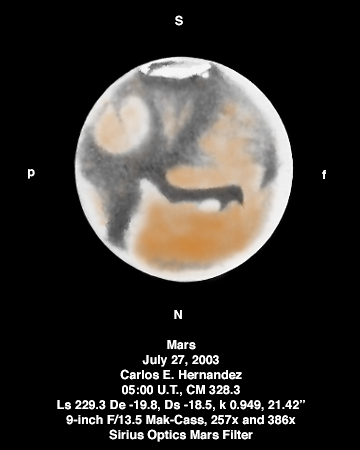
The South Polar Cap (SPC) was brilliant (10/10) with a dark to dusky (3-4/10) streak and a dark (3/10), thin rift over it's preceding half. The SPC border appeared irregular and Argenteus Mons (10/10) was noted towards the following limb. Sabaeus Sinus (3/10) was noted on the CM and Meridiani Sinus (3/10) towards the following limb. Edom was prominent (8/10) along the northern border of Sabaeus Sinus and following Meridiani Sinus. Syrtis Major (3/10), Mare Hadriacum (3/10), and Mare Tyrrhenum (3/10) were noted towards the following limb. An extremely bright (9/10) and thin evening (preceding) limb haze was noted. Libya appeared very to extremely bright (8-9/10) along the preceding limb. Hellas appeared shaded to bright (6-7/10) with it's western (preceding) border appearing very bright (8/10, possibly containing some dust) and the southern portion of Alpheus (4-5/10) noted as well. Iapygia Viridis (3/10) and Mare Serpentis (3/10) were noted on and just following the CM. Hellespontus (3/10) and Yaonis Fretum (3/10) were noted preceding and following the CM, respectively, with Yaonis Regio (7/10) bisecting the two. Deucalionis Regio and Noachis appeared bright (7/10). Aeria, Arabia, Moab, and Eden were bright (7/10). Hammonis Cornu appeared very bright (8/10). Ismenius Lacus (southern border) was noted adjacent to the extremely bright (9/10) northern limb haze. Margaritifer Sinus appeared as a dark (3/10) spike adjacent to an extremely bright (9/10) morning (following) limb haze. Mare Erythraeum appeared dusky to dull (4-5/10) with portions obscured by haze.
The best of luck in your future Mars imaging and observations.
Carlos E. Hernandez
Date (U.T.): July 27, 2003
Time (U.T.): 05:00
CM 328.3
Ls 229.3, De -19.8, Ds -18.5, k 0.95, 21.42"
Instrument: 9-inch (23-cm) F/13.5 Maksutov- Cassegrain
Magnification: 257x and 386x
Filter: Sirius Optics Mars Filter
Seeing (1-10): 5-6 (moments of 7-8), Antoniadi (I-V): III
Transparency (1-6): 5
Notes:
The South Polar Cap (SPC) was brilliant (10/10) with a dark to dusky (3-4/10) streak and a dark (3/10), thin rift over it's preceding half. The SPC border appeared irregular and Argenteus Mons (10/10) was noted towards the following limb. Sabaeus Sinus (3/10) was noted on the CM and Meridiani Sinus (3/10) towards the following limb. Edom was prominent (8/10) along the northern border of Sabaeus Sinus and following Meridiani Sinus. Syrtis Major (3/10), Mare Hadriacum (3/10), and Mare Tyrrhenum (3/10) were noted towards the following limb. An extremely bright (9/10) and thin evening (preceding) limb haze was noted. Libya appeared very to extremely bright (8-9/10) along the preceding limb. Hellas appeared shaded to bright (6-7/10) with it's western (preceding) border appearing very bright (8/10, possibly containing some dust) and the southern portion of Alpheus (4-5/10) noted as well. Iapygia Viridis (3/10) and Mare Serpentis (3/10) were noted on and just following the CM. Hellespontus (3/10) and Yaonis Fretum (3/10) were noted preceding and following the CM, respectively, with Yaonis Regio (7/10) bisecting the two. Deucalionis Regio and Noachis appeared bright (7/10). Aeria, Arabia, Moab, and Eden were bright (7/10). Hammonis Cornu appeared very bright (8/10). Ismenius Lacus (southern border) was noted adjacent to the extremely bright (9/10) northern limb haze. Margaritifer Sinus appeared as a dark (3/10) spike adjacent to an extremely bright (9/10) morning (following) limb haze. Mare Erythraeum appeared dusky to dull (4-5/10) with portions obscured by haze.
The best of luck in your future Mars imaging and observations.
Carlos E. Hernandez
Attached Image:
