
I made an observation of Mars on September 14, 2005 (06:30 U.T. (IL/W30) and 06:50 U.T. (W38)) under average to good seeing conditions (5-6/10, moments of 7/10). I noted an impressive amount of detail extending between Sinus Sabaeus and Solis Lacus (on the following limb). Mare Erythraeum appeared very complex and mottled. I welcome any comments on my observations.
Date (U. T.): September 14, 2005
Time (U.T.): 06:30 (left image) and 06:50 (right image)
CM: 012.7 (left image) and 017.5 (right image)
Ls 288.0 (Early Northern Winter/Southern Summer)
De -11.3, Diameter 15.7", Phase (p) 0.89
Instrument: 9-inch (23-cm) F/13.5 Maksutov-Cassegrain
Magnification: 248x and 388x
Filters (Wratten): 30 (magenta) and 38 (blue)
Seeing (1-10): 5-6 (moments of 7), Antoniadi (I-V): III
Notes:
06:30 U.T (Left image, IL and W30): The South Polar Cap (SPC) appears small, but brilliant (10/10) surrounded by a dark (3/10) collar (Mare Oceanidum?). Hellespontus appears dark (3/10) along the south-preceding limb. Noachis appears shaded to bright (6-7/10). Chalce (?) appears as a dusky (4/10) wedge extending into Noachis. Pandorae Fretum appears dark to dusky (3-4/10) south of Sabaeus Sinus (3/10) and Meridiani Sinus (3/10) which are separated by a shaded to bright (6-7/10) Deucalionis Regio. Brangaena appears a thin, dark (3/10), curvilinear projection from the north-following border of Meridiani Sinus. Margaritifer Sinus appears dark (3/10) and wedge-shaped on the CM. Aram appears bright (7/10) between Meridiani Sinus and Margaritifer Sinus. Oxia Palus appears as an elliptical, dusky (4/10) albedo feature north of the tip of Margaritifer Sinus. Mare Erythraeum appears complex and mottled (3-6/10) following the CM. Aurorae Sinus appears dark (3/10) and wedge-shaped towards the following limb. The northern border of Mare Erythraeum appears complex with thin, dusky to dull (4-5/10) projections extending into Chryse-Xanthe (7/10). Solis Lacus appears dark (3/10) and foreshortened along the following limb. Niliacus Lacus appears as a dark to dusky (3-4/10) wedge partially obscured by an extremely bright (9/10) North Polar Hood (NPH). Extremely bright (9/10) morning and evening limb hazes (MLH and ELH) are noted.
06:50 U.T. (Right image, W38): The South Polar Cap (SPC) appears small and brilliant (10/10). Pandorae Fretum, Sabaeus Sinus, Meridiani Sinus, Margaritifier Sinus, Mare Erythraeum, and Solis Lacus are visible as dusky to dull (4-5/10) albedo features towards the center of the disk. Aram appears bright (7/10, possible water-ice clouds?). A bright to very bright (7-8/10) cloud appears to extend between Eden and Tharsis over Chryse-Xanthe. Niliacus Lacus is visible as dull (5/10) wedge south of an extremely bright (9/10) North Polar Hood (NPH). Extremely bright (9/10) morning limb haze (MLH) and evening limb haze (ELH) is noted.
The best of luck imaging and observing the red planet as it approaches closer to Earth.
Regards,
Carlos E. Hernandez
Date (U. T.): September 14, 2005
Time (U.T.): 06:30 (left image) and 06:50 (right image)
CM: 012.7 (left image) and 017.5 (right image)
Ls 288.0 (Early Northern Winter/Southern Summer)
De -11.3, Diameter 15.7", Phase (p) 0.89
Instrument: 9-inch (23-cm) F/13.5 Maksutov-Cassegrain
Magnification: 248x and 388x
Filters (Wratten): 30 (magenta) and 38 (blue)
Seeing (1-10): 5-6 (moments of 7), Antoniadi (I-V): III
Notes:
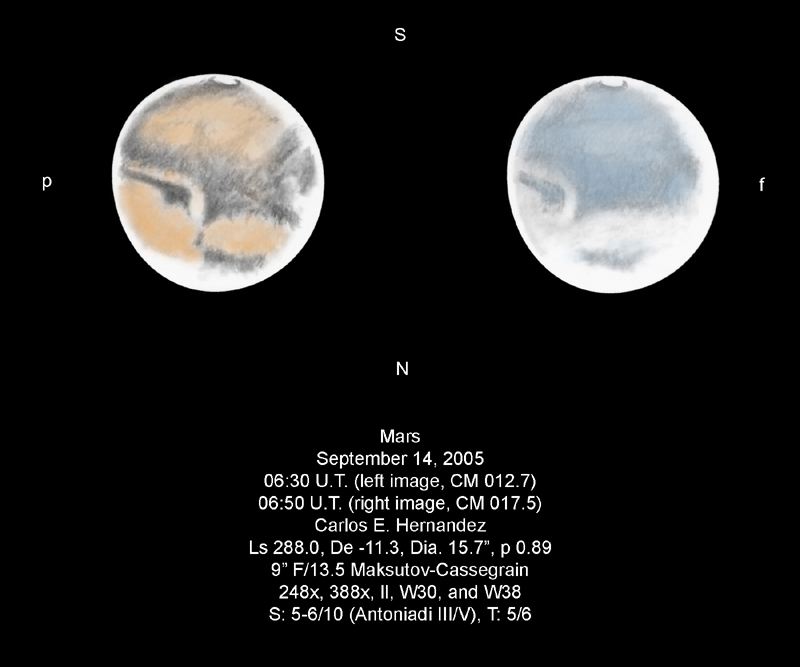
06:30 U.T (Left image, IL and W30): The South Polar Cap (SPC) appears small, but brilliant (10/10) surrounded by a dark (3/10) collar (Mare Oceanidum?). Hellespontus appears dark (3/10) along the south-preceding limb. Noachis appears shaded to bright (6-7/10). Chalce (?) appears as a dusky (4/10) wedge extending into Noachis. Pandorae Fretum appears dark to dusky (3-4/10) south of Sabaeus Sinus (3/10) and Meridiani Sinus (3/10) which are separated by a shaded to bright (6-7/10) Deucalionis Regio. Brangaena appears a thin, dark (3/10), curvilinear projection from the north-following border of Meridiani Sinus. Margaritifer Sinus appears dark (3/10) and wedge-shaped on the CM. Aram appears bright (7/10) between Meridiani Sinus and Margaritifer Sinus. Oxia Palus appears as an elliptical, dusky (4/10) albedo feature north of the tip of Margaritifer Sinus. Mare Erythraeum appears complex and mottled (3-6/10) following the CM. Aurorae Sinus appears dark (3/10) and wedge-shaped towards the following limb. The northern border of Mare Erythraeum appears complex with thin, dusky to dull (4-5/10) projections extending into Chryse-Xanthe (7/10). Solis Lacus appears dark (3/10) and foreshortened along the following limb. Niliacus Lacus appears as a dark to dusky (3-4/10) wedge partially obscured by an extremely bright (9/10) North Polar Hood (NPH). Extremely bright (9/10) morning and evening limb hazes (MLH and ELH) are noted.
06:50 U.T. (Right image, W38): The South Polar Cap (SPC) appears small and brilliant (10/10). Pandorae Fretum, Sabaeus Sinus, Meridiani Sinus, Margaritifier Sinus, Mare Erythraeum, and Solis Lacus are visible as dusky to dull (4-5/10) albedo features towards the center of the disk. Aram appears bright (7/10, possible water-ice clouds?). A bright to very bright (7-8/10) cloud appears to extend between Eden and Tharsis over Chryse-Xanthe. Niliacus Lacus is visible as dull (5/10) wedge south of an extremely bright (9/10) North Polar Hood (NPH). Extremely bright (9/10) morning limb haze (MLH) and evening limb haze (ELH) is noted.
The best of luck imaging and observing the red planet as it approaches closer to Earth.
Regards,
Carlos E. Hernandez
Attached Image:


