Image of the day

Captured by
Byron Davies

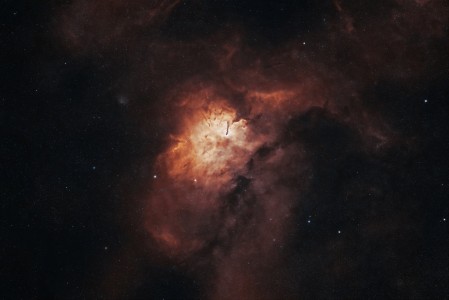
Sh2-86 (NGC-6820)

My Account

New to Astromart?

Register an account...

Need Help?

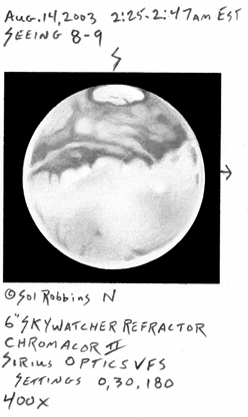
Mars Sketch 8.14.03

Started by Sol R., 08/14/2003 09:12AM
Posted 08/14/2003 09:12AM Opening Post
Hi,

After 2 1/2 weeks of clouds, I finally got a clear and steady night. Mars showed a lot of detail with a lot a break up in the darker albedo features. SPC was notched with the preceding edge being brighter.

My 10" reflector is almost finished. Star test was nearly null. Just some small balancing issues left to resolve.smile

Thanks, Sol Robbins

Attached Image:
Sol R.'s attachment for post 8356
Posted 08/14/2003 11:58AM #1
Heeeeeeee's BAAAAAACK!

Outstanding, Sol! Glad the skies finally opened up for ya, it's good to have you back. I can't wait to see the results of your 10"!
Posted 08/14/2003 02:53PM #2
So glad you can now show us your beautiful sketch again, Sol! I see that your 6-incher can resolve (easily) the two "fangs" protruding from Mare Cimmerium as Don Bates described it. Such exquisite details. Can't wait to see how your sketch would look from your new 10-incher!

Ron B[ee]
Posted 08/14/2003 03:48PM #3
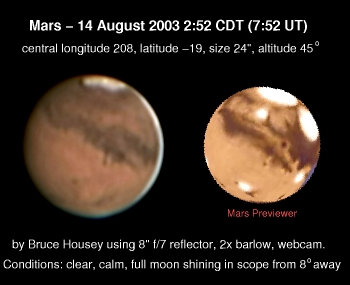
Great drawing, Sol. Here's an image I took about an hour later (about same time in each time zone, but in different time zones). You captured the mottling I saw better than my picture did.

My notes from this morning follow:

With an almost-full moon just 8 degrees away from Mars this morning, moonlight was flooding into the tube testing my baffling job to the max! Looking into the tube the flocking paper in the first 14 inches gobbled up the unwanted light well, and the rough black paint in the remainder of the 5 foot long tube soaked up the rest. I was glad to see no real difference in the view of Mars with the moon so nearby, and the detail on Mare Sirenum and Cimmerium was fabulous.

I also noticed a lot more "mottled" area near the south polar region than my last viewing session 3 days ago, in what appears to be the Mare Chronium or possibly even Mare Australe regions. The attached picture shows this area as somewhat dark, but does not show the mottling visible to the eye during excellent seeing moments. The Elysium area in the north (white spot at bottom on simulation) was also very clear this morning, along with the two dark blotches on the sides of it. The morning limb (right) showed as a beautiful bright white arc... I will be curious to see how morning appears after Aug 27th when the terminator starts creeping in from that side.

The blue cloud over the northern polar region (NPR hood?) still seems about the same size as three days ago, while the south polar cap (top) had a large notch in it. I saw no signs of dust storms whatsoever. Conditions were fabulous for my two-hour viewing session from 2am to 4am: calm, not a cloud in the sky, and actually a little cool at 75 degrees. Mars was high up at around 45 degrees for the whole session.


Attached Image:

bhousey's attachment for post 70089
Posted 08/14/2003 05:50PM #4
Hey Sol, fantastic sketch!

I'm jealous. Where are you located? Here in SE Michigan I've never had the seeing (at Mars's altitude of 35 degrees or lower) better than maybe 6 or 7. I get fleeting glimpses of such detail in my 8" f/8, but it never lasts long enough to get a good handle on it. It's probably the (lack of) altitude because straight up star images are textbook.

I was out last night around 3:00 EDT (07:00 UT) looking at Mars and the seeing varied from maybe 5 to 6. ARGH!!!!!

Doug
Posted 08/15/2003 08:12AM #5
Sol,

A wonderful observation of Mars showing much detail between Mare Sirenum (on the right in this image) and Mare Cimmerium (with fangs) on the left. The mottled region to the south is Mare Chronium and the lighter regions are Eridania, Electris, and Phaethontis (from left to right). The bright, curved streak south of Mare Cimmerium is Hesperia. The bright streak separating Mare Cimmerium from Mare Sirenum is Atlantis. Trivium Charontis is shown similar to many images obtained showing it as a small, dark circle. An outstanding example of what the eye and hand can accomplish. Bravo!!!

The fangs projecting from the northern border of Mare Cimmerium are more closely related to an albedo feature noted by the famed German astronomer Johann Hieronymus Schroter http://www.nmsi.ac.uk/piclib/imagerecord.asp?id=10324083 in the late 1700's named Cyclops (or Spitz B). The fangs represent the east-west borders of this transient feature. Laestrygonium Sinus is actually more to the west and was noted to be an elongated albedo feature (east-west) and not recorded as a projection (north-south). These features are obviously produced by the redristibution of martian sand exposing the dark volcanic bedrock underneath.

Bruce

Wonderful image of Mars. Please keep up the good work!

Carlos