Image of the day

Captured by
Mark Eby

M33 Triangulum Galaxy

My Account

New to Astromart?

Register an account...

Need Help?

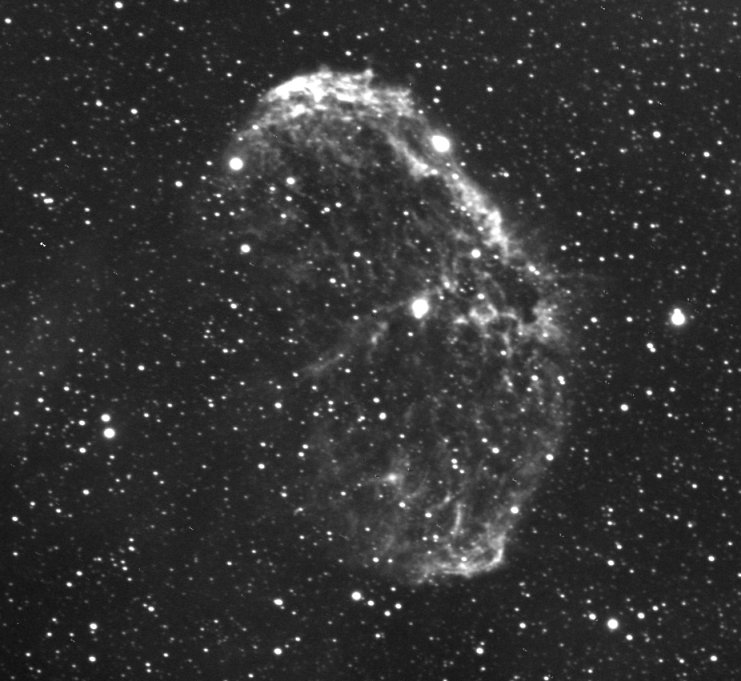
Crescent w/AP 130 F/6, SXV H9 in HA

Started by Rob Mackie, 06/17/2006 06:00PM
Posted 06/17/2006 06:00PM | Edited 06/17/2006 06:02PM Opening Post
This is one of my first CCD efforts. Image consists of six 12 min HA (Astronomik 13nm)exposures acquired with a Starlight Express SXV H9. Ota is an AP 130 F/6 atop a Tak EM200, guided using the SXV guide head/Tak FS60C. Acquired from my light polluted SF Bay Area home on a moonlit night. Guiding seems a bit off, either that or I'm not combining subs correctly. I used MaximDL for camera control and ImagesPlus for aligning and combining images. Processing consisted of digital development and sharpening via Richardson Lucy function.

I was gratified to see how effective an HA filter could be in enabling me to image a dim nebulous object from a bright suburban location. FWHM readings were around 2.5, so seeing wasn't that great. A few nights earlier FWHM was consistently 1.5 or thereabouts.

The image is 80% actual size. My imaging is largely hit or miss as I figure out the hard way what works and what doesn't. Comments and criticism most welcome.

Rob Mackie
El Cerrito, CA
Attached Image:

Rob Mackie's attachment for post 32059
Posted 06/17/2006 06:28PM #1
Isn't H-alpha amazing? Great beginning!

Tom

Starsearch Observatory
Lat 42N 47' 00" Long 112W 10' 47"
Elev 1752m
www.tvdavisastropics.com
Posted 06/17/2006 10:54PM | Edited 06/17/2006 11:01PM #2
That's an excellent start, Rob.
Flexure could also account for the star elongation.
If your guiding numbers are good during guiding, then it's either flexure or the alignment of subs.
If there is no elongation in your subs, then it's alignment.
Did you also try aligning in Maxim? It might give a better result than Images Plus. CCDStack has an excellent alignment procedure and I think they have a free trial time of a month or so.
Narrow band is great for making those light polluted skies into dark skies.
One other thing:
Your white point looks to be clipped a bit, either from processing or saturated subs, but that is easily remedied.
You've made a good entrance into the world of CCD imaging.

dan kowall
photonhunter.com
Posted 06/18/2006 05:15AM #3
Rob, the image looks great!

"The expression of the beautiful is in direct ratio to the power of perception acquired by the artist." (Gustave Courbet)
Posted 06/19/2006 01:24PM #4
Hi Rob!

Your stars look nice and round, so if there was indeed flexure at least it didn't make it into the final image (either that or I'm not looking in the right spot). You've dived headlong into imaging, congratulations! I waited over a year before my first attempt at narrowband imaging, then again I didn't have a separate guider.

How is your guiding going with the EM200 and SXV guide head? Are you still using the STV?

Eric
Posted 06/20/2006 03:56AM #5
Rob, Really nice image. I should post some of my first images here - they are pretty laughable, but you gotta start somewhere. Looks like you are well up the curve with your early efforts.

It is amazing what can be done with narrow band in light pollution. Some of our colleagues in more northerly locations than yours never get a true dark sky in the summer. They can use HA in deep twilight and still get a reasonable result.

Jim Thommes

Mak-Newt 152 mm
C8
Megrez II APO
Zenithstar 66 mm APO
G11/Gemini
ST8300M
Artemis285 Camera
Canon 350D DSLR

http://jthommes.com/Astro/
Posted 06/21/2006 03:50AM #6
Hey Rob. Me and you have a lot of the same equipment. I also use an AP-130F/6 with a FS-60C as a guide scope. My camera is also an SXV-H9. Only place we differ is I use a G11/Gemini and an STV autoguider. I don't have any flexure at all. How do you have your guide scope mounted? I use all Losmandy stuff. You can see how I got mine setup here: http://www.pbase.com/panotaker/fs-60c

Personally I think H-Alpha imaging is the easiest way to start imaging. The processing is super easy. All I do is stack and stretch in Images Plus. LRGB is a different story. I need a lot of help there. Your picture looks a little fuzzy to me, like if you didn't nail the focus or something. It could be the flexure, or the stacking. I am sure you will figure it out. If I can do it, anybody can do it.

I shot the same object last year as you. I already had a few h-alpha shots before I shot it so I had a little bit more practice. You can see my version here: http://www.pbase.com/panotaker/image/45809316

If you need some help, let me know.

Ralph
Posted 06/21/2006 05:01AM | Edited 06/21/2006 05:05AM #7
Hi Rob,

Check a few points with your autoguider:

1. You calibrated on a star nearby.
2. Your scope is nicely balanced in both axes. You may need to check the balance isn't different at a different angle (especially if piggybacking another scope).
3. You have the correct declination set for the autoguiding software (I use CCDSoft and I have to manually put the current declination in the box).
4. Not sure for your area but I find the shorter the autoguiding exposure the better. For my skies 1 second guide exposures is my target and gives best results. If your seeing is poor that may need to be longer. Also with Ha or blue filters, longer guide exposures are needed if you are guiding through them.
5. Make sure cables are supported and not adding unneccessary weight on the camera and can move freely without tangle or sudden slips as the scope tracks.
6. Check your polar alignment. The autoguider has to work very hard if the polar alignment is off and it cannot compensate for rotation so you will get elongated stars no matter what if the polar alignment is off. This is really the number one point and the most important point of all of these.
7. Check your guiding rate. I experiment with this using Chuck Faranda's Temma driver. It allows you to change the guide rate. I usually use 50% but sometimes use 90%. It is a simple matter of typing in the new number and then hit send and then watch the guide error numbers to see if they improve or get worse. If you are not using his driver then post on the Tak Uncensored Yahoo group and he will send it to you. I use it with the Sky V6.0.
You can also park the mount with this driver so that it is still aligned the next time you power it up. Very handy.

I hope this is of some use to you.

Generally it is; polar alignment not right, scope not balanced well or too long a guide exposure.

If you have all the above in, you can get below .5 pixel errors guiding at 2118mm focal length routinely.
Certainly below 1 pixel which is where I draw the line and start handling things.

Greg.
