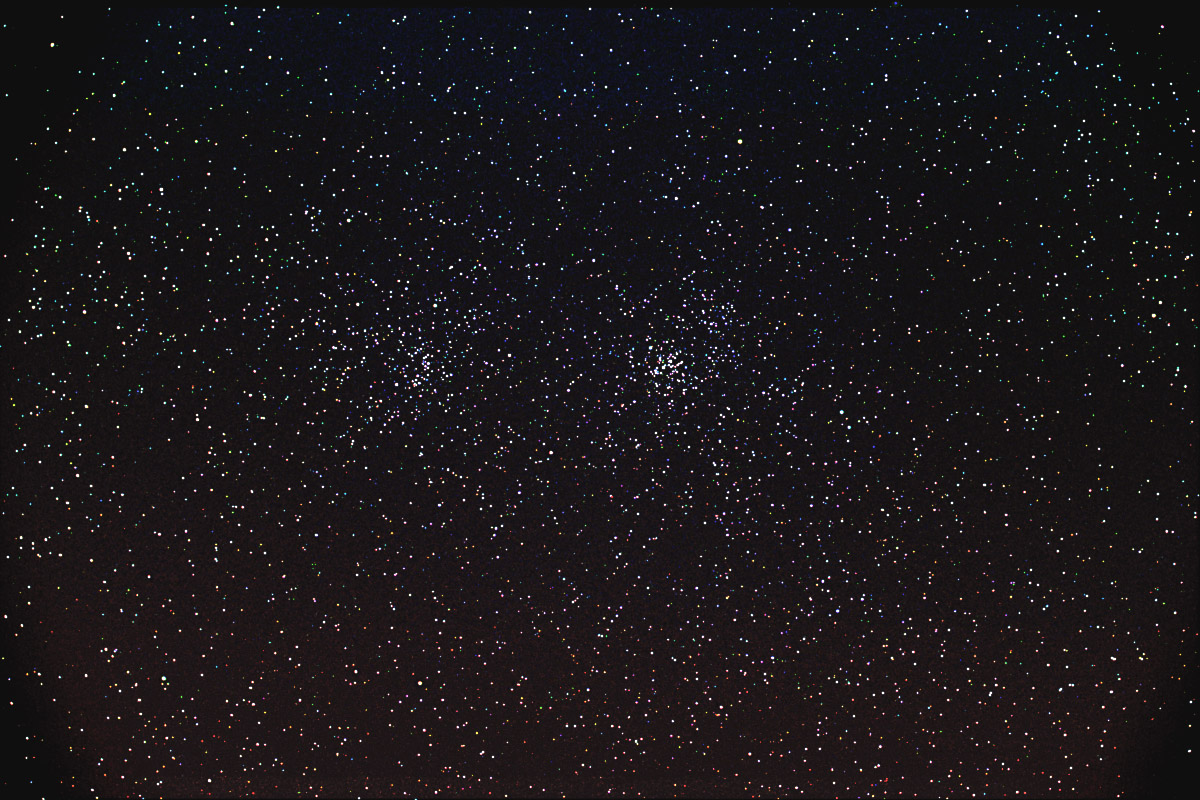
This image of the Double Cluster was taken with my 160EDF refractor and an experimental telecompressor/corrector at F5.8. The attached image is reduced to approximately 1/4 of the original size of the ST11000 format. At that reduction, the stars became so tiny, that most of them disappeared on my computer screen. Therefore I had to try some techniques to get them to re-appear on the screen.
Normally one tries to get the tightest focus possible to get the prettiest picture, but in this case I actually had to defocus the image in Photoshop by applying a Gaussian blur to give the stars a bit of size so they would re-appear on the screen. On the original image, the stars had a FWHM size of 1.3 pixels, so theoretically when reduced down, they would have only 1/3 pixel size. This essentially means that they not only lose their size, but also most of their brightness when reduced. By blurring them, and boosting their brightness to the original levels, then reducing the image size, I was able to keep the colorful stars on the monitor.
This ST11000 is on loan to me from Ray Gralack for testing. I can see that it is extreme overkill for a typical computer monitor, but you should see what a 20" print looks like with full resolution. You have to examine it with a magnifier to see all the detail. I really like this camera, and have to think hard about whether I want to replace my trusty ST10XE. I thought that the ST11000 with its anti-blooming feature would be super slow to record stuff. I was basically wrong about that. This image consists of two 5 second exposures each of LRGB taken last night during a full Moon and somewhat hazy skies. Essentially a 10 second unguided image under poor conditions. Not bad at all.
Roland Christen
Normally one tries to get the tightest focus possible to get the prettiest picture, but in this case I actually had to defocus the image in Photoshop by applying a Gaussian blur to give the stars a bit of size so they would re-appear on the screen. On the original image, the stars had a FWHM size of 1.3 pixels, so theoretically when reduced down, they would have only 1/3 pixel size. This essentially means that they not only lose their size, but also most of their brightness when reduced. By blurring them, and boosting their brightness to the original levels, then reducing the image size, I was able to keep the colorful stars on the monitor.
This ST11000 is on loan to me from Ray Gralack for testing. I can see that it is extreme overkill for a typical computer monitor, but you should see what a 20" print looks like with full resolution. You have to examine it with a magnifier to see all the detail. I really like this camera, and have to think hard about whether I want to replace my trusty ST10XE. I thought that the ST11000 with its anti-blooming feature would be super slow to record stuff. I was basically wrong about that. This image consists of two 5 second exposures each of LRGB taken last night during a full Moon and somewhat hazy skies. Essentially a 10 second unguided image under poor conditions. Not bad at all.
Roland Christen
Attached Image:

