Hi Folks,
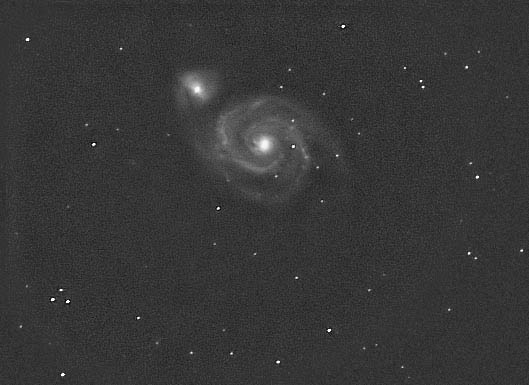
Last night I tried to shoot M-51 with my E-155 (6" f/5), HX-916, and TT filters. I tried to use my "SkySensor" goto mount to center the galaxy, as I couldn't see it in the eyepiece at any power (light pollution). After having gotten close enough, I got the galaxy approximately centered, and started shooting. After about 30 frames, I stacked about 20 of the best 15-second exposures to see how I was doing. Not bad, I thought, but still a bit noisy when I went to heavy non-linear stretching. I finally accumulated about 100 frames, and 10 each of R-G-B for color.
Upon processing, I was greeted by a nasty surprise; no matter how many frames I stacked, I couldn't get the "noise" out of the frame. It was in all the data; the color as well as the "L" data, and it was practically ruining the shot. Frustrated, I was about to hit the "Flush" button on my keyboard, when something struck me; the "noise" was confined to a roughly circular pattern in the center of the FOV, while the corners were free of it. With my jaw slack, I realized what I was looking at; the "noise" was actually light pollution, and the dark area was vignetting caused by my smallish secondary (the 'scope was originally intended for planetary observing, not wide-field imaging). If I had been imaging from a dark sky, I would have probably captured a beautiful shot of the galaxy, but instead, got one that looked like it was being viewed through static from an old t.v. set. I was wondering why a camera as clean as the HX-916 would still be showing noise after combining about 75 frames, and I got my answer; it wasn't noise from the camera, it was noise from society.
Maurizio
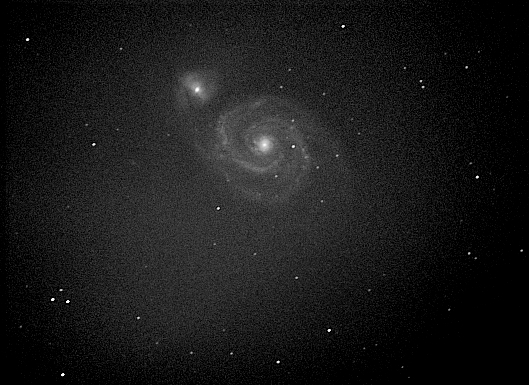
Last night I tried to shoot M-51 with my E-155 (6" f/5), HX-916, and TT filters. I tried to use my "SkySensor" goto mount to center the galaxy, as I couldn't see it in the eyepiece at any power (light pollution). After having gotten close enough, I got the galaxy approximately centered, and started shooting. After about 30 frames, I stacked about 20 of the best 15-second exposures to see how I was doing. Not bad, I thought, but still a bit noisy when I went to heavy non-linear stretching. I finally accumulated about 100 frames, and 10 each of R-G-B for color.
Upon processing, I was greeted by a nasty surprise; no matter how many frames I stacked, I couldn't get the "noise" out of the frame. It was in all the data; the color as well as the "L" data, and it was practically ruining the shot. Frustrated, I was about to hit the "Flush" button on my keyboard, when something struck me; the "noise" was confined to a roughly circular pattern in the center of the FOV, while the corners were free of it. With my jaw slack, I realized what I was looking at; the "noise" was actually light pollution, and the dark area was vignetting caused by my smallish secondary (the 'scope was originally intended for planetary observing, not wide-field imaging). If I had been imaging from a dark sky, I would have probably captured a beautiful shot of the galaxy, but instead, got one that looked like it was being viewed through static from an old t.v. set. I was wondering why a camera as clean as the HX-916 would still be showing noise after combining about 75 frames, and I got my answer; it wasn't noise from the camera, it was noise from society.
Maurizio
Attached Image: