

Hi all.
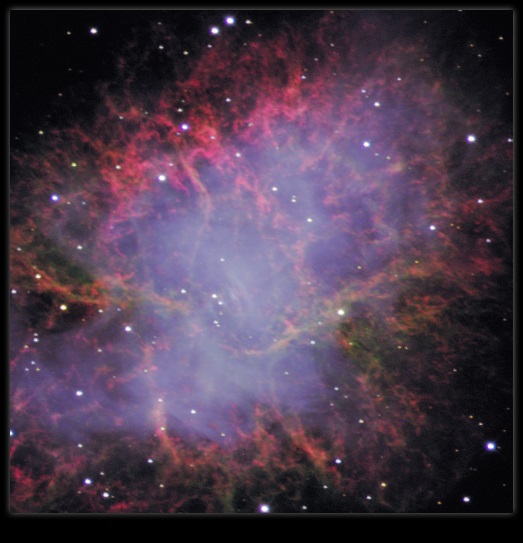
This image was taken by a group of local astronomy enthusiasts from the Salt Lake Astronomical Society (SLAS) on the night of Friday, January 15th. It was captured using the 2-meter Faulkes North telescope on Haleakala in Hawaii.
The image nicely illustrates the intricate structure of this remnant of a huge supernova that was recorded by Chinese and Arab astronomers in 1054 CE. The nebula has a spinning neutron star at its core that has been dubbed the "Crab Pulsar". This neutron star has a spin rate of roughly 30.2 revolutions per second, and it is extremely energetic: giving off radiation at wavelengths from gamma rays to radio waves. The pulsar has been creating shock waves that can be seen near the center of this image as concentric arcs. These shockwaves have been captured in many images and their speed has been computed at an astounding 24,000 km per second, or nearly 8 percent of the speed of light. The diffuse blue light, called synchrotron radiation, is emitted from curving electrons traveling at up to 1/2 the speed of light.
This image was possible due to the hard work of many individuals, who handled all the arrangements, including Rodger Fry and Bob Moore, among many others. A special "Thank You" goes out to J.D. Armstrong, who made this entire project possible.
For a larger version, go to:
http://71.18.228.62/gpage8.html
Cheers,
Tyler
This image was taken by a group of local astronomy enthusiasts from the Salt Lake Astronomical Society (SLAS) on the night of Friday, January 15th. It was captured using the 2-meter Faulkes North telescope on Haleakala in Hawaii.
The image nicely illustrates the intricate structure of this remnant of a huge supernova that was recorded by Chinese and Arab astronomers in 1054 CE. The nebula has a spinning neutron star at its core that has been dubbed the "Crab Pulsar". This neutron star has a spin rate of roughly 30.2 revolutions per second, and it is extremely energetic: giving off radiation at wavelengths from gamma rays to radio waves. The pulsar has been creating shock waves that can be seen near the center of this image as concentric arcs. These shockwaves have been captured in many images and their speed has been computed at an astounding 24,000 km per second, or nearly 8 percent of the speed of light. The diffuse blue light, called synchrotron radiation, is emitted from curving electrons traveling at up to 1/2 the speed of light.
This image was possible due to the hard work of many individuals, who handled all the arrangements, including Rodger Fry and Bob Moore, among many others. A special "Thank You" goes out to J.D. Armstrong, who made this entire project possible.
For a larger version, go to:
http://71.18.228.62/gpage8.html
Cheers,
Tyler
Attached Image:
"The expression of the beautiful is in direct ratio to the power of perception acquired by the artist." (Gustave Courbet)


