Image of the day

Captured by
Michael Scherman

M17 Swan-Omega Celestron C6 Hyperstar2

My Account

New to Astromart?

Register an account...

Need Help?

ST2000xm vs. ST10xme

Started by Joe Bruessow, 12/19/2008 10:45AM
Posted 12/19/2008 10:45AM Opening Post
I am pondering the move to a more sensitive camera... I own an ST2000xm and really enjoy it... but I always look around wondering what else might be out there to "improve" the acquisition of pretty pics of the universe.

So, for those of you who have owned an ST10xme... I know the sensitivity is awesome, but how bad are those blooms to work with? Are they easily taken out with software... or do you lose a lot of options in trying to avoid blooms that can "ruin" an image. What is the typical work flow for imaging (especially brighter targets)?

I think the narrowband sensitivity would be nice.... and I am sure that those faint galaxies would be easier to capture details in... but are the blooms on brighter targets worth the hassle?

Opinions/ experiences please...

Posted 12/19/2008 03:27PM #1
Hi Joe,
You'll love the QE of the ST10. It's a noticeable difference.
Don't worry about the blooms, they're easy to take care of.
You didn't say what processing software you use, so I can't give a specific answer. CCDStack has an excellent bloom removal option or lots of people take a set of non-blooming short exosures and layer them in using PhotoShop or something similar. There are other techniques, too.
The ST10 matches up well with a long focal length 'scope. You usually don't have that many blooms to deal with.

dan
Posted 12/19/2008 04:11PM #2
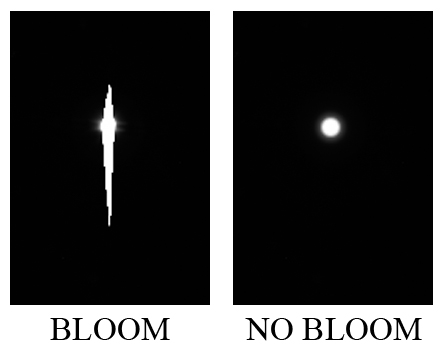
The 2 images are not from an ST10 but from a QSI but blooms are blooms in MaxIm it only takes 4 clicks of the mouse and their gone

Good luck with the new camera
Bob

Attached Image:

RUSTY845's attachment for post 126908

R.A.C. Advisory Committee
NEAIC Co-Chairman
NEAF Advisory Committee

http://www.deer-pond-observatory.com
Warwick, New York
41.15984 -74.2541

[B]Takahashi MT 160

10" F4.5 Newt 8O
R200SS grin
Some kind of 127mm APO

Orion Atlas EQ-G
Losmandy G11 with Gemini
iOptron Mimi Tower
iOptrom Cube Pro

Meade DSI PRO II 8O
SBIG ST-10ME
Image Source 21AU04.AS

Posted 12/20/2008 03:27AM #3
I have the ST10xe (non-m version, and was told by SBIG within the last month that the difference in QE wasn't as big as you might think). I need the non-anti-bloom feature to get quantitative numbers, but also like the fact that I can do "color by calculation" (which often gives results that might be different than your typical auto color balance). In practice, I usually do some test exposures using the focus tool to calculate when stars start to saturate, and try to approach, but not exceed that time. (Stars saturate before they bloom.) And as Robert indicated, blooms aren't that big a deal.

Charlie


Fort Lewis Observatory: (37.238, -108.052) ~2360m (7744 ft.) elevation.
Darkness - typically 6.5+
Scope - Meade 16" LX200; f6.3 focal reducer
Focus - JMI Smart focus
Camera - SBIG ST-10XE; (~.5"/pixel)
Guiding - AO-8 and/or Meade 5"/DSI/PHD
http://www.fortlewis.edu/observatory
Posted 12/20/2008 04:02PM #4
Hi Joe,

I have owned both cameras and made the same upgrade you are considering. I was pretty happy with the ST-2000 but wanted the added sensitivity of the ST-10,the difference in my opinion is well worth the investment.

The blooming took me some time to get used to dealing with,software makes it easy to remove but sometimes may leave some artifacts,at least on my images. You can also take shorter exposures that are not bloomed to add in to the stack to take care of severe blooms.
The only difference in processing would be the bloom removal,I do mine right after calibration.

It's probably not the best choice if you are looking to shoot bright star clusters and such but if you want to go after galaxies and nebula it is great,especially good for Ha!

I really can't think of much of a reason not to recommend it over the ST-2000.

Jason
Posted 12/20/2008 07:34PM #5
Joe,

My situation was similar to yours. I have had my ST-2000XM for about five years now and it has been a mostly frustrating experience. As much as I like the antiblooming option, it has low sensitivity (especially in the red) and high noise (bias frames are over 1000 ADU).

The only reason I never managed to get satisfactory images of galaxies was the low QE and where my 10- and 15-minute histograms were quite poor.

Approximately six weeks ago my ST-10XME arrived and it was love at first sight. The camera really sucks in those photons; the bias frames are around 100 ADU and the darks are very clean with very low ADU counts; the TC-237 chip as opposed to the TC-211 I have on my ST-2000XM is a godsend; and the cooling is excellent (I am getting around 45 degrees below ambient).

The only problem is the blooming spikes. In studying some of my results, I notice that blooming begins around 52,000 ADU or thereabouts. There are a number of tools available for their removal including Ron Wodaski's BloomRemover, Maxim/DL and CCDStack. The blooms can be removed quite effectively but under special situations: if you have an open field (ex. open cluster), it is rather trivial to remove the spikes (occasionally you will also remove a smaller and dimmer star in the immediate vicinity and/or one covered by a blooming spike). With galaxies, it depends how close the bloom is to the core and any spiral arms. With nebulae, it can be a problem since it will easily leave artefacts.

I use a string in front of my dewshield for the generation of spikes and this is a further complication when it comes to removing blooms using software.

If you have a friend or a member in a local club who has an ST-10XME, ask him if you can borrow the camera for an evening and take some test exposures of an open cluster, a globular cluster, a galaxy and a nebula so that you can see for yourself.

Generally I study the histogram to determine what exposures to use. However, with the ST-10XME, my first glimpse is the field of view and the brightest stars. Anything at mag 6 and over is okay with five minute exposures. Things get ugly when there is a really bright star in the field of view (ex. mag 3-4) and which leads me to the next step (isolated or with other stars in the immediate vicinity).

In general, the ST-10XME is an awesome camera .... if it wasn't for those blooms, it would have been a dream camera.

Anthony.