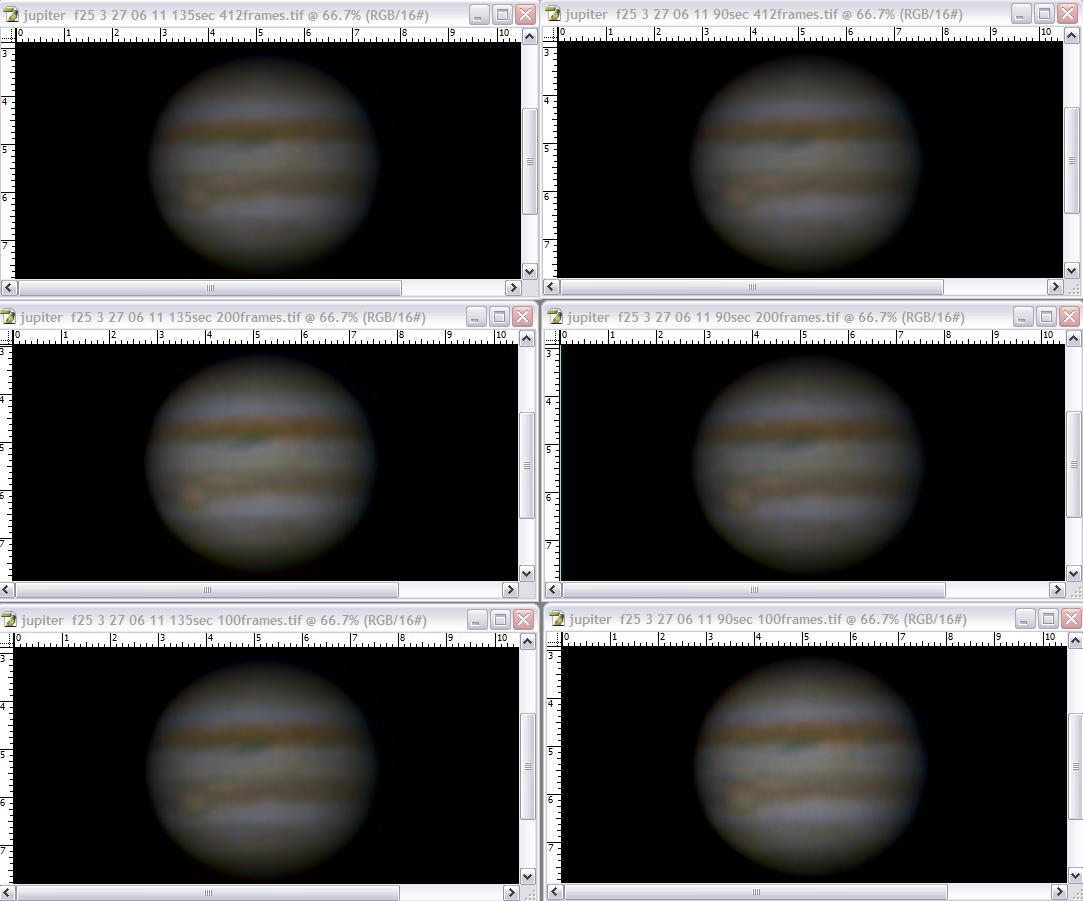

After the passing of the high clouds I started "imaging" Jupiter after 1AM, knowing the transit was 2:30AM. Even with my best collimation, I could not focus my webcam on the low hanging planet, not matter what I tried. Finally, by 2AM the detail was starting to improve and Jupiter was finally out of the trees. By 2:15AM I was surprised to see the Great Red Spot appear! With such a small window of time, I decided against trying the no raw mode. The "best" seeing which was really considered "average" peaked 15min before/after the transit time. By 3AM, the image of Jupiter was already too unstable.
This shot was taken right at the transit with normal Toucam factory settings, C11 w/2.5x powermate, Toucam Pro with IR blocking, 135sec, 5fps, 1/25sec, 50% Br, 0% Gam, 100% Sat, 10% Gain, Auto off, best 200 frames stacked with Registax. This shot is my first capture of the Great Red Spot. I would like to try the no raw mode next time, but am afraid to waste my 30min of "reasonable" Jupiter seeing in case it does not work again. At this point, we can only wait for 1 chance at perfect seeing between now and the opposition in April. Good luck getting at least one 5/5er!
Regards,
Steve
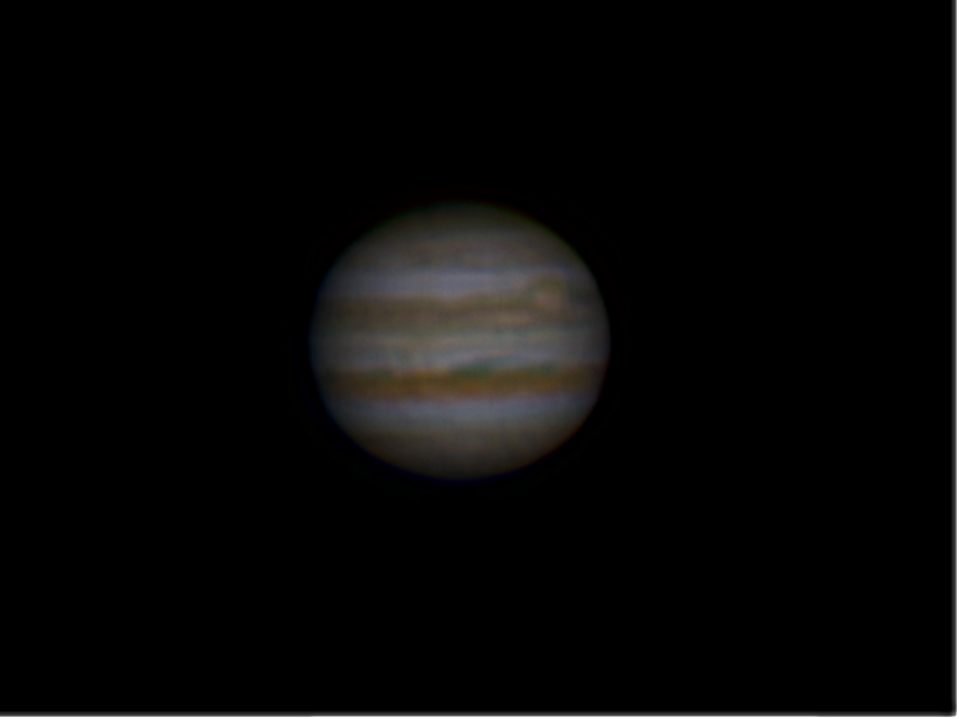
This shot was taken right at the transit with normal Toucam factory settings, C11 w/2.5x powermate, Toucam Pro with IR blocking, 135sec, 5fps, 1/25sec, 50% Br, 0% Gam, 100% Sat, 10% Gain, Auto off, best 200 frames stacked with Registax. This shot is my first capture of the Great Red Spot. I would like to try the no raw mode next time, but am afraid to waste my 30min of "reasonable" Jupiter seeing in case it does not work again. At this point, we can only wait for 1 chance at perfect seeing between now and the opposition in April. Good luck getting at least one 5/5er!
Regards,
Steve
Attached Image: