Hi all,
Boy! What a busy week. Between trying to buy a house, three family members in the hospital, and remodeling my Mother-in-laws bathroom, I have barely had time to breathe, let alone sleep. To top it all off, I caught a cold!
But Saturday night/Sunday morning around midnight I gave up on sleeping due to my hacking cough. I decided to let my wife get some sleep and went upstairs to the living room. Low and behold, the clouds had moved out and the stars were back! If you can't sleep anyway, you may as well go take a look, right?
So I threw my scope on the pier and started out with the Moon. It has been a long time since I had shot the Moon and it looked so good I decided to go get my camera and snap a couple shots. By the time I got back it was going down behind the mountains. So I decided to test all my focal reducer combinations out on Orion. But after I finished I realized that a fence post was blocking most of my light. I was impressed however with my f/2.7 combination of reducers. I had my f/6.3 on the back of the SCT, followed by the T-adapter, my f/5 t-threaded reducer and then the T-ring and my camera. My best measurement guess is f/2.7 using a comparative measurement of the separation of two stars versus an F/10 shot of the same area. Someday, I will drag out the Covington book and do the math correctly, but I think f/2.7 is pretty close.
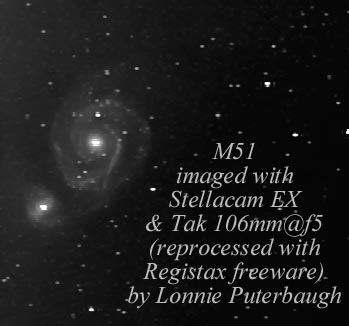
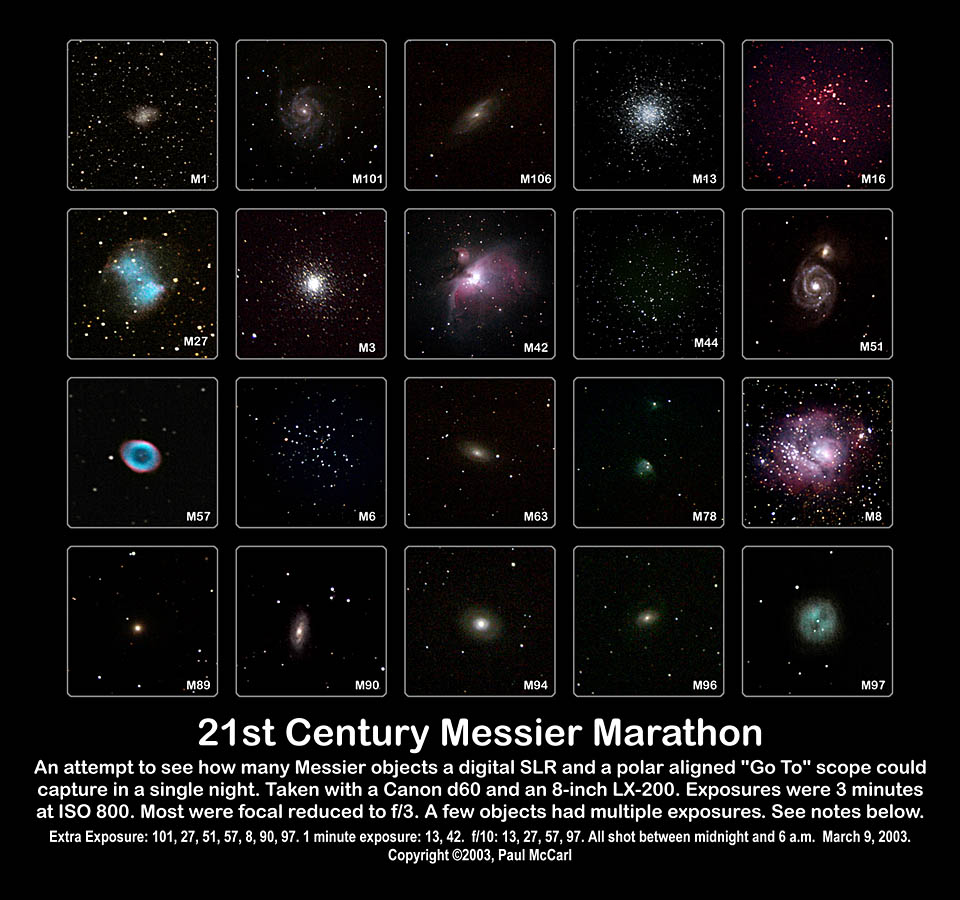
Anyway, I got a crazy thought wondering how many messier objects I could shot in an hour. I was polar aligned, but I hadn't refined it like I should and I was only screwing around, so I set the camera to ISO 800 and my timer remote to three minutes and started with M42. Now my hour gave way to closer to six hours, and I even switched back to f/10 for some planetary nebulas in the middle. I also have to admit that I couldn't help myself. Some of the objects like M51 and M101 were so cool that I had to take some extra frames to make the image better. So twenty objects in six hours is probably not a record, but it does show what a digital SLR and the Go To function of a Meade LX-200 are capable of.
Most of these shots are single exposures of 180 seconds at ISO 800 processed in Photoshop 4.0. I didn't autoguide these and in fact, I just focused on a bright star and let the scope center the object for me. Most weren't dead center, but they were all well within the field of view. The sky was already getting blue as I tried to shoot stuff in the Sagittarius region, M8 turned out OK. I can't wait for summer.
Thanks!
Paul McCarl
P.S. it was good for my soul but bad for my cold.
Boy! What a busy week. Between trying to buy a house, three family members in the hospital, and remodeling my Mother-in-laws bathroom, I have barely had time to breathe, let alone sleep. To top it all off, I caught a cold!
But Saturday night/Sunday morning around midnight I gave up on sleeping due to my hacking cough. I decided to let my wife get some sleep and went upstairs to the living room. Low and behold, the clouds had moved out and the stars were back! If you can't sleep anyway, you may as well go take a look, right?
So I threw my scope on the pier and started out with the Moon. It has been a long time since I had shot the Moon and it looked so good I decided to go get my camera and snap a couple shots. By the time I got back it was going down behind the mountains. So I decided to test all my focal reducer combinations out on Orion. But after I finished I realized that a fence post was blocking most of my light. I was impressed however with my f/2.7 combination of reducers. I had my f/6.3 on the back of the SCT, followed by the T-adapter, my f/5 t-threaded reducer and then the T-ring and my camera. My best measurement guess is f/2.7 using a comparative measurement of the separation of two stars versus an F/10 shot of the same area. Someday, I will drag out the Covington book and do the math correctly, but I think f/2.7 is pretty close.
Anyway, I got a crazy thought wondering how many messier objects I could shot in an hour. I was polar aligned, but I hadn't refined it like I should and I was only screwing around, so I set the camera to ISO 800 and my timer remote to three minutes and started with M42. Now my hour gave way to closer to six hours, and I even switched back to f/10 for some planetary nebulas in the middle. I also have to admit that I couldn't help myself. Some of the objects like M51 and M101 were so cool that I had to take some extra frames to make the image better. So twenty objects in six hours is probably not a record, but it does show what a digital SLR and the Go To function of a Meade LX-200 are capable of.
Most of these shots are single exposures of 180 seconds at ISO 800 processed in Photoshop 4.0. I didn't autoguide these and in fact, I just focused on a bright star and let the scope center the object for me. Most weren't dead center, but they were all well within the field of view. The sky was already getting blue as I tried to shoot stuff in the Sagittarius region, M8 turned out OK. I can't wait for summer.
Thanks!
Paul McCarl
P.S. it was good for my soul but bad for my cold.
Attached Image: